
“Delayed 48 Days”! U.S. September Nonfarm Payrolls Coming Tonight

After a 48-day delay, the U.S. Bureau of Labor Statistics will finally release September nonfarm payrolls data on Thursday, partially filling the official employment data gap caused by the U.S. government shutdown—though clearly this report can only offer a rather outdated “rear-view mirror” perspective.
The consensus forecast is for 54,000 new nonfarm jobs in September—higher than the previous 22,000—but still signaling a weak U.S. labor market.
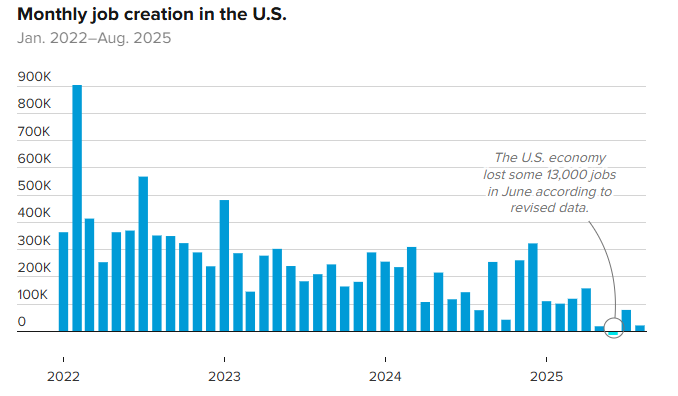
Despite its lag, the report will at least provide some material for investors, economists, and Fed officials who, during Washington’s record-long government shutdown, had to rely heavily on private-sector alternative data to gauge the U.S. economy. This will also be the first monthly employment report from the BLS since the August nonfarm data released on September 5.
RSM chief economist Joseph Brusuelas said: “My sense is that the September report, along with revisions to July and August, will show a slightly better picture than widely expected—but nothing to write home about.”
On specific sub-metrics, the current media consensus predicts the report—released one week after the government deadlock ended—will show the September unemployment rate holding at 4.3%, average hourly earnings up 0.3% month-on-month and 3.7% year-on-year—all unchanged from August.
“I don’t expect the (September nonfarm) report to look very different from recent reports,” said Indeed Hiring Lab economist Allison Shrivastava. “I really expect this soft labor market to persist.”
Goldman Sachs forecasts September nonfarm additions could reach 80,000—above the current consensus—but expects October nonfarm to fall by 50,000, mainly due to the expiration of delayed separations under the Department of Government Efficiency’s workforce reduction plan.
In addition to September data, tonight’s report will include revisions to July and August nonfarm numbers. Both Brusuelas and Goldman economists expect the revised figures to be higher than previously reported.
Unlikely to Shift Expectations for a December Pause
Industry insiders generally say that since the data reflects conditions in September, the report offers limited help to policymakers grappling with today’s complex situation and may not get much market attention—especially as the U.S. economy changes rapidly and many Americans and businesses feel life is getting harder.
At last month’s post-meeting press conference, Fed Chair Jerome Powell likened the current environment to “driving in thick fog” and warned investors not to treat further rate cuts as a foregone conclusion.
Meanwhile, the BLS on Wednesday updated release dates for several October and November data points.
The BLS announced that due to insufficient data collection during the shutdown, it will not release the October monthly employment situation report (i.e., the nonfarm payrolls report), as the Current Population Survey was unable to collect household survey data for the October 2025 reference period.
The BLS also said the November employment report, originally scheduled for December 5, will be postponed to December 16 and will include whatever October establishment survey data the agency was able to collect. This means the U.S. October unemployment rate will, unprecedentedly, remain blank forever…
After the BLS said it would not release October nonfarm data and pushed the November report to December 16 (after the Fed’s December meeting), rate traders on Wednesday almost completely abandoned bets on a December cut.
Data shows swaps tied to the Fed policy rate now price in only 6 bps of easing at the December meeting—equivalent to roughly a 24% chance of a 25 bps cut—with cumulative easing priced in through January at just 19 bps. Before Wednesday, swaps had priced in 11 bps for December, implying roughly 50-50 odds of a cut in three weeks.
Brusuelas said: “The economy is trudging through a period of pervasive uncertainty right now. Given how long the shutdown lasted, I think it won’t be until early February next year that we get a clear read on the U.S. labor market.”
Goldman economists Ronnie Walker and Jessica Rindels wrote: “Although we expect the BLS will not publish an October unemployment rate, we estimate it likely rose, reflecting upward pressure from furloughs during the shutdown and broader labor market slack indicators.”
From a market-news perspective, given Nvidia’s “explosive” post-market earnings report Wednesday night that sent the AI leader soaring after hours, tonight’s U.S. open is more likely to follow tech momentum than this somewhat dated employment data—unless the numbers deviate wildly from expectations.
Still, Fort Washington Investment Advisors portfolio manager Dan Carter expects: “If nonfarm comes in weak, the market reaction could be larger than if it meets or slightly beats expectations, because pause pricing for December is already very high. The Fed has few tier-1 data points left before the meeting.”