
Nvidia’s Halo Vanishes! U.S. Stocks Suffer Brutal High-Level Plunge – All of Wall Street Is Asking: Why?

U.S. stocks staged the most violent intraday reversal since April on Thursday. Despite opening sharply higher on Nvidia’s explosive earnings, the benchmark S&P 500 tumbled to its lowest level in over two months. Meanwhile, bewildered Wall Street traders are scratching their heads trying to figure out what triggered this massive shakeout.
According to FactSet, the Nasdaq Composite recorded its widest intraday trading range since April, when Trump’s “Liberation Day” tariff announcement rocked markets. The S&P 500 surged as much as 1.9% in the first hour but erased all gains and closed down 1.6% — marking its biggest reversal since the April turmoil and wiping out more than $2 trillion in market value.
The VIX “fear gauge” closed above 26, its highest level since April.
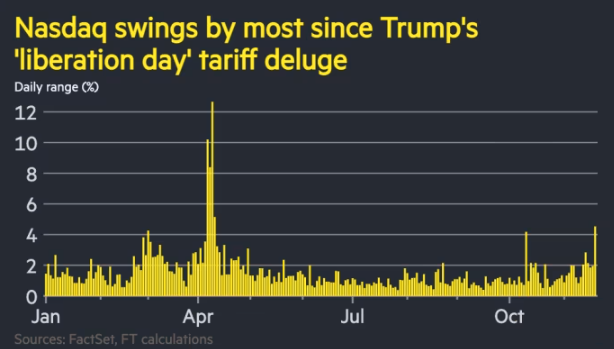
The S&P 500 is now down more than 5% from its October all-time high and, for the first time since February, has broken below its 100-day moving average. Thursday’s close was the lowest since September 11.
The sell-off was especially brutal in the riskiest corners of the market: the most-shorted stocks index fell 3.5%, Goldman Sachs’ basket of unprofitable tech companies dropped 3.7%, and the Russell Microcap Index declined 1.9% — pushing its drawdown from peak to 10%.
Among megacap tech, the “Magnificent” names led the Nasdaq 100 down 2.4% on the day, widening its decline from the October 29 record high to 7.9%. Tesla, Alphabet, Apple, Microsoft, Broadcom, and Amazon each saw single-day market-cap swings exceeding $100 billion. The VXN climbed above 32 for the first time since April.
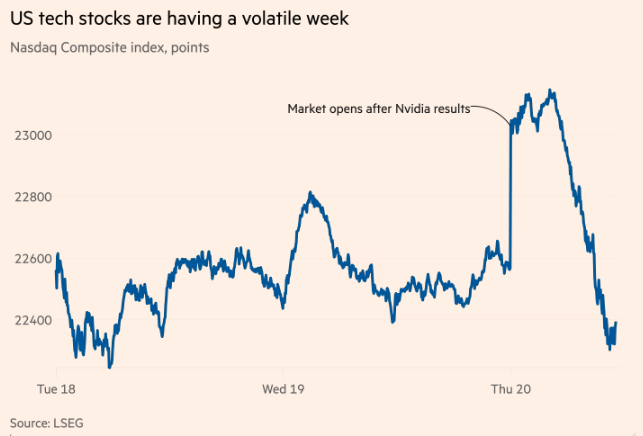
Nvidia was the biggest drag on the Nasdaq 100. After being up 2.4% early, it erased all gains and closed down 3.2%, evaporating nearly $400 billion from its intraday peak. Despite beating revenue forecasts, investors appear increasingly worried about the sustainability of AI chip spending, triggering a broad sell-off in AI-related names.
“Today was absolute madness,” said Lou Brien, trader at quantitative giant DRW, adding that the Nasdaq Composite’s move on Thursday was “extraordinary.”
After the close, Wall Street remained divided on the exact cause of the day’s chaos.
Some traders pointed to renewed fears that AI projects may not generate enough revenue or profit to justify the massive tech spending. Others cited the delayed release of strong September jobs data as the latest signal that the Fed is done cutting rates this year. Still others blamed risk-off signals from Bitcoin’s drop to six-month lows, combined with general overvaluation concerns and rising volatility ahead of Friday’s options expiration.
Whatever the reason, the midday plunge crushed early-session optimism that the recent rebound would continue. After hitting record highs in late October, U.S. stocks have been under pressure for two straight weeks. Nvidia — the poster child of the AI boom — initially looked set to rescue the market with stellar results, and solid consumer spending updates from retailers like Walmart also briefly fueled hope. All of that was swiftly overwhelmed by a sudden and ferocious wave of selling.
Here’s what a number of Wall Street analysts, strategists, and traders had to say about Thursday’s wild swings:
Nvidia fails to dispel AI bubble fears
Nvidia’s blockbuster results late Wednesday initially appeared to ease some AI-bubble concerns, but Thursday’s price action proved it was only temporary relief.
Arun Sai, multi-asset strategist at Pictet Asset Management, said markets remain worried about overvaluation among chipmakers’ competitors and when big tech’s enormous AI infrastructure spending will finally deliver meaningful returns.
Kristina Hooper, chief global market strategist at Man Group, added that unease has actually been building for weeks. Even Nvidia’s blowout numbers could only calm nerves for a few hours.
Matt Maley, chief market strategist at Miller Tabak + Co. LLC: “Is AI profitability really at the level the market has priced in? That’s the key question. Traders are worried whether today’s AI investment will still pay off in five years. A lot of people are saying, ‘I need to take some profits first.’”
Brent Schutte, chief investment officer at Northwestern Mutual Wealth Management: “Nvidia has to be viewed in the context of all the unresolved issues lately — strong labor market, tariffs, inflation pressure, Fed path, AI sustainability, stock valuations, private credit risks, unprofitable tech, crypto pullback… In short, there are a lot of unanswered economic and market questions sparking intense debate.”
Greg Taylor, CIO at PenderFund, on the initial gap-up: “I think the early optimism was essentially short covering. Now the market is having a sober second thought.”
Fed year-end rate-cut hopes remain slim
Investors were also closely watching the mixed signals from Thursday morning’s U.S. jobs data.
While September nonfarm payrolls added 119,000 jobs — far above expectations — the unemployment rate ticked up from 4.3% to 4.4%, further muddying the outlook for a December cut.
This week’s Fed minutes revealed deep internal divisions on whether further easing is needed this year, and Chair Powell has already warned that a December move is not a done deal.
Over the past week, as several Fed officials voiced caution about easing while inflation remains elevated, traders have increasingly bet the Fed will stay on hold in December. CME FedWatch currently shows only a 40% probability of a December cut.
Morgan Stanley economists said Thursday’s data suggests summer job weakness was overstated and that the bank no longer expects a December cut.
Cleveland Fed President Hammack reiterated her opposition to further cuts, citing inflation above target and already-loose financial conditions, warning that easing could be seen as “insurance” for the labor market but risks financial stability.
Other market concerns
From a technical standpoint, the S&P 500’s break earlier this week below the key 6,725 level and its 50-day moving average had already signaled growing danger. On Thursday, it fell through the 100-day moving average for the first time since February.
Goldman Sachs derivatives strategist Brian Garrett noted last weekend that 6,725 was critical and a break could flip trend-following CTAs from buyers to sellers.

Chris Murphy, co-head of derivatives strategy at Susquehanna International Group: “With Nvidia out of the way and December cut odds fading, investors are questioning what drives the year-end rally. CTAs reportedly remain vulnerable; net long exposure in systematic strategies is limited, and a deeper pullback could trigger more selling.”
Scott Rubner, stock & derivatives strategist at Citadel Securities: “These mechanical outflows could stay strong for a few more days and then vanish completely.”
Frank Monkam, cross-asset macro strategist at Buffalo Bayou Commodities: “As crypto enters a bear market, the cross-asset deleveraging chain reaction isn’t over yet. Crypto is retail-driven, and retail has been the main driver since spring — their fragility is obvious.”
Steve Sosnick: “One of my big focus points right now is Bitcoin, because whether you like it or not, it has become a real barometer of overall investor risk appetite.”