
Crypto Crash Dragging Stocks Down? When Bitcoin Becomes the Fulcrum – It Really Can Tip the U.S. Market


Lately, the simultaneous turmoil in global crypto markets and U.S. stocks has led more and more market participants to focus on the growing linkage between the two.
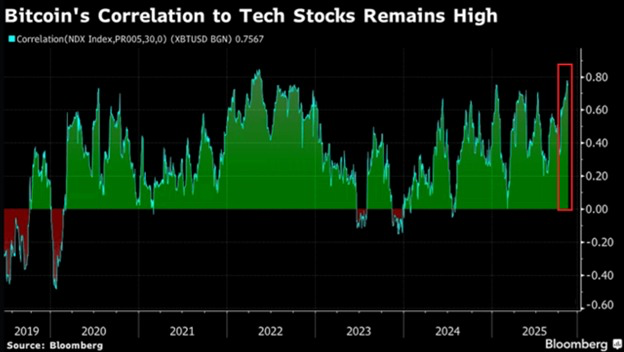
The correlation between Bitcoin and U.S. tech stocks has reached levels unseen in years – the 30-day correlation coefficient between Bitcoin and the Nasdaq 100 hit around 0.80 in mid-November (where 1 is perfect correlation), the highest since 2022 and the second-highest reading in nearly a decade.
Over the past few weeks, Bitcoin’s relentless plunge has become one of the biggest focal points across global markets. Over the weekend, Bitcoin briefly dipped toward the $80,000 level, now down roughly 34% from its all-time high above $120,000 set in October.
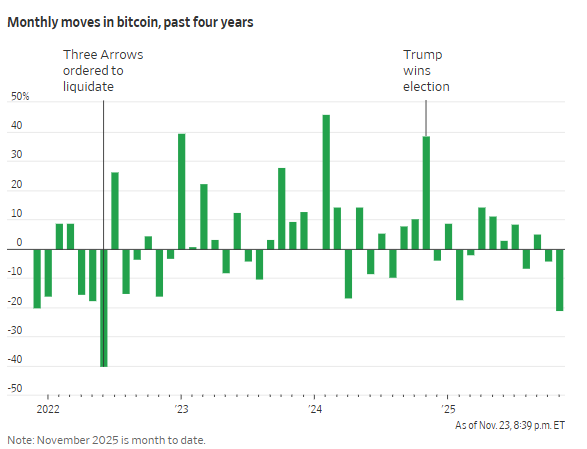
While crypto has always been known for extreme volatility and many Bitcoin believers insist a rebound is still coming, the so-called “crypto treasury companies” that raise cash by selling stock to buy crypto are getting crushed. A strategy that was all the rage earlier this year now looks to be collapsing – take MicroStrategy as an example: its shares are down 37% this month alone.
Some Bitcoin traders have already pointed out that as long as these crypto treasury companies remain in distress, they can’t buy more crypto, depriving the market of a critical source of big-money buying power needed to spark a rebound.
In the past, crypto crashes rarely had much impact on U.S. stocks or the broader economy. When Sam Bankman-Fried’s FTX (then the world’s second-largest crypto platform) imploded, equities barely blinked.
But now, with far more crypto holders and a much larger market, fears are growing that the spillover could be much wider. Plenty of traders say Bitcoin has effectively become a leading indicator for turns in the U.S. stock market.
Last Friday, prominent hedge fund manager Bill Ackman admitted he “underestimated” the linkage between crypto and Fannie Mae and Freddie Mac stocks (down 4.5% and 1.1% that day, respectively), with crypto investors facing margin calls triggering selling of these pink-sheet mortgage giants.
How exactly is Bitcoin flipping the stock market?
Many traders trying to explain the violent swings in both markets have pointed the finger at leverage and year-end profit-taking impulses.
Wall Street and retail investors alike have piled into leverage in recent years to amplify bets. According to FINRA, margin debt in brokerage accounts topped $1.1 trillion at the end of October – a new all-time high. Morningstar data also shows assets in leveraged equity funds surged past $140 billion this fall, the highest level since records began in the 1990s.
Leverage magnifies gains on the way up, but in choppy markets it can quickly spiral out of control, forcing investors to dump holdings to meet margin calls. At the same time, many of the same traders using heavy leverage on risky stocks also try to lever up their bullish Bitcoin bets. When Bitcoin tanks, they can suffer massive losses.
Benn Eifert, managing partner at San Francisco-based QVR Advisors: “There’s a cohort of over-leveraged participants who are long both crypto and bubbly tech stocks. When their crypto positions get liquidated, they sell tech shares to raise cash.”
Frank Monkam, cross-asset macro strategist and trader at Buffalo Bayou Commodities: “As crypto enters a bear market, the cross-asset deleveraging chain reaction is far from over. The crypto market is retail-dominated, and retail has been the main driver of the rally since spring – their fragility is obvious.”
On top of that, simple human “ring-fencing” psychology may be amplifying stock volatility. Investors are still sitting on sizable gains in mainstream U.S. markets this year – the S&P 500 is up 12% YTD, and bonds are having their best year since 2020. Meanwhile, a cratering Bitcoin has already wiped out all of its 2025 gains this month.
Hedge fund traders often get “gun-shy” heading into year-end – terrified that a late reversal could see huge bonuses slip through their fingers. When markets weaken at this time of year, they tend to race to sell stocks, especially now that they’re watching many crypto traders end the year with nothing to show for it – or even blown up.