
A Roundup of “Smart Money” Moves: Which Stocks Are U.S. Hedge Funds Shorting Right Now?

With the U.S. stock market turning turbulent lately, Oracle CDS trading surging, and even AI insiders beginning to admit there’s some froth, exactly how, when, and where hedge funds and other active players are shorting has become a major focus for many investors.
Fortunately, Goldman Sachs’ latest hedge fund positioning report contains a wealth of information worth digging into. The key takeaway from the report: so-called “smart money” is not yet ready to aggressively short the AI giants, but some funds have already started targeting relatively weaker players in the sector…
U.S. Short Interest Near Multi-Year Highs
First, the big picture. Despite strong gains this year, the median short interest as a percentage of market cap across S&P 500 constituents remains astonishingly high. Current short interest stands at 2.4% of total market cap — at the 99th percentile over the past five years and far above the long-term average since 1995.
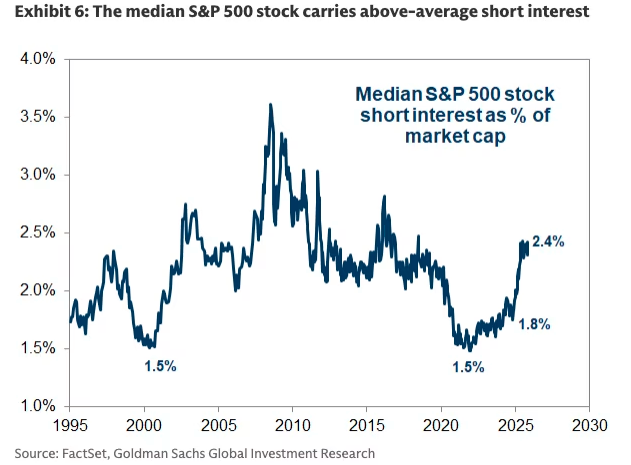
Industry watchers actually spotted the resurgence in short interest as early as May, but interestingly, levels have edged slightly higher since then and stayed elevated — even after two painful (though small) short squeezes in July and mid-October.
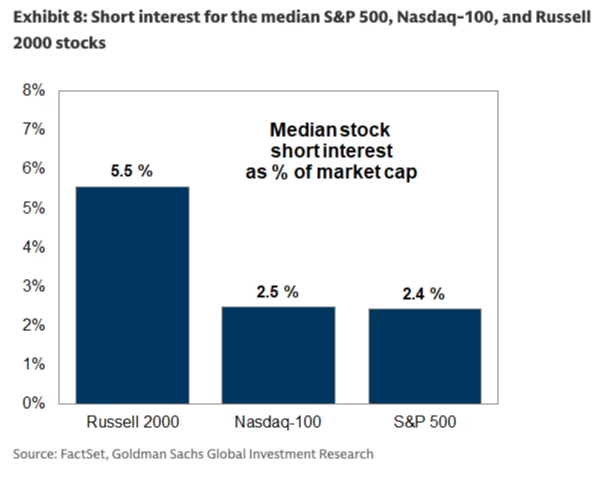
Across indices, the tech-heavy Nasdaq 100 has a slightly higher short ratio than the S&P 500 at 2.5%. Naturally, small-caps remain the most shorted: the median short interest in Russell 2000 names is now a whopping 5.5%.
Utilities Becoming a Microcosm of the AI Bubble?
In terms of specific sectors, perhaps the most striking recent development is the sharp jump in short interest in utilities.
Short interest in the sector rose 0.3 percentage point to 3.2%. That may not sound extreme, but according to Goldman Sachs data, it is one of the highest levels ever recorded for the sector.
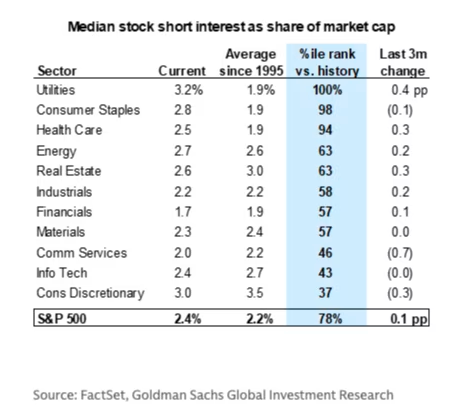
Many see this as an indirect reflection of the AI bubble. After all, the extremely power-hungry data centers required to support AI models have made once-overlooked utility stocks suddenly attractive this year.
Take American Electric Power (AEP) as an example: its shares are up more than 31% YTD with a market cap of $65 billion. Last month it boosted its already massive five-year capex plan from $54 billion to $72 billion, largely to supply power to data centers being built by Alphabet, Amazon, and Meta.
Short interest in the stock has now climbed to 4%, well above the 1-2% range that was normal over the past decade (Koyfin data).
Which Individual Stocks Are Shorts Targeting Most?
So have utilities become the hottest short sector in Goldman’s data? Not quite — overall short interest remains moderate compared with other industries, and utilities still carry a “defensive halo” in many managers’ eyes.
According to the Goldman report, Tesla has once again claimed the top spot as the most-shorted U.S. stock, while a surprising new entrant — JPMorgan Chase — lands in fourth place. Notably, many of the new names in Goldman’s most-heavily-shorted basket can fairly be classified as weaker AI participants or stocks that have exhibited extreme bubble-like behavior.
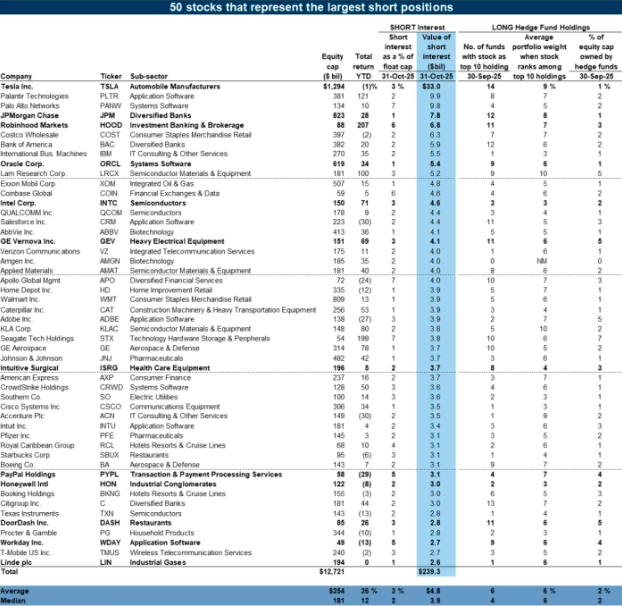
Goldman data shows current short interest of $5.4 billion in Oracle, $4.6 billion in Intel, and $4.1 billion in General Electric (which supplies gas turbines for AI data centers).
Of course, these are mega-cap names, so as a percentage of market cap the shorts remain small — 1% for Oracle, 3% for both Intel and GE.
Which Stocks Are the Most Shorted Relative to Their Market Cap?
Among U.S. stocks with a market cap of at least $25 billion, the title of most-shorted goes to Bloom Energy. The stock peaked earlier this month at $147.86 — nearly 10× its ~$15 level from April — before collapsing below $100 in recent sessions. Some are already calling it a price “people will look back on and laugh.”
The rest of Goldman’s most-shorted list includes Strategy, CoreWeave, Coinbase, Live Nation, Robinhood, and Apollo.
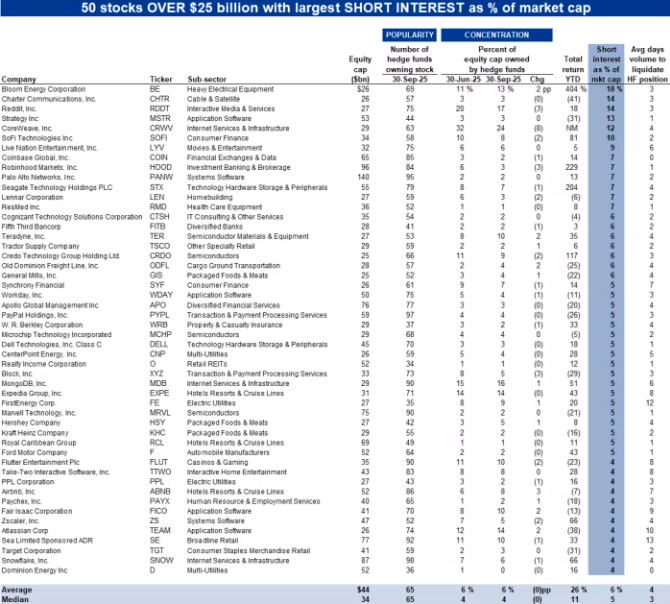
Goldman’s hedge fund positioning report is only a lagged snapshot of the current market. Still, it’s based on the latest 13F filings from 982 hedge funds with $4 trillion in total equity positions, making it highly valuable.
From this week’s price action, U.S. stocks appear to have regained upside momentum after last week’s violent swings. Given that bubbles can last far longer than solvency, most hedge funds remain cautious about outright shorting the hyperscalers. In fact, Amazon, Microsoft, Meta, Nvidia, and Alphabet are currently the five most common long positions among U.S. hedge funds.
Yet the rising short interest in utilities and certain lagging AI names still suggests some investors may be starting to probe for the next big short opportunity in the sector.