
AI Race Shifting to the “Edges” – Massive Opportunities Emerging! Analysts Bullish on These Three Lesser-Known Asian AI Stocks

Recent signs show that as technological change and bubble fears reshape the investment landscape, investors are actively hunting for the next wave of Asian AI winners – while yesterday’s “kings” appear to be losing some luster…
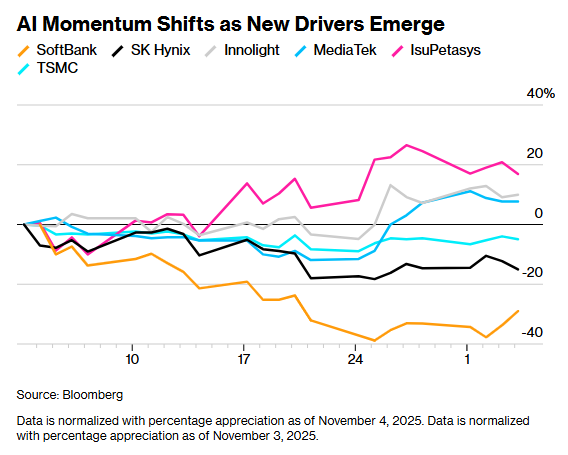
Since last month – as the AI wave sparked by OpenAI’s ChatGPT launch enters its fourth year – regional heavyweights like TSMC and SK Hynix have started showing fatigue. Meanwhile, attention is shifting to smaller, less heralded names such as MediaTek and InnoLight.
Of course, the well-known companies indispensable to AI fundamentals could still rebound after a brief cooling. But as market focus moves from training large language models to everyday applications and cost efficiency, more players are likely to “share the stage.”
A New Pricing Paradigm in the Market
“The market is pricing a new narrative, a new paradigm: what if the companies dominating large language models (LLMs) aren’t just OpenAI? That’s the root of all current market moves,” said Andy Wong, Head of Multi-Asset Investing for Hong Kong at Pictet Asset Management.
Wong noted, “Investors need to digest these changes, recalibrate strategies, and apply new risk premiums.”
Japan’s SoftBank Group – seen as the market’s direct proxy for OpenAI due to its close ties – plunged 38% in November, its worst monthly performance in 25 years. Core Nvidia foundry TSMC and memory supplier SK Hynix both fell 4% last month, with their earlier strong momentum fading.
In fact, over the past few weeks, not only has ChatGPT faced growing competition, but Nvidia’s AI chips are gradually losing their former dominance as integrated training-inference ASICs like Google’s TPUs mature. Investors are now worried about potential negative impacts on product pricing.
Quad Investment Management CIO Han Sangkyoon said if LLMs become commoditized, “the lower-cost provider will be the winner.” He expects the next six months to be a “critical period” for how the bubble created by Nvidia and OpenAI deflates.
“Google Chain” Companies Stealing the Spotlight
Clearly, Asian market investors haven’t abandoned the AI sector entirely – they’re just pivoting to stocks that weren’t previously the hottest names…
Last month, Google parent Alphabet launched an upgraded Gemini model and signed deals with multiple companies to procure its in-house AI chips, quickly triggering a chain reaction across the AI sector. Amazon’s newly launched Trainium 3 chip further fueled the shift in AI stock trading.
Market data shows Taiwan chip designer MediaTek – a Google partner – posted its best weekly performance since 2002 last week. Korean high-layer PCB supplier IsuPetasys, which supplies Alphabet, surged 18% last week to an all-time high.
Meanwhile, despite fierce AI competition between the U.S. and China, supply chains remain tightly interdependent. Take Chinese optical communications component maker InnoLight: 22% of revenue comes from Alphabet, 11% from Amazon. Its shares jumped 11% last week to a record high.
These moves highlight that no matter which brand ultimately dominates or how U.S. giants sit at the top of the supply chain, upstream Asian suppliers will always benefit…
BlackRock’s emerging markets and Asia equity head Egon Vavrek noted, “Roughly 90% of global data center hardware – including servers, test environments, memory cards needed for chip manufacturing, and even cooling systems – is produced in China, South Korea, Japan, and Thailand.”
Yesterday’s “Kings” Won’t Stay Dormant Forever
At the same time, the rise of new Asian AI stars doesn’t mean the former leaders of the AI wave will remain sidelined indefinitely.
TSMC still possesses the world’s most advanced chip manufacturing technology and provides foundry services for all major players – its shares are on track for a third straight yearly gain, having crossed the $1 trillion market cap threshold earlier this year.
Macquarie Group research shows SK Hynix and Samsung Electronics together hold over 90% of the global HBM market – this high-end memory chip has become an indispensable component of the AI wave.
Recent data indicates that despite SK Hynix shares more than tripling this year, short interest has been declining. S&P Global data shows the short position ratio has fallen from over 3% in May to 0.6% of float.
In short, as the AI wave deepens, investors are constantly exploring new directions – driven by following industry trends, caution over high valuations in popular names, and the need to rebalance portfolios. The resulting sector rotation is itself healthy…
JPMorgan Private Bank Hong Kong Asia equity strategist Timothy Fung noted, “Although the AI theme has been running for three years, it remains the core focus for tech investors. Opportunities across the AI supply chain are constantly evolving, but the essence is still closely tied to physical infrastructure.”