
Global Highlights This Week:Nonfarm Payrolls and CPI to Reshape Expectations for Fed's Interest Rate Cuts

As Oracle and Broadcom successively released negative news, concerns about the artificial intelligence (AI) boom have resurfaced, weighing on tech stocks and pulling U.S. stocks back from record highs.
A series of previously delayed employment, inflation and other key economic data will be released collectively this week. These data are expected to provide the market with a long-awaited "panoramic view" of the U.S. economy and help investors better judge the market direction in the year-end period.
After the U.S. federal government shutdown caused a data gap, multiple important economic reports were forced to be delayed. Investors and the Federal Reserve have been assessing the economic situation with "a serious lack of information", making the upcoming data particularly crucial.
According to the schedule, the U.S. November nonfarm payrolls report will be released this Tuesday, while the closely watched Consumer Price Index (CPI), which measures inflation trends, will come out this Thursday.
Jim Baird, chief investment officer of Plante Moran Financial Advisors, said: "Investors have been lacking clear basis for judgment. Strong corporate earnings have indeed supported the market, and expectations of interest rate cuts from the Federal Reserve and the market have also provided some boost. But now it's time to refocus on economic fundamentals and figure out which economic track we are on."
Last week, the Federal Reserve cut the benchmark interest rate by another 25 basis points amid internal divisions. This is the central bank's third consecutive interest rate cut, aiming to support the weakening labor market. However, the Federal Reserve also signaled that the possibility of further interest rate cuts in the short term is slim until more economic data is available.
At present, the biggest concern for investors is: how much and how fast will interest rates be cut from now on. Although the Federal Reserve only expects one more interest rate cut in 2026 in its latest forecast, market expectations are significantly more aggressive.
Economists expect that U.S. nonfarm payrolls will increase by only 35,000 in November, a weak performance. Federal Reserve Chairman Jerome Powell said on Wednesday that although official data since April shows an average monthly increase of about 40,000 jobs, the Federal Reserve believes this figure is overestimated, and the actual situation may be an average monthly decrease of about 20,000.
Marvin Loh, senior global macro strategist at State Street Global Advisors, said that if nonfarm payrolls start to turn negative, discussions about whether the economy is in recession will be inevitable, and expectations of Federal Reserve interest rate cuts will also heat up.
At the same time, the upcoming CPI data has also attracted much attention. Current inflation is still higher than the Federal Reserve's target, which means that if inflation does not cool down significantly, it will restrict further easing in the future. In this interest rate cut decision, three Federal Reserve officials voted against it, two of whom believed that interest rates should remain unchanged.
Economists at Morgan Stanley said in a research report: "We still expect further interest rate cuts in January and April, but if the labor market stabilizes, subsequent interest rate cuts may have to wait until there is a more clear decline in inflation."
James Knightley, economist at ING, claimed: "The U.S. economy is likely to have already started to lose jobs, which highlights the fact that policy risks are clearly tilted towards the Federal Reserve providing more support next year."
Derek Halpenny, analyst at MUFG Bank, said that given that Federal Reserve Chairman Jerome Powell previously cited the weakening labor market as the main reason for interest rate cuts, if the employment data to be released this week is weak, the U.S. dollar may face further selling pressure before the end of the year.
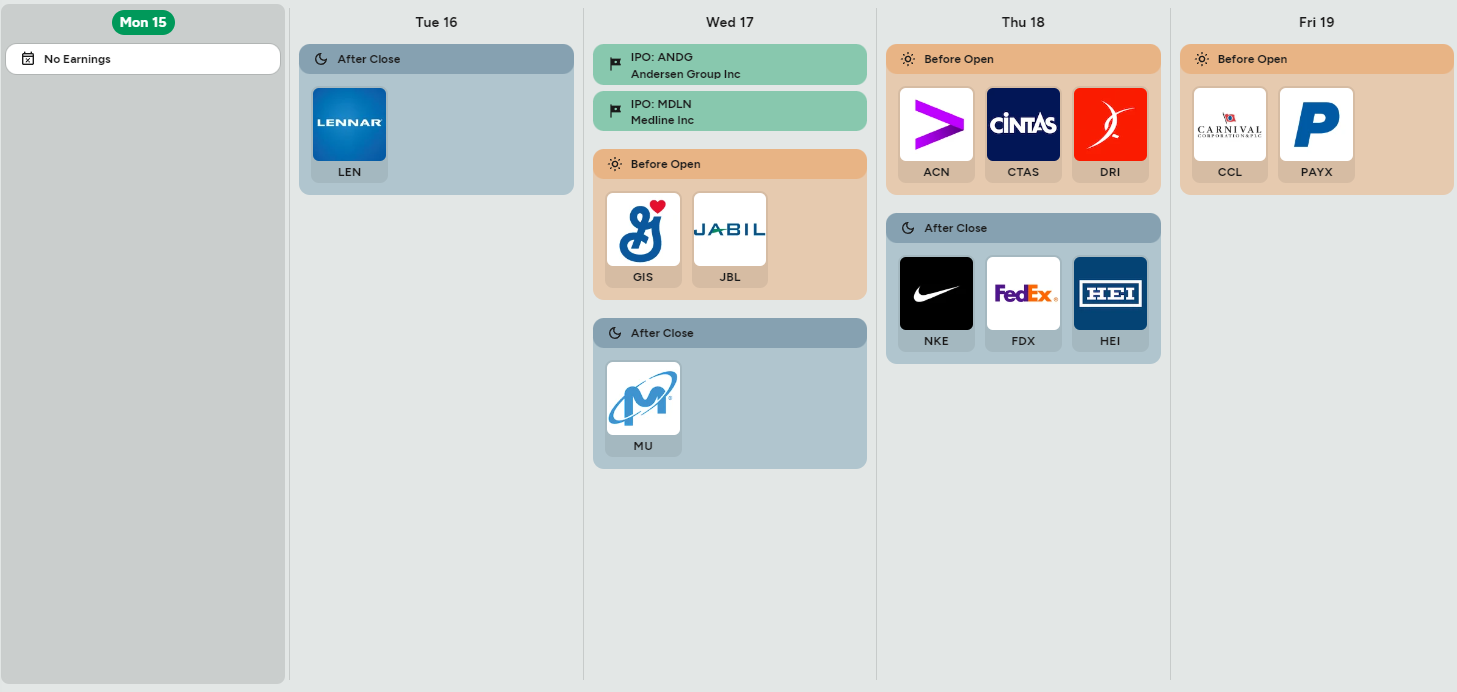
In terms of earnings reports, companies such as Micron Technology, Nike, Accenture and FedEx will release their results this week. After obvious fluctuations in AI-related stocks, Micron Technology's performance has attracted extra attention from the market.
In addition to the U.S., the interest rate decisions of the Bank of Japan, the European Central Bank and the Bank of England will also be the focus of the market. The market generally expects: the Bank of Japan may raise interest rates; the Bank of England will cut interest rates by 25 basis points; the European Central Bank may release a signal indicating that there is limited room for further interest rate cuts.
Against the background of persistent inflationary pressures and increasing confidence among policymakers in wage trends, the Bank of Japan is generally expected to raise its policy interest rate this Friday.
Bank of Japan Governor Kazuo Ueda previously said that the central bank will assess the pros and cons of raising interest rates at this meeting, a statement that further fueled market expectations of an interest rate hike.
Ayako Fujita, Japan economist at JPMorgan Chase, believes that from an economic fundamental perspective, the Bank of Japan has almost no reason to continue to maintain the current interest rates. She added that the yen has been continuously weakening since the Bank of Japan's October meeting, and this trend may also prompt the Kishida Cabinet to accept the interest rate hike decision.
After the much-watched November fiscal budget was finalized, the UK's policy focus has shifted back to boosting the persistently weak economy. If this interest rate cut is implemented, it will be the Bank of England's fourth interest rate cut in 2025.
However, current UK inflation is still high. The inflation rate rose to 3.6% year-on-year in October, significantly higher than the central bank's 2.0% policy target. Therefore, analysts expect that there will still be a highly divided vote in this interest rate decision, which may be passed by a narrow margin of 5 votes in favor and 4 against, with Bank of England Governor Andrew Bailey casting the deciding vote.
Overview of important events this week:
Monday (December 15): China's November total retail sales of consumer goods year-on-year, China's November industrial value-added of enterprises above designated size year-on-year, Eurozone's October industrial output month-on-month, Canada's November CPI month-on-month, U.S. December New York Fed Manufacturing Index, State Council Information Office holds a press conference on the operation of the national economy, Federal Reserve Governor Milan delivers a speech, New York Fed President Williams delivers a speech on the economic outlook
Tuesday (December 16): UK's November unemployment rate, Germany's December ZEW Economic Sentiment Index, Eurozone's December ZEW Economic Sentiment Index, Eurozone's October seasonally adjusted trade balance, U.S. November unemployment rate, U.S. November seasonally adjusted nonfarm payrolls, U.S. October retail sales month-on-month, U.S. November average hourly earnings month-on-month, U.S. December S&P Global Manufacturing PMI flash reading, U.S. September business inventories month-on-month
Wednesday (December 17): U.S. API crude oil inventories for the week ending December 12, UK's November CPI month-on-month, UK's November retail price index month-on-month, Germany's December IFO Business Climate Index, Eurozone's November CPI year-on-year final value, U.S. EIA crude oil inventories for the week ending December 12, U.S. EIA Cushing, Oklahoma crude oil inventories for the week ending December 12, New York Fed President Williams delivers the opening speech at the 2025 Foreign Exchange Market Structure Conference hosted by the New York Fed
Thursday (December 18): RMB's share in global payments via Swift in November (China), Switzerland's November trade balance, Bank of England's interest rate decision until December 18, European Central Bank announces interest rate decision, European Central Bank President Lagarde holds a monetary policy press conference, U.S. November unadjusted CPI year-on-year, U.S. November seasonally adjusted CPI month-on-month, U.S. initial jobless claims for the week ending December 13, U.S. December Philadelphia Fed Manufacturing Index, U.S. EIA natural gas inventories for the week ending December 12
Friday (December 19): Japan's November core CPI year-on-year, UK's December Gfk Consumer Confidence Index, Germany's November PPI month-on-month, UK's November seasonally adjusted retail sales month-on-month, Canada's October retail sales month-on-month, Eurozone's December Consumer Confidence Index flash reading, U.S. December University of Michigan Consumer Confidence Index final value, U.S. December one-year inflation expectation final value, Bank of Japan's target interest rate until December 19, Bank of Japan Governor Kazuo Ueda holds a monetary policy press conference, Central Bank of the Russian Federation announces interest rate decision