
US Stocks Extend Gains for Two Days: Wall Street’s Back in Swagger—Will This Year’s Santa Claus Rally Deliver?

After speculating all December whether the year-end Santa Claus Rally would materialize, U.S. stock traders may finally be seeing the long-awaited turnaround they’ve been hoping for.
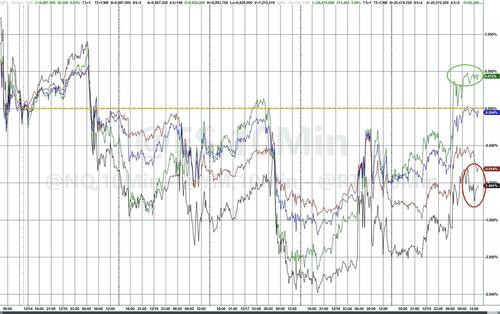
The S&P 500 jumped 0.8% on Thursday, snapping a four-day losing streak, and closed with a similar gain on Friday. That wrapped up the final full trading week for U.S. equities this year.
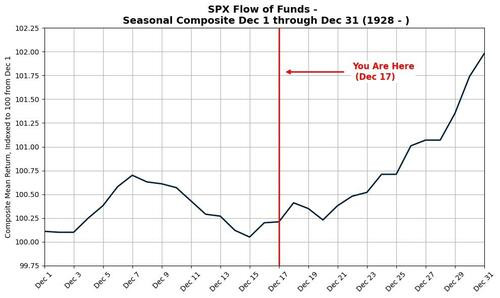
History suggests more upside could be in store. Citadel Securities data shows that since 1928, the S&P 500 has risen 75% of the time in the last two weeks of December, with an average gain of 1.3%.
While long-term worries about the AI sector and its still-stretched valuations persist, strong economic performance and corporate profit outlooks are shoring up investor confidence. As Susquehanna International Group notes, traders are snapping up call options on chipmakers and tech giants, and retail enthusiasm for U.S. stocks shows no signs of fading.
In a client note, Goldman Sachs’ trading team wrote: “Barring a major shock, the current strong seasonal trend and clearer positioning are unlikely to reverse.”
Gail Hafif, a member of the team, added: “We don’t expect a sharp rebound, but we do see room for upside from current levels through year-end.”
Thursday’s initial rally was fueled by a lower-than-expected (though controversial) inflation report, which boosted bets on further rate cuts next year. Tech stocks led the charge: the Bloomberg Magnificent Seven Index soared 2%, and the Nasdaq 100 climbed 1.5% after five straight days of volatility. On Friday, the momentum extended, with the Nasdaq 100 rising more than 1% again, driven by sharp gains in Micron, Oracle, and others.
Thomas Martin, senior portfolio manager at Globalt Investments, said: “Tech companies—especially AI-related ones—had been under significant pressure. But when Micron reported earnings and the market reacted positively, there’s a sense that maybe it’s time to buy these stocks back.”
Call Options Surge
That’s good news for derivatives traders, who have been piling into call options in recent days, betting on a further tech rebound.
Susquehanna data shows traders are snapping up call spreads linked to NVIDIA, Micron Technology, and the Technology Select Sector SPDR Fund (XLK), while selling put options on heavyweights like Alphabet, NVIDIA, and Broadcom.
Notably, both “Google ecosystem” and “OpenAI ecosystem” stocks have rallied over the past two days.
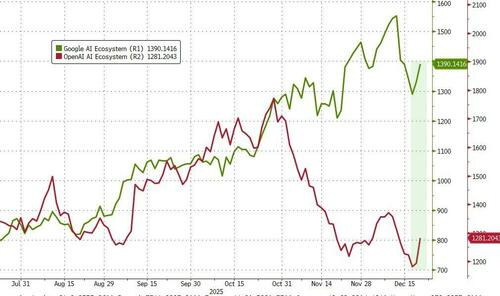
Chris Murphy, co-head of derivatives strategy at Susquehanna, said: “This fully reflects market confidence that any pullback will be limited and short-lived. Instead of selling these sectors, investors are using the tech dip to add to positions in AI, semiconductors, and growth tech.”
The broader U.S. stock market environment remains positive. Goldman Sachs data shows investors have poured roughly $100 billion into U.S. equities over the past nine weeks, extending a steady inflow trend that began in 2025. The firm’s investor sentiment gauge has hit its highest level since April.
Retail investors—this year’s biggest market drivers—show no signs of exiting. Citadel Securities data reveals retail traders have been net buyers of U.S. stock call options for 32 out of the past 33 weeks, the longest streak on record for the firm.
Scott Rubner, head of equity and equity derivatives strategy at Citadel Securities, noted in a client note: “After a year of strong portfolio returns and record household wealth growth, retail investors are entering 2026 with unwavering confidence and ample capital, positioning them to expand their market participation.”
Rubner added that institutional optimism is also growing. In recent weeks, institutions have not only been buying call options across the board but also piling into sectors beyond tech giants. He pointed out that economically sensitive real estate and industrial stocks have sent the strongest buy signals for the second straight week.
Will the Santa Claus Rally Deliver This Year?
Easing volatility could be another tailwind as the annual seasonal lull approaches. The S&P 500’s 10-day realized volatility has dropped to one of the lowest levels of the year—a trend that may prompt volatility-hedging and trend-following funds to increase their stock allocations.
Goldman Sachs’ trading desk said: “We still see room for further volatility compression. Lower implied volatility means systematic leverage will gain more momentum.”
And the much-needed two-day rebound in U.S. stocks has left more market participants optimistic about the upcoming Santa Claus Rally.
According to the Stock Trader’s Almanac, since 1950, the so-called Santa Claus Rally—when the S&P 500 averages a 1.3% gain over the last five trading days of the year and the first two of January—has been a reliable seasonal trend.
This year, the Santa Claus Rally window opens next Wednesday and runs through January 5.
“The economic data this week has reinforced expectations that the Fed will stick to its rate-cutting path,” said Angelo Kourkafas, senior global investment strategist at Edward Jones. He added that while investors may lock in profits in the coming days after a solid year, creating some selling pressure, the latest data “likely gives the green light for this year’s Santa Claus Rally.”