
One Article Review: Behind the Venezuela Situation – Who Are the Potential Winners and Losers in the Global Oil Industry?

The arrest of Venezuelan President Nicolás Maduro has revived a question largely shelved in the oil market for years: If Venezuela’s oil industry begins a so-called “normalization” process under U.S. influence, what changes will it bring to the global oil sector?
In his latest speech on Saturday, U.S. President Trump said U.S. sanctions on Venezuelan oil will continue, but he also noted that the U.S. plans to “deeply engage” in Venezuela’s oil sector, investing tens of billions of dollars to repair the country’s severely damaged infrastructure, especially oil infrastructure, and start generating revenue.
The U.S. government positions this as a “resource recovery program,” implying companies will achieve “cost compensation” through direct access to crude oil.
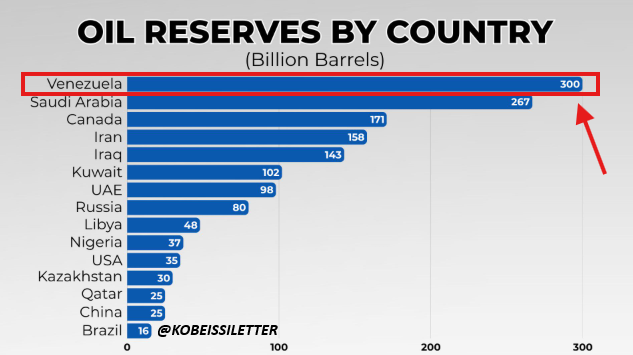
According to official data, Venezuela holds the world’s largest oil reserves, but due to mismanagement, underinvestment, and sanctions, its crude production remains only a fraction of previous capacity.
Per the London Energy Institute, Venezuela holds about 17% of global oil reserves — 303 billion barrels, exceeding OPEC’s de facto leader Saudi Arabia. However, Venezuela currently accounts for only 1% of global supply. Per the U.S. Energy Department, most of Venezuela’s reserves are heavy oil in the central Orinoco River basin, making production costly but technically relatively simple.
Wood Mackenzie estimates show achieving a 500,000 bpd production increase would require $15–20 billion investment — highlighting the high capital intensity of its extra-heavy crude. Yet in the global energy landscape, this could still be a worthwhile deal: as a restoration of existing fields rather than new discoveries, per-barrel capacity costs are ~25% lower than current deepwater projects in Guyana or Brazil.
It’s foreseeable that regardless of how the situation evolves, reshaping Venezuela’s entire oil industry will be a lengthy process. Short-term, oil prices will remain primarily influenced by OPEC+ policy, Russian exports, and global demand changes — not Venezuela’s political shifts.
But from the entire supply chain perspective, future impacts will first emerge downstream — in oil processing firms including refineries and petrochemical plants.
Potential Winners: U.S. Gulf Coast Refiners?
Many industry insiders say if Venezuela’s industry policies fall under U.S. control, U.S. Gulf Coast refiners will benefit most directly — Venezuelan crude is high-sulfur heavy oil, perfectly suited to the design capabilities of most refineries in the region.
Previously, U.S. sanctions on Venezuela and Russia forced U.S. refineries to replace heavy crude with more expensive or suboptimal alternatives, sometimes narrowing profit margins.
Even moderate, reliable Venezuelan supply could improve feedstock flexibility and economics for refineries configured for heavy sour crude — allowing discounted purchases.
Per latest U.S. Energy Information Administration import data, only a few U.S. refineries received Venezuelan crude in October — total imports ~4.2 million barrels. Valero led with ~1.6 million barrels, followed by PBF Energy’s Paulsboro refinery (1.2 million), Chevron (1 million), and Phillips 66 (~0.5 million).
Overall, these Venezuelan imports are negligible compared to these refiners’ purchases from other heavy crude suppliers.
In October last year alone, Valero imported nearly 5 million barrels from Mexico, over 2 million from Colombia, and added heavy crude from Brazil, Ecuador, and Argentina. Chevron’s Gulf Coast and West Coast refining systems heavily rely on Guyana, Mexico, Saudi, Iraqi, and Canadian crude — Guyana imports several times Venezuela’s.
Chevron is currently the only major U.S. oil company operating in Venezuelan fields, with its produced heavy crude supplying U.S. Gulf Coast and other refineries. Francisco Monaldi, Director of Latin American Energy at Rice University’s Baker Institute, said Chevron is fully prepared and will be the biggest beneficiary once Venezuelan oil opens up. However, he noted other U.S. oil companies will closely monitor Venezuela’s political stability and watch for evolutions in operating environments and contract frameworks.
He said the most likely to return is ConocoPhillips, owed over $10 billion — unlikely to recover without re-entering Venezuela. He added ExxonMobil could also return, but owed less than ConocoPhillips. “ExxonMobil, ConocoPhillips, and Chevron won’t worry about investing in heavy oil — demand is huge in the U.S., and their decarbonization focus is lower.”
Meanwhile, U.S. refiners don’t need Venezuela to reclaim major global supplier status to gain economic benefits — even small, reliable incremental crude with financing, insurance, and trading terms could broaden options for complex refineries processing heavy sour crude and improve feedstock cost efficiency.
MST Financial Energy Research Head Saul Kavonic estimates if Venezuela’s new government lifts sanctions and attracts foreign investors back, mid-term Venezuelan oil exports could approach 3 million bpd.
Long-Term Losers: Canadian Heavy Crude Producers
The most profound competitive landscape will emerge further out — Canadian heavy oil producers’ exports will face impact, intersecting with Canada’s own efforts to reduce U.S. dependence.
This may be the key significance of U.S. attempts to dominate Venezuelan crude exports. Venezuelan crude directly competes with Canadian oil sands in quality, refining fit, and end markets. Both are high-sulfur heavy crudes, mainly purchased by U.S. refineries with coking capabilities.
Even moderate, sustained Venezuelan exports will reintroduce competition in a niche where Canada enjoyed unusually favorable positioning.
Venezuela’s long absence from Western markets solidified Canadian heavy crude as the dominant supplier for U.S. refineries configured for heavy crude.
Canada currently exports ~3.3 million bpd to the U.S., accounting for a quarter of U.S. refinery throughput. Most is heavy oil sands crude, flowing to U.S. Midwest and Gulf Coast — refineries originally built to process Venezuelan and Mexican heavy crude.
This U.S. dependence has long been seen as a strategic weakness by Canada. Successive Canadian governments have aimed to expand export channels and end markets. Under current PM Carney’s influence on economic policy, focus has shifted from expanding production at all costs to improving market access, enhancing price resilience, and boosting long-term competitiveness.
However, deeper export diversification has a long way to go. Grand visions like building true east-west pipelines linking Alberta crude to the Atlantic coast face political and commercial challenges — unlikely before 2030. Rail exports offer limited flexibility but at higher cost and lower reliability. The U.S. remains the overwhelming primary destination for Canadian oil sands products.
Venezuela’s rapid situation changes could embed long-term narrative risks for U.S.-listed Canadian producers like Suncor Energy, Cenovus Energy, Canadian Natural Resources, and Imperial Oil. Venezuelan crude won’t displace Canadian supply overnight — this isn’t a 2026 earnings issue. But over time, intensified competition could cap heavy crude spread upside, eroding the scarcity premium supporting oil sands profits — while Canada may still not have fully escaped excessive U.S. market dependence.
In contrast, U.S. shale producers are largely unaffected — output mainly light crude, unable to substitute Venezuelan heavy. Their economics depend on drilling efficiency, costs, and oil prices — not heavy crude competition.