
First Nonfarm Night of 2026: Will U.S. Jobs Data Throw a Curveball?

The global markets kicked off 2026 on a strong note. But investors could face the year’s first real test this Friday when the U.S. Department of Labor releases December jobs data at 8:30 a.m. Eastern Time. On the same day, the U.S. Supreme Court is expected to issue its final ruling on the legality of most of President Trump’s tariffs.
Options traders are on high alert, bracing for what could be the most volatile trading day of the year so far—the S&P 500 is priced for a big swing. According to Interactive Brokers chief market strategist Steve Sosnick, pricing on Friday-expiring at-the-money options implies the S&P 500 could move at least 0.9% up or down on Friday.
Sosnick also questions whether investors are cautious enough. In a note, he wrote: “A relatively calm market means there’s still room for surprises.”
Nonfarm Preview: The Most “Reliable” U.S. Jobs Report in Over Two Months?
Tonight’s jobs report is drawing huge attention partly because many in the industry see it as potentially the first “clean” U.S. economic data since the historic government shutdown in October last year. That makes this release particularly important—it could either reinforce market expectations for the Fed to hold rates steady this month or boost the case for a fourth straight rate cut…
Natixis North America head of U.S. rates strategy John Briggs said: “December’s jobs data will be the first clean U.S. economic report we’ve gotten in a very long time.”
CreditSights head of investment-grade and macro strategy Zachary Griffiths noted: “We expect volatility to pick up as these data start coming out on a more regular basis. The market had been in a very calm period toward the end of 2025.”
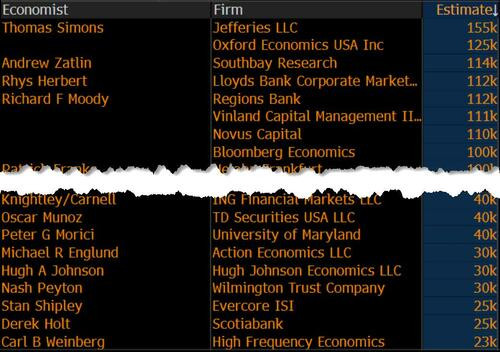
On the data itself, consensus expects December nonfarm payrolls to be close to November’s 64,000. Media midpoints vary slightly: Reuters’ most-cited figure is 60,000; Bloomberg’s survey is 70,000; The Wall Street Journal is 74,000.
Among major Wall Street banks, the lowest forecast comes from High Frequency Economics at 23,000, while the highest is Jefferies at 155,000. Notably, no major firm is currently predicting negative growth.
On the other key nonfarm night metric—unemployment rate—most expect December to dip from November’s 4.6% to 4.5%. The Federal Open Market Committee (FOMC) in December projected year-end unemployment at 4.4%, falling to 4.2% in 2027.
Goldman Sachs’ latest preview expects December nonfarm payrolls to rise 70,000, matching Bloomberg’s consensus.
Goldman sees supportive signals in moderate private-sector job growth from big data and seasonal factors helping December overall. Headwinds include an expected 5,000 drop in government jobs (all federal), while construction growth slows after November’s big jump and early-survey bad weather.
Goldman also expects December unemployment to edge down to 4.5% from 4.6%. The firm notes November’s unrounded rate was 4.56%, so rounding to 4.5% isn’t a stretch. Continued claims have eased slightly in recent weeks, and federal workers (likely a big driver of November’s spike) have returned.
JPMorgan analysts expect December nonfarm to be flat or slightly above recent trends. They say summer/third-quarter economic weakness fears proved overblown, with strong consumer demand supporting GDP growth. But hiring has lagged consumption acceleration, making this expansion unusual by historical standards.
JPMorgan also notes the NFIB small-business index (which usually leads nonfarm by 1–2 months) has trended higher since summer. While it may not fully show in December, it could signal faster hiring ahead.
Financial Markets on Edge
With the labor market cooling, the Fed cut rates at its last three meetings in 2025—25 bps each time. That helped U.S. Treasuries rise more than 6% last year, the best showing since 2020.
Investors currently expect that if tonight’s jobs data shows overall labor market stability, it could give the Fed room to pause at its January 27–28 meeting. Last Wednesday’s ADP report showed December private payrolls rose 41,000—below the 48,000–50,000 consensus but back in positive territory.
Rate markets price a ~10% chance of a Fed cut this month. Traders expect the next cut in June—the month after Chair Powell’s term ends—with another possible in Q4.
AmeriVet Securities head of U.S. rates trading and strategy Gregory Faranello said if nonfarm is “very weak”—e.g., near flat growth—it would “force the Fed’s hand,” potentially lifting January cut odds to 50%. Such an outcome would lower yields across the curve, but short-end bonds would likely outperform, steepening the curve.
Sevens Report Research founder and president Tom Essaye said whether data is much better or worse than expected, it could pose risks. “Like the last two jobs reports, a ‘Goldilocks’ number—solid job growth with stable unemployment—is best for stocks and keeps this rally alive.”
JPMorgan market intelligence team’s analysis outlines five potential S&P 500 reactions to tonight’s nonfarm:
- Nonfarm >105,000 (5% probability): S&P 500 falls 0.5%–1%
- Nonfarm 75,000–100,000 (25% probability): S&P 500 rises 0.25%–1%
- Nonfarm 35,000–75,000 (40% probability): S&P 500 rises 0.25%–0.75%
- Nonfarm 0–35,000 (25% probability): S&P 500 ranges from −0.25% to +0.5%
- Nonfarm <0 (5% probability): S&P 500 falls 0.5%–1.25%
Of course, nonfarm isn’t the only headline tonight. Many traders are also watching the Supreme Court, which could rule as early as Friday morning Eastern Time on the legality of most Trump tariffs.
“Over the past few months, with little economic data, market sentiment has been complacent,” said CreditSights head of investment-grade and macro strategy Zachary Griffiths. “We could see volatility pick up.”
He called the tariff decision a “huge unknown,” and Friday could bring a double whammy to the $30 trillion U.S. Treasury market. Bond volatility has been dormant for a month, with the 10-year yield stuck in a tight 4.1%–4.2% range.
JPMorgan strategists including Jay Barry said in a note this week that repealing tariffs could “reignite fiscal worries, raise long-end yields, and steepen the curve risk.” But they believe actual impact should be “quite limited” since the government can reinstate most tariffs through other channels.