
Gold +7%, Silver +23% in January! Precious Metals Bull Run Is Back in Full Force Before Mid-Month?

Gold and other precious metals hit eye-popping levels in 2025, making it hard to imagine similar returns in 2026. Yet robust global safe-haven demand and aggressive central bank buying are fueling the continuation of this “crazy bull” run…
Market data shows that right out of the gate in the new year, gold and silver both hit fresh highs: spot gold is up nearly 7% YTD, breaking above $4,600; spot silver has skyrocketed 23%, pushing past $88 and charging toward $90. Platinum is also up 15% this year, nearing its all-time peak.
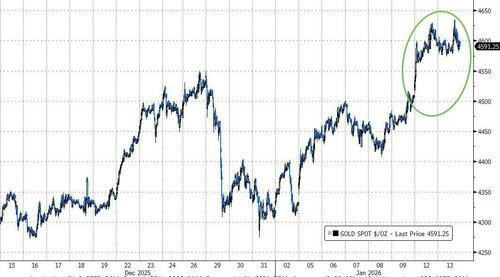
What’s even more striking: this surge comes on top of 2025’s monster gains—gold +65%, platinum +125%, and silver +145% for the year.
With a barrage of political, economic, and geopolitical headlines out of Washington, any notion of profit-taking or pause in precious metals vanished instantly. It brings to mind Lenin’s famous line: “There are decades where nothing happens; and there are weeks where decades happen.”
Just last week, President Trump ordered the purchase of $200 billion in mortgage-backed securities (MBS), directed major U.S. oil companies to ramp up activity in Venezuela, attempted to ban stock buybacks and dividends at defense firms, and pushed for a 10% cap on credit card interest rates.
At the same time, the Justice Department threatened criminal charges against Fed Chair Jerome Powell.
All of these moves acted as rocket fuel for gold and silver. While the “dollar devaluation trade” narrative may be overstated—the dollar has been remarkably stable for months—the sheer strength in precious metals suggests there’s real substance behind it.
Gold Demand Accelerating
Private investors’ rush into “quality assets” for safety and inflation hedging is perfectly complementing the highly inelastic nature of central bank demand for gold. Meanwhile, for strategic and diversification reasons, reserve managers continue to buy gold regardless of price.
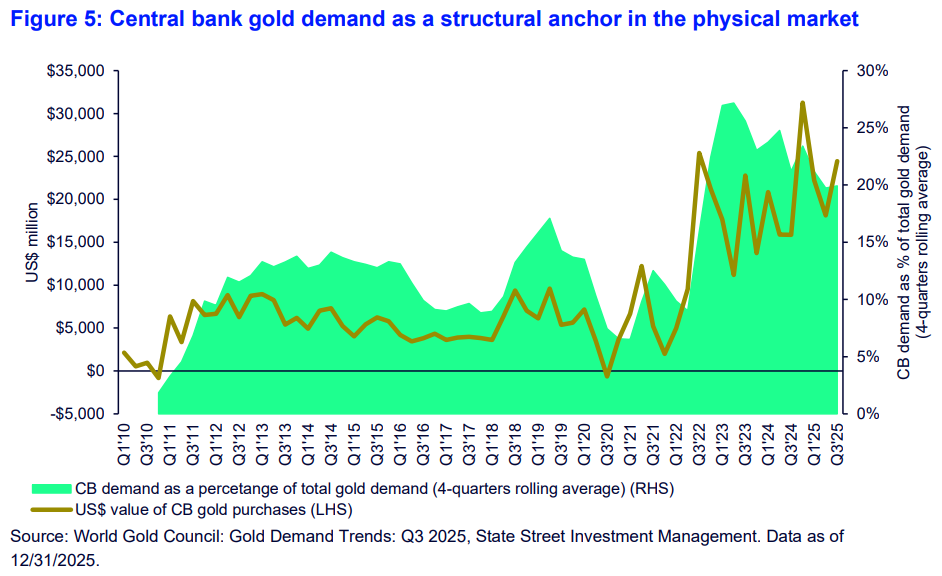
Deutsche Bank analysts wrote Monday: “Clearly, high gold prices have not yet deterred reserve managers from continuing to accumulate.”
State Street Bank analysts share the view, noting that official-sector gold buying is forming a “sticky” demand source and signaling a “durable shift” in reserve management—from U.S. Treasuries toward gold.
This effectively raises the floor price for gold—State Street sees that floor at $4,000/oz, not far from Monday’s record high of $4,634/oz. The ceiling is rising too, with a break above $5,000 appearing increasingly likely.
World Gold Council data shows gold accounted for 25.9% of global forex reserves in October last year. By comparison, the euro’s share in the IMF’s official COFER data was around 20%. Some analysts even argue that gold reserves surpassed U.S. Treasuries for the first time since 1996.
Of course, gold is not included in the IMF’s official COFER data, which benchmarks global forex reserve composition. It appears instead in broader central bank asset metrics. For this reason—plus varying reporting transparency—estimates of gold’s relative standing versus currencies or assets like Treasuries should be viewed with caution.
Regardless of exact figures, the trend in central bank reserve allocation is undeniable. In a world of heightened turbulence, central banks are unlikely to reverse course anytime soon.