
After-hours plunge of 13%! Intel Q4 results beat expectations but guidance disappoints — all because of yield issues?

On Thursday after market close Eastern Time, Intel released its fourth-quarter earnings report and guidance for the first quarter of this year.
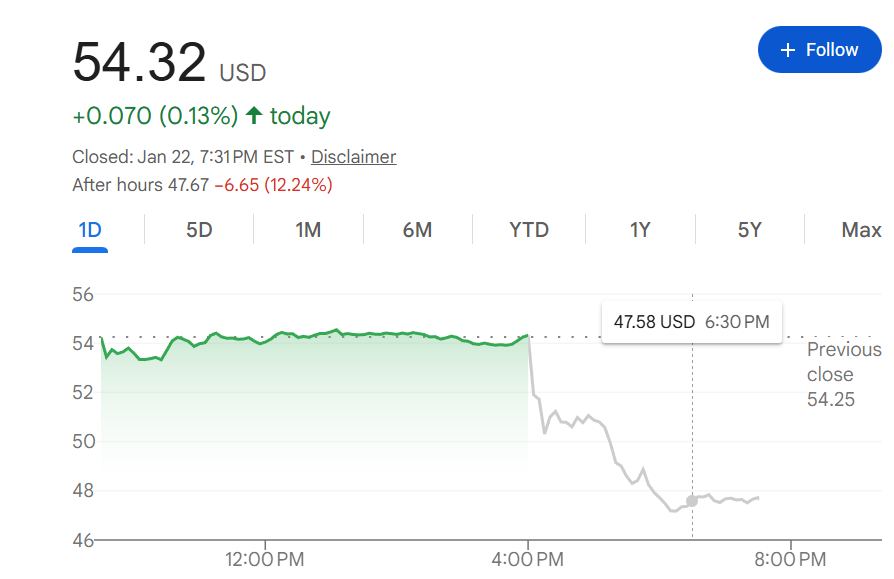
Although its Q4 performance exceeded Wall Street expectations, the conservative outlook for Q1 caused the stock to drop as much as 13% in after-hours trading. The main culprit behind this may still be the company's chip manufacturing yield problems.
Intel stock plunges in after-hours trading
Here’s how the company compared to Wall Street expectations (based on LSEG analyst surveys):
- Adjusted earnings per share (Non-GAAP EPS): 15 cents, beating expectations of 8 cents
- Revenue: $13.7 billion, beating expectations of $13.4 billion
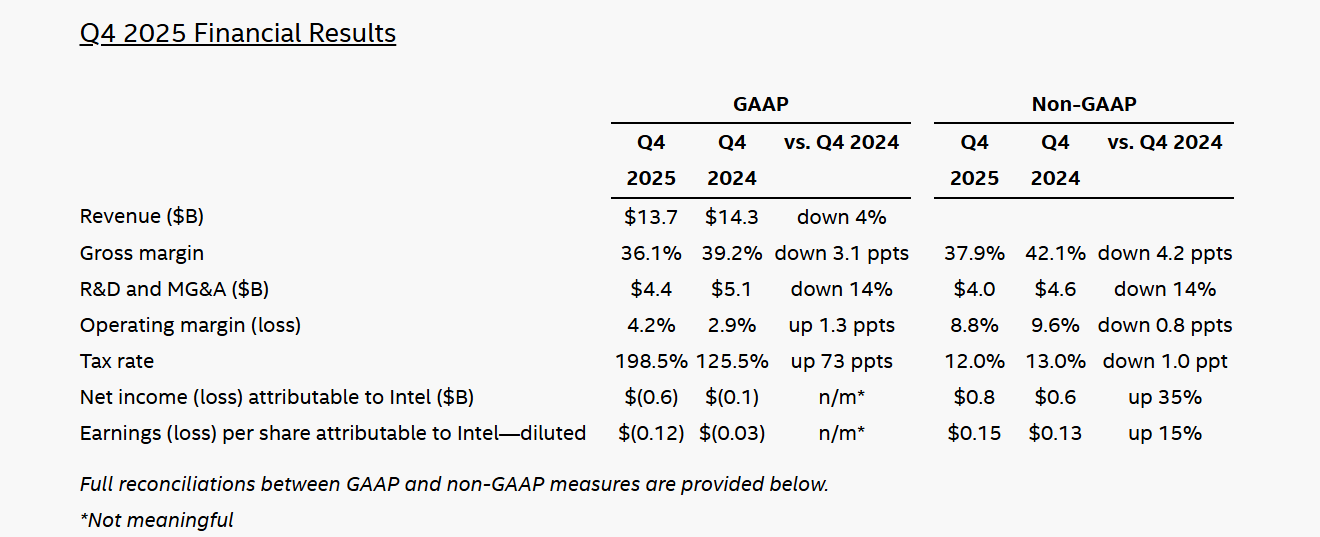
Intel said it expects Q1 revenue to range between $11.7 billion and $12.7 billion, with adjusted EPS at $0 (breakeven). In contrast, LSEG expected Q1 EPS of 5 cents and revenue of $12.51 billion (midpoint around $12.6 billion in some consensus figures).

In an interview, Intel CFO David Zinsner explained that the Q1 guidance was cautious, partly because the company couldn’t meet seasonal demand due to supply constraints, which are expected to improve in Q2.
Zinsner wrote in the earnings statement:
“Despite industry-wide supply shortages, our fourth-quarter revenue, gross margin, and EPS all exceeded expectations. We expect available supply to hit its lowest level in the first quarter, then gradually improve in the second quarter and beyond.”
During the analyst call, Intel CEO Lip-Bu Tan (陈立武) stated that the company is focused on improving production efficiency to boost product supply. Although the Intel 18A process node has officially begun shipping, Tan acknowledged shortcomings in yields for its leading-edge nodes.
“I’m disappointed we couldn’t fully meet market demand… Yields are in line with our internal plan but still below my expectations,” Tan said. He added that 18A yields are improving month-over-month, targeting 7% to 8% gains per month — a pace Intel hopes will help reduce unit costs.
Advancing into 14A territory
Before the report, investors had high hopes for Intel. Thanks to optimism around the company securing its first major external customer for its foundry business, the stock had surged 147% over the past year.
Earlier this month, Tan stated that the 18A manufacturing technology (competing with TSMC’s 2nm) “over-delivered” in 2025, indicating sufficient maturity for volume production of products like Intel’s own Core Ultra Series 3 CPUs.
In the statement, Tan said Intel is “aggressively working” to ramp up 18A supply to meet “strong customer demand.”
Zinsner revealed that customers for the next-generation 14A technology will emerge in the second half of this year, though the company is unlikely to disclose all details.
“Once we have those customers, we’ll need to start really investing in 14A — that’s the confirmation you can count on,” Zinsner said.
Steady growth in AI and foundry businesses
The earnings showed Q4 revenue broken down into three main segments: Client Computing Group (laptop chips), Data Center and AI (CPUs), and Foundry.
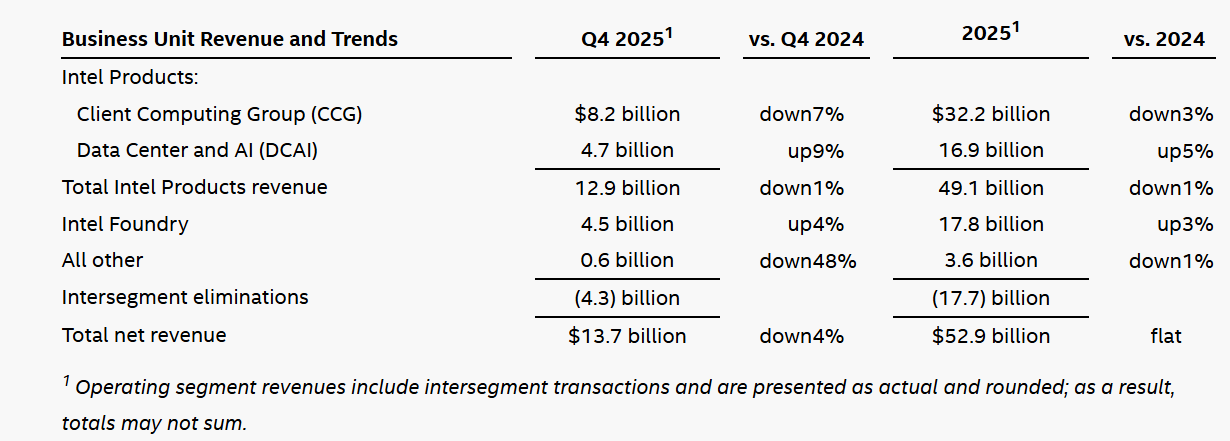
Specifically:
- Foundry revenue: $4.5 billion, up 4% year-over-year (though part of this was internal production of Intel’s own chips);
- Client Computing Group revenue: down 7% YoY to $8.2 billion;
- Data Center and AI revenue: up 9% YoY to $4.7 billion, driven by strong AI demand.
Analysts noted that Intel’s Data Center and AI segment is seeing significant volume growth as companies increase spending on AI infrastructure.
In Thursday’s statement, Tan emphasized that “with systems built for AI, our CPUs are becoming increasingly important. We are more convinced than ever that CPUs play a critical role in the AI era.”
During 2025, major investments came from the U.S. government, SoftBank, and Nvidia, all becoming significant shareholders. Intel confirmed completing a $5 billion stock sale to Nvidia this quarter.