
US “Magnificent Seven” Earnings Drop This Week: Key Things Investors Should Watch

Over the past few years, the “Magnificent Seven” — Microsoft, Apple, Nvidia, Alphabet, Amazon, Meta, and Tesla — have dominated the spotlight every earnings season, and this Q4 season is no exception.
Tonight, three of the group (Tesla, Meta, and Microsoft) report first, with Apple following on Friday morning.
Wall Street analysts remain broadly confident in the group's performance, but as the AI boom matures, companies that demonstrate clear traction from AI infrastructure buildout and monetization will stand out most.
At the same time, growing constraints around capital, power supply, and policy/regulatory headwinds are becoming a bigger focus for the group's aggressive AI push.
Strong Q4 Expectations for the Mag7
Earnings season is in full swing this week, with 102 S&P 500 companies reporting — including four of the Magnificent Seven.
Analysts are optimistic overall. FactSet senior earnings analyst John Butters expects the Mag7 to deliver 20.3% year-over-year EPS growth in Q4 — far outpacing the 4.1% growth for the rest of the S&P 500 — with Nvidia, Alphabet, and Microsoft likely leading the pack.
LPL Research notes that — excluding Tesla — the other six are projected to contribute more than 60% of the S&P 500's total earnings growth this quarter.
LPL adds: “The Mag7 earnings growth rate could exceed 25%, likely more than double what the ‘S&P 493’ (the rest of the index) can achieve.”
Divergence Among the Seven Is Becoming Clearer
While the group is often discussed as a monolith, their paths have started to diverge as the AI cycle evolves.
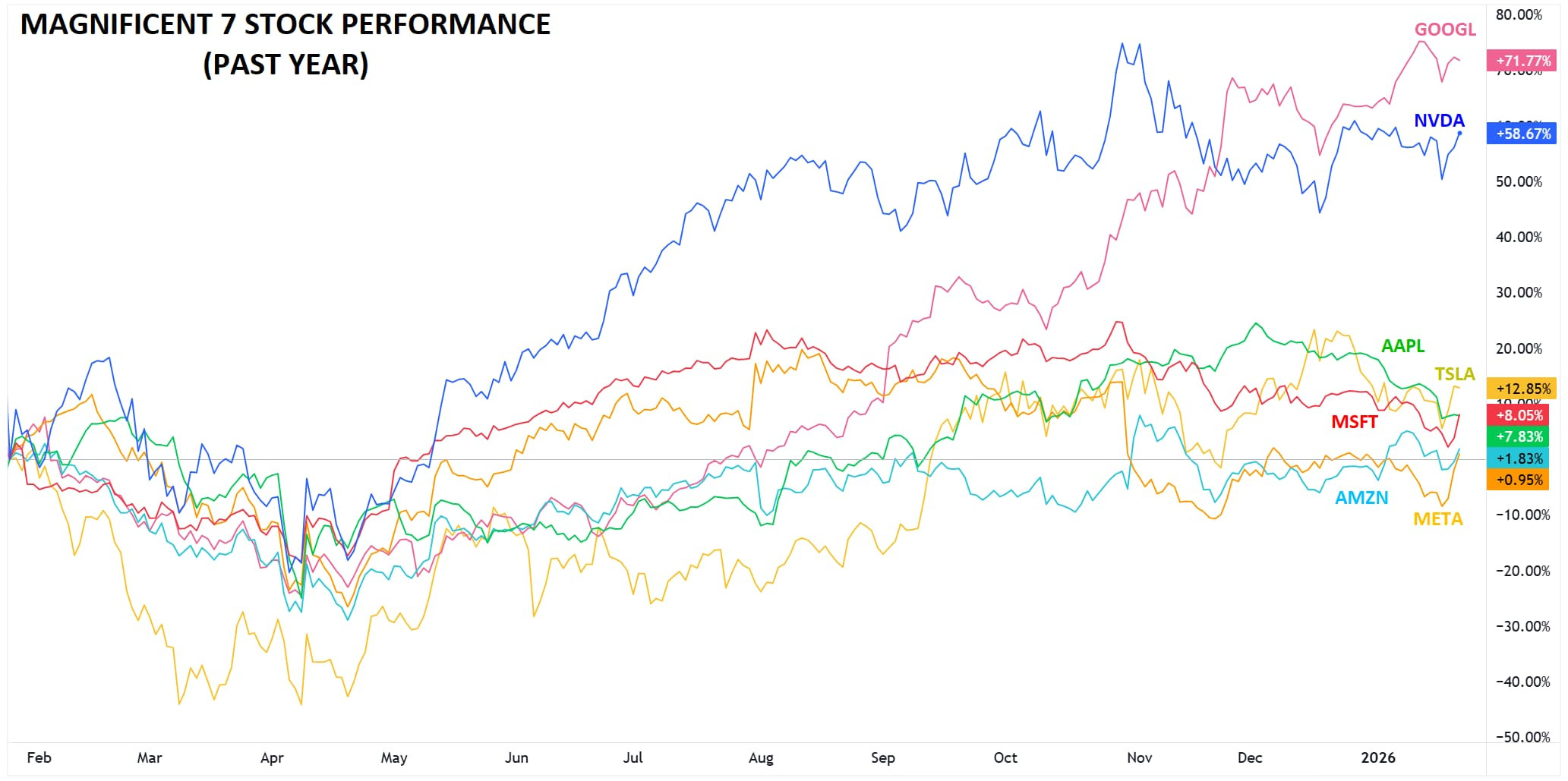
Matt Weller, global head of research at Gain Capital, writes that for the past few years the Mag7 moved largely in lockstep, but this earnings season the differences are stark again: AI- and cloud-centric companies are expected to benefit most from infrastructure momentum and monetization traction, while consumer-sensitive and ad-reliant names will lean more on demand resilience and margin execution.
Weller stresses that the key question this quarter is no longer “is AI real?” but “has the AI boom entered a phase where capital, power, and policy constraints start to weigh on growth?” He highlights four major themes investors should watch closely.
1. Real-World Constraints on AI Infrastructure Buildout
The most immediate shift: AI capex cycles are increasingly bumping up against reality — bond markets, power grids, and regulation.
Last year's guidance showed the Mag7 collectively planning over $600 billion in capex for 2026, mostly AI-related. These companies are increasingly funding the race via debt issuance.
Weller notes: “This matters for earnings because attention is shifting from ‘who spends the most’ to ‘who can sustain spending without eroding free cash flow’ — especially if AI monetization takes longer than expected.”
Beyond funding, power is the second big bottleneck. Data-center rollout faces multi-year grid interconnection delays, equipment lead times, and local permitting hurdles in many markets. Energy availability itself has become a U.S. political and economic issue. This makes AI operating capacity more sensitive than markets may expect — particularly for the largest cloud platforms.
Microsoft (Azure), Amazon (AWS), Alphabet (Google Cloud), and Meta will face this pressure most directly. Traders are especially watching whether Azure growth is slowing and how demand stacks up against capacity.
2. Digital Advertising Details
While AI infrastructure dominates the narrative, digital advertising quietly remains the second-biggest swing factor.
Dentsu forecasts global ad spending growth of 5.1% in 2026 — crossing $1 trillion for the first time — with algorithmic-driven ads accounting for ~71.6% of the total.
This is broadly positive for Alphabet and Meta, whose core businesses rely heavily on ads.
Investors should drill into specifics: Meta may highlight short-video consumption scale and monetization progress, but will also need to justify surging investments in ad-delivery systems.
3. Consumer Electronics & Autos in a “Two-Speed” Economy
The third theme is the “two-speed economy” — divergent growth across sectors. Unlike Microsoft/Meta's AI focus, Apple and Tesla face greater scrutiny on consumer demand for non-essential hardware and vehicles.
Gain Capital analysts expect Apple may struggle to craft a strong narrative this quarter as markets weigh robust iPhone cycle demand against rising component costs pressuring margins.
Tesla sits at the other end of consumer sensitivity: delivery numbers and automotive margin durability amid fierce competition remain in focus. As always, guidance will likely matter more than the quarter itself in determining whether the stock gets rewarded this season.
4. Policy, Regulatory, and Geopolitical Clouds
Finally, regulatory and geopolitical risks remain ever-present. Beyond ongoing antitrust pressures on Alphabet and Apple, Nvidia faces outsized geopolitical exposure.
Any commentary on regional demand patterns, export pathways, or customer reactions to restrictions could move 2026 expectations for these names.
Overall, while the Mag7 still lead the market, this earnings season will likely highlight which ones are best positioned to navigate the maturing AI cycle — and which face the biggest near-term hurdles from capital discipline, power availability, consumer demand, and the policy backdrop.