
SpaceX & xAI Officially Merge! Aiming for Space-Based Data Centers

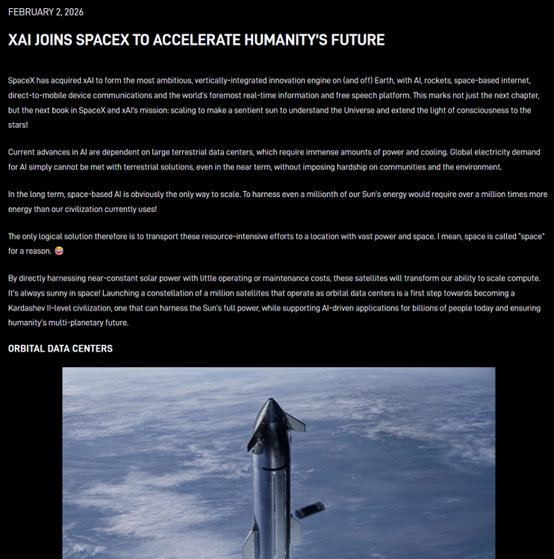
On Monday local time, Elon Musk's SpaceX confirmed in an internal memo — later posted on its website — that it has formally merged with xAI.
This puts an end to recent market rumors. Last month, reports surfaced that SpaceX and xAI were in merger talks.
SpaceX, founded by Musk in 2002, is a rocket and satellite company. xAI, launched by Musk in 2023, is an artificial intelligence enterprise.
In the memo, Musk wrote that the deal creates “the most ambitious vertically integrated innovation engine on Earth (and beyond), encompassing artificial intelligence, rocket technology, space-based internet, direct-to-device mobile communications, and the world’s leading real-time information and free-speech platform.”
The memo was initially sent to employees and then published on SpaceX's official website.
Musk emphasized that the acquisition will enable the combined entity to build data centers in space.
“This is not just the start of a new chapter — it marks the next phase of the SpaceX and xAI mission: to build a perceiving sun at scale to understand the universe, and extend the light of consciousness across the stars!” Musk wrote.
He explained that current AI development relies on massive ground-based data centers that consume enormous electricity and cooling resources. Even in the short term, ground solutions alone cannot meet global AI power needs without severely impacting communities and the environment.
“In the long run, space-based AI is clearly the only path to scale. Even using one millionth of the sun’s energy would provide a million times more power than all of human civilization currently consumes!” Musk said. “Therefore, the only logical solution is to move these resource-intensive projects to where there is vast energy and space.”
Musk outlined a technical roadmap for shifting AI compute to space.
SpaceX plans to launch 1 million satellites to form an orbital data-center constellation, directly harnessing near-constant solar energy in space with extremely low operating and maintenance costs.
Musk estimated that launching 1 million tons of satellites per year, with each ton delivering 100 kW of compute power, would add 100 gigawatts of AI compute capacity annually.
He projects that within two to three years, space-based AI compute will become the lowest-cost option. This cost efficiency will allow companies to train AI models and process data at unprecedented speed and scale.
Musk had already floated the idea of space data centers at an all-hands xAI meeting late last year.
He previously stated that SpaceX will deploy orbital AI data centers in the coming years, efficiently utilizing solar power. Last Friday, SpaceX filed an application with the U.S. Federal Communications Commission (FCC) to launch up to 1 million satellites for an orbital data-center network.
For xAI, the merger provides access to SpaceX’s orbital data-center network to build more powerful AI models.
The deal also brings funding support. xAI reportedly burned through billions in 2024, while SpaceX plans to raise up to $50 billion in a late-2026 IPO.
xAI aims to compete head-on with OpenAI and Google in the fierce AI race. The startup recently closed a $20 billion funding round at a $230 billion valuation. SpaceX is valued at around $800 billion.
Post-merger, the combined entity is reportedly priced at about $527 per share, implying a $1.25 trillion valuation.
This blockbuster merger is the latest move in Musk’s consolidation of his business empire — which also includes Tesla, brain-computer interface company Neuralink, and tunneling firm The Boring Company.