
US Sells, Then Asia Follows! AI Tsunami Continues to Hammer Software Stocks: Is the Wolf Really Here This Time?

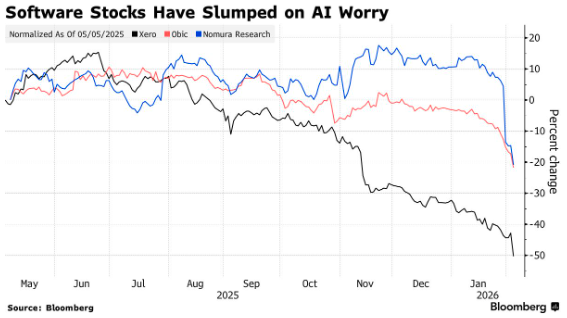
On Wednesday (February 4), Asian software stocks fell sharply, extending the global selloff from overnight, as investors grew increasingly worried that AI's rapid advancement could disrupt traditional software business models.
Several software firms led declines in Asian regional markets. Japanese IT services and systems integrator TIS plunged more than 15%, Trend Micro fell over 8%, and NS Solutions dropped nearly 7%.
Indian IT shares also tumbled sharply, with the Nifty IT index down nearly 6%. Major players Tata Consultancy Services and Infosys fell 5.8% and 6.2% intraday, respectively; HCL declined 5.5%.
In Hong Kong, Kingdee International once fell more than 15%, Tencent Holdings dropped over 3%, and Baidu declined more than 2%.
In Sydney, cloud accounting software provider Xero Ltd. plunged as much as 15% at one point — its biggest intraday drop since March 2020.
“AI is making tech industry competition even fiercer,” said Ed Yardeni, president of Yardeni Research.
“Software stocks took a beating after Anthropic rolled out new tools for its Cowork product,” he added. “The utility of the new tools is yet to be proven, but investors have already decided to lower software valuations.”
Software companies, long favored for their sticky subscriptions and stable renewals, now face a severe test — AI not only threatens to automate workflows and compress pricing power but also lowers barriers for new competitors to enter the market.
UBS senior equity strategist Vey-Sern Ling said: “For the sector to regain valuations, companies must prove AI can become a growth engine rather than a pure competitive threat — and convincing skeptical investors may take longer than usual.”
Ling noted that UBS prefers infrastructure software (lower risk of AI disruption) and cybersecurity (where pricing power remains and AI can drive upsell).
Ortus Advisors analyst Andrew Jackson wrote in a report: “The current situation is particularly concerning for software companies, as AI could completely replace traditional lock-in SaaS products, destroying their business models.”
The selloff in software had already intensified overnight in U.S. trading. The pressure was clear across the sector: London Stock Exchange Group (with large data analytics business) -13%, Thomson Reuters -16%, CS Disco Inc. -12%, LegalZoom.com Inc. -20%.
According to estimates, two S&P sector indices tracking software, financial data, and exchanges lost a combined ~$300 billion in market cap on Tuesday. The volatility contributed to a 1.4% drop in the tech-heavy Nasdaq Composite.
In Asia's tech space, one silver lining for investors: losses were mainly concentrated in software stocks, as the broader regional tech sector remains dominated by hardware makers — especially chipmakers — who have been primary beneficiaries of the AI investment boom. This contrast helped cushion regional benchmark indices.
“During this uncertainty, Asia's tech sector appears better positioned thanks to its higher hardware weighting, where earnings momentum remains strong,” said Gary Tan, portfolio manager at Allspring Global Investments.
Tan added: “Compared to the U.S. and Europe, pure software stocks have a relatively small weight in Hong Kong and A-share indices, and their businesses are less prone to disruption — many U.S. foundation models have limited access to the Chinese domestic market.”