
G10 Central Banks Fire the First Rate-Hike “Shot” of 2026! Bad News for the Fed and Warsh?

Some global central bankers and bond investors may feel uneasy about the Reserve Bank of Australia's decision this week…
The RBA hiked rates for the first time in over two years on Tuesday, a move that could signal a broader shift in global credit policy as the world economy heats up again.
Excluding the Bank of Japan's unique case, the RBA is the first major central bank to raise rates since 2023 — just six months after its last cut.
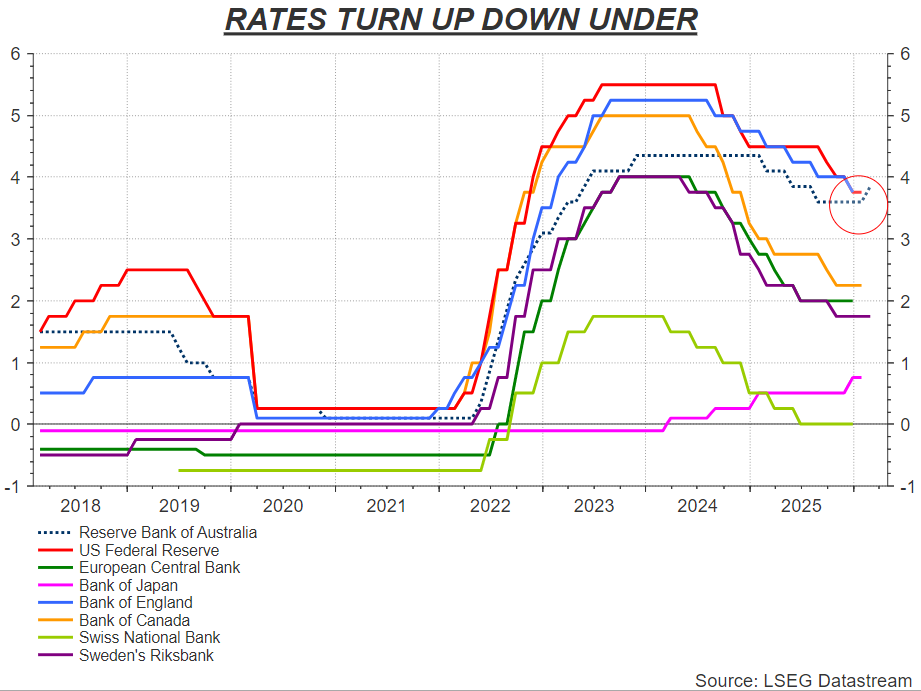
While markets had priced in this month's hike, the RBA's tone on further tightening was notably hawkish. Officials were vague about whether a new tightening cycle has begun, but clearly expressed unease about failing to bring inflation back to target and doubts that prior policy moves had worked.
The debate also revolves around a tricky concept: where exactly is the “neutral rate”? Despite political noise and calls for more cuts, this remains the core dilemma facing the Fed and other central banks.
While some economists argue neutral rate is too vague and elusive as a policy calibration tool, the idea of a rate that neither restrains nor stimulates credit creation and economic activity still guides many central banks seeking an ideal equilibrium.
In 2022, central banks aggressively tightened to curb post-pandemic inflation spikes. Over the past 18 months, as consumer price pressures eased, they collectively cut rates. Markets expected rates to settle at or near neutral — and stay there.
The problem: in most countries — including Australia and the U.S. — inflation has not yet returned to target. And signs are emerging that economic activity and credit demand are accelerating again.
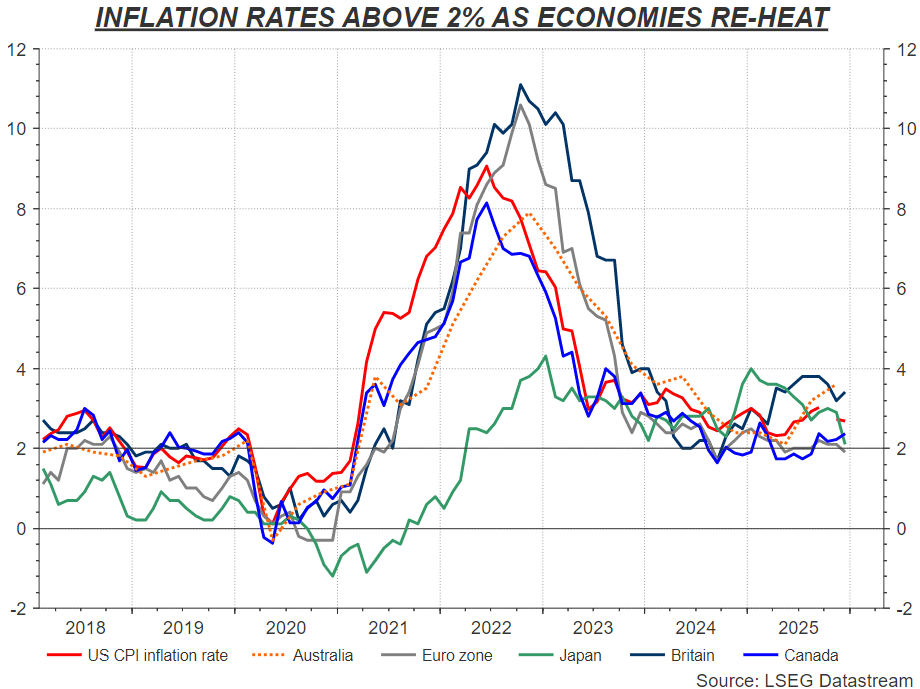
As the RBA noted this week, with robust household spending and private investment, capacity pressures persist, and inflation is expected to remain above the 2–3% target “for a considerable period.” Raising the cash rate target was therefore appropriate.
Investors now price in a 75% chance of another RBA hike in May. Two of Australia's big four banks, along with Goldman Sachs, shifted their RBA rate path forecasts this week. They now expect the RBA to hike 25 bps to 3.85% this week, followed by another hike to 4.1% in May.
The RBA's statement candidly admitted it seems to have lost its bearings: “Financial conditions eased in 2025, and it is uncertain whether they remain restrictive.” While some criticize tracking the almost unmeasurable “real neutral rate” (r-star) as meaningless, the RBA seems to be saying: when you're not there, you'll know.
Will the Fed Face Similar Tightening Pressure?
Extrapolating the RBA's tightening pressure to other major central banks may be unfair. The ECB, for example, has successfully guided inflation precisely back to target and appears content with its “comfort zone.”
But at least for the Fed, parallels exist.
Despite U.S. political pressure for aggressive further cuts — and Kevin Warsh's nomination to take over as Fed Chair in May — the reality facing the Fed is: core inflation remains a full percentage point above target, while financial conditions are the loosest since 2021.
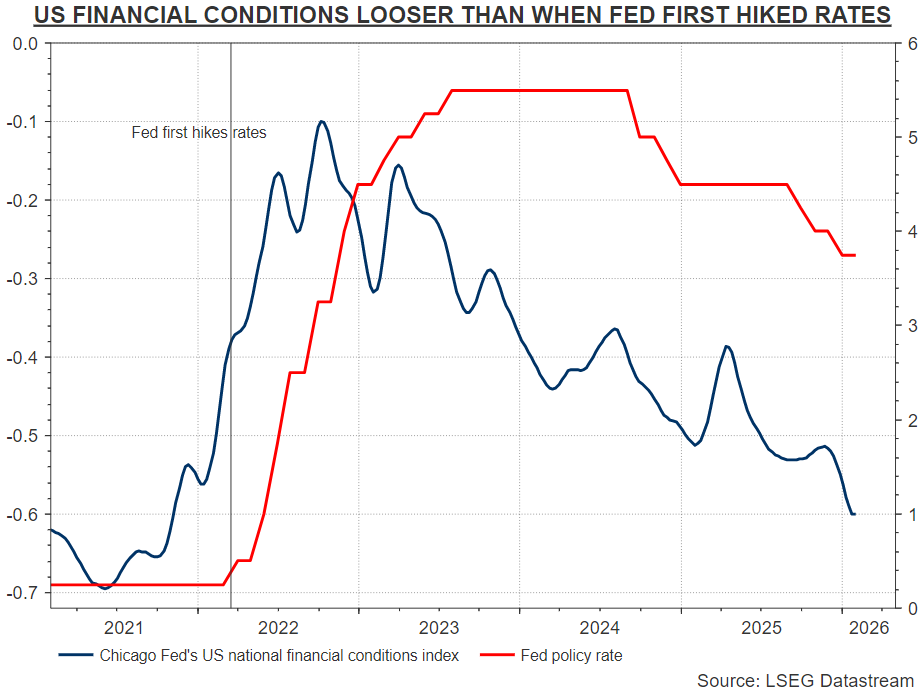
With U.S. GDP trackers still showing annualized growth above 4%, corporate profits growing double digits, and the labor market holding steady, recent data again point to signs of accelerating U.S. growth in the new year. January's ISM U.S. manufacturing survey showed factory activity surging to the highest since 2022 — the sector's first expansion in over a year. New orders drove the leap, while input prices continued to rise rapidly.
JPMorgan detailed how this growth trend is echoed globally. The firm noted that January surveys showed global industrial growth accelerating to 2–3% at the start of the year.
Société Générale strategists also noted: “The economic recovery is broadening: the SG Global Cycle Indicator has now entered the ‘boom’ zone.”
Additionally, the Fed's Senior Loan Officer Opinion Survey showed demand for commercial loans at large and medium-sized firms hit the highest level since Q2 2022 in Q4 last year. Banks expect demand to strengthen further this year.
In fact, some Fed-published r-star estimates already place current U.S. policy rates in stimulative territory. While many Fed officials still describe current policy as slightly restrictive.
Some market participants have already noted that — despite the RBA and Fed being very different institutions with vastly different economies — the debate and action in Australia this week could catch Washington's attention.
TS Lombard economist Dario Perkins wrote: “A truly ‘overheated’ economy could bring unpleasant surprises — especially for bond markets that didn't foresee central banks keeping rates outside ‘neutral’ forever.”
At the same time, it could pose a tough challenge for Warsh, newly nominated as Fed Chair. During his prior tenure as Fed Governor, Warsh cultivated a hawkish image — seemingly at odds with the nomination process, where he likely had to endorse aggressive cuts to win Trump's favor.
Unless the U.S. economic heat wave early this year proves fleeting, Warsh's most daunting task may be finding reasons for further rate cuts.