
Global Gallium Prices Triple in Two Years

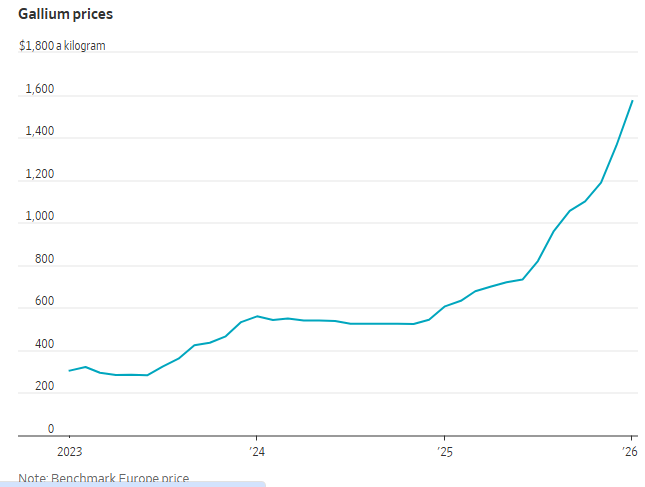
Gallium is a peculiar, silvery-white metal with a melting point so low it can liquefy in the palm of a hand. Over the past two years, however, its market price has surged toward a literal boiling point.
Market data reveals that international benchmark prices for low-purity gallium in Rotterdam have nearly tripled over the last 24 months. According to Argus Media, average prices hit a record high of approximately $1,572 per kilogram this January.
The applications for gallium across global technology and defense sectors are vast. When processed with nitrogen and arsenic, it forms high-performance semiconductor substrates. In the chip industry, gallium-based components can handle higher currents and offer superior resistance to heat and moisture compared to silicon. Beyond smartphones and laptops, satellites utilize gallium to shield sensitive components from cosmic radiation.
As global supply-demand dynamics tighten, the U.S. government is acting with unprecedented urgency.
In recent months, Washington has channeled hundreds of millions of dollars into domestic and overseas facilities. The goal is to establish an independent supply chain and reduce import reliance through a three-pronged "mining and refining" strategy: overseas positioning, multinational partnerships, and domestic recycling.
These initiatives are part of a broader push by the Trump administration to secure rare earths and critical minerals for the defense, automotive, and tech industries. This effort includes billions of dollars in financing and the establishment of strategic stockpiles for materials such as lithium, cobalt, and nickel.
Overseas Positioning
A flagship project under this strategy is located in Wagerup, Western Australia. Since the 1980s, Alcoa has operated a refinery there that processes bauxite into alumina. Because bauxite contains trace amounts of gallium, the company plans to build a new extraction facility at the site.
The U.S. government intends to co-finance the project alongside Australia and Japan. In exchange, the three governments will receive a portion of the plant’s gallium output. Alcoa estimates the facility could eventually produce 100 metric tons annually—roughly 10% of global demand. For context, global gallium production totaled 760 metric tons in 2024.
"We have known for years that gallium could be extracted from our process," Alcoa CEO William Oplinger said in a recent interview. "If global demand grows significantly and it is economically viable, we could replicate this at our other refineries."
Multinational Partnerships
The U.S. is also aggressively leveraging domestic investment to bolster supply through international alliances.
Late last year, the Department of Defense (DoD) joined private investors in a $1.9 billion equity stake in a joint venture with Korea Zinc. This move assisted the Seoul-based firm in acquiring U.S. zinc mines and a smelter.
Korea Zinc plans to extract gallium and over a dozen other critical metals from zinc refining residues at its Tennessee facility. An additional $4.7 billion in private and government loans will support the construction of a smelter capable of complex metal separation. The Tennessee project is expected to yield up to 54 tons of gallium annually starting in 2030.
Domestic Recycling
A third initiative is underway in Louisiana, home to the only alumina refinery in the United States. Atlantic Alumina, located between New Orleans and Baton Rouge, is planning to expand its alumina production—a key raw material for aluminum—and install gallium processing equipment.
For years, Atlantic Alumina has stockpiled "red mud," a byproduct of converting bauxite to alumina. Previously, the company lacked the capability to extract minerals like gallium from this waste. The DoD has stepped in with a $150 million investment for an equity stake in Atlantic Alumina to support its $450 million expansion and gallium project. The company expects an annual output of approximately 50 tons.
Costs and Market Risks
According to forecasts by Rovjok, a Finnish critical minerals consultancy, global gallium demand is set to rise by roughly 24% by 2030.
However, Rovjok’s estimates also indicate that the cost of producing gallium in the U.S. will be more than 20% higher than in China.
Ian Lange, an economics professor at the Colorado School of Mines, warns that the rush to increase production by the U.S. and its allies could lead to a supply glut. "This market is so small that it could easily collapse," Lange noted.