Gold Set for $6,000 by Year-End! BNP Paribas: Current Rally is "Entirely Rational"

David Wilson, Head of Commodity Strategy at BNP Paribas, stated this week that the ongoing gold rally is "entirely rational" given persistent macroeconomic and geopolitical risks. Wilson projects that gold could climb to $6,000 per ounce by year-end, with the gold-silver ratio likely to widen further.
While the gold-silver ratio remains below its two-year average of over 80x, it has begun to trend upward recently. "I think there is room for further decoupling [between gold and silver]," Wilson said in a televised interview. "To me, gold possesses a unique value; silver simply doesn't offer the same level of risk-hedging functionality."
Gold’s outlook is further bolstered by sustained central bank buying. For instance, Poland's central bank recently announced a plan to add 150 tons to its reserves—following its stint as last year's largest buyer. Additionally, the People's Bank of China increased its holdings for the 15th consecutive month in January, underscoring the resilience of official demand.
Wilson also noted that gold ETF inflows remain steady, experiencing only a brief dip during last week’s market correction before resuming their ascent.
Meanwhile, silver has faced intense volatility over the past few months, driven by strong physical buying in Asia. However, Wilson believes the physical silver market is showing signs of fatigue. The upcoming Lunar New Year holiday could further dampen Chinese demand for the white metal.
BNP Paribas joins a growing chorus of bullish voices, including Deutsche Bank and Goldman Sachs, who argue that long-term demand drivers remain supportive.
Roukaya Ibrahim, Chief Commodity Strategist at BCA Research, noted on Tuesday that ETF investment demand—particularly from Asia—has become a primary engine for gold prices. Over the past year, ETF inflows have accounted for the lion's share of investment growth, far outstripping demand for bars and coins.
While Ibrahim admits that ETF flows are "relatively more volatile" than physical bullion demand—explaining recent market swings—she maintains that emerging market central banks will continue their reserve diversification. This central bank activity is expected to "provide a floor" for prices, preventing any correction from spiraling into a long-term bear market.
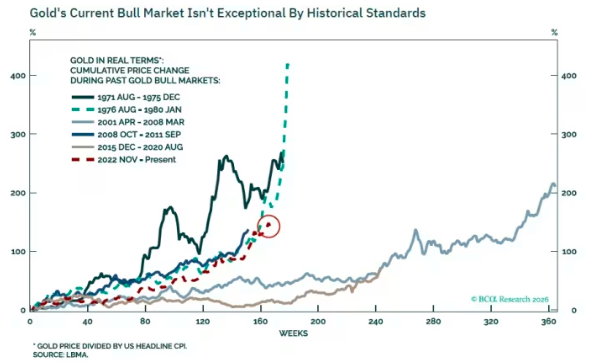
Ibrahim added that the current bull market "is not an anomaly by historical standards." In terms of percentage gains, the current run still trails the legendary bull markets of 1971–1974 and 1976–1980.