
GoAI Market Wrap - 18th Feb

Stock Market
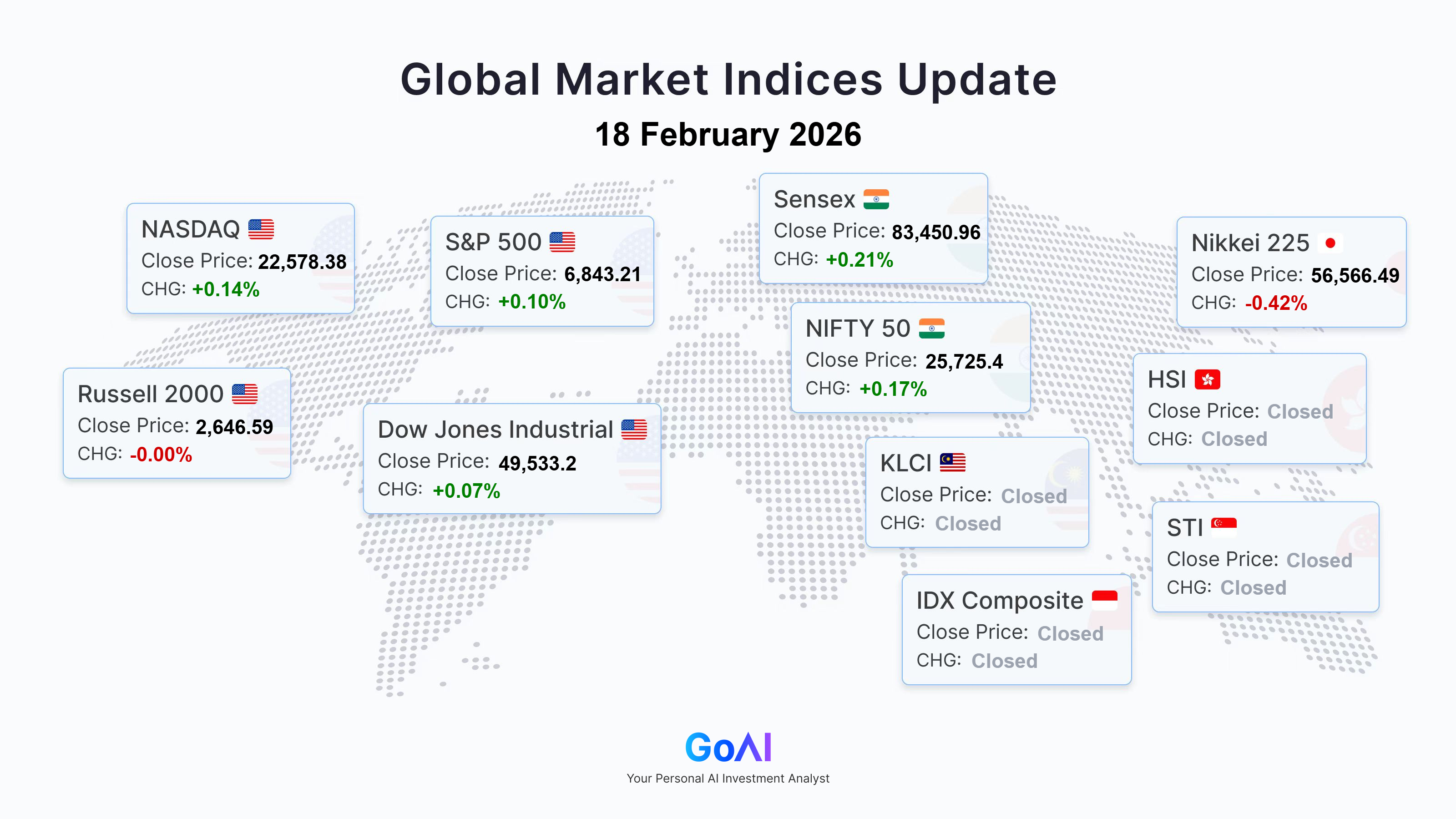
On Tuesday, U.S. equities overcame a lower open to finish the session with modest gains across the major indices.
By the close, the Dow Jones Industrial Average rose 0.07% to 49,533.19, while the S&P 500 and Nasdaq Composite edged up 0.1% and 0.14% to end at 6,843.22 and 22,578.38, respectively.
Performance within the S&P 500 sectors was mixed, with four sectors advancing and seven declining; Real Estate and Financials led the gainers, while Energy and Consumer Staples were the primary laggards.
Early in the day, Brent crude fell approximately 1.8% following comments from Iranian Foreign Minister Abbas Araghchi, who stated that Iran and the U.S. had reached a consensus on guiding principles for negotiations.
Software stocks continued to face heavy pressure, with AppLovin sliding 3.66%, Salesforce dropping 2.86%, and Datadog falling 2.11%. Tech giants Google and Microsoft both shed more than 1%. The iShares Expanded Tech-Software Sector ETF (IGV) fell 2.19%, bringing its year-to-date decline to 23.23%.
The sell-off reflects persistent investor anxiety that AI tools may replace traditional software vendors. During the session, Anthropic released its new Claude Sonnet 4.6 model, which is capable of executing multi-step computer operations and coordinating information across multiple browser tabs.
"We need time to see the earnings performance of these software companies," commented Leah Bennett, Chief Investment Strategy Officer at Concurrent Investment Advisors. "Companies that cannot compete or lack a clear advantage will face significant challenges." Bennett added that this volatility will ultimately help the market distinguish the winners from the losers in the space.
Scott Chronert, U.S. Equity Strategist at Citi, noted that AI-driven disruption is shaking valuation multiples across various sectors, forcing investors to focus on specific idiosyncratic risks. "Currently, the U.S. equity narrative is disconnected from favorable medium-term fundamental trends," Chronert stated.
"Companies will be forced to prove the longevity of their business moats to the market, which is likely to become a dominant theme of this earnings season unless the prospect of a macroeconomic soft landing regains central focus."
Global Markets
Russia-U.S.-Ukraine Trilateral Talks Conclude First Day in Geneva
The first day of the third round of trilateral negotiations between Ukraine, the U.S., and Russia concluded after more than four hours. The Ukrainian President’s Office confirmed that European security advisors also arrived in Geneva to participate.
While advisors from key European nations did not enter the main negotiation room, they remained in constant contact with the participants throughout the session.
U.S. Officials Expect Detailed Iranian Proposal Within Two Weeks
A U.S. official stated on February 17 that Iran has indicated it will present a detailed proposal within the next two weeks to bridge differences in nuclear negotiations.
The official, speaking on condition of anonymity, noted that while some progress has been made, many details remain under discussion to resolve current disparities in their respective positions.
Corporate News
Nvidia and Meta Announce Strategic Partnership for Massive Chip Deployment
Nvidia and Meta Platforms have established a multi-year strategic partnership.
Meta, already Nvidia's second-largest customer, plans to deploy millions of Nvidia chips across its on-premise, cloud, and AI infrastructure. Nvidia highlighted that this marks the first large-scale deployment of its Grace platform, supported by software optimization and joint design investments.
Apple Accelerates Development of Three AI-Driven Wearables
Apple is fast-tracking three new wearable devices as part of its shift toward AI-integrated hardware, competing with rivals like OpenAI and Meta.
Sources indicate that Apple is ramping up R&D for smart glasses, a wearable "pendant" that can be clipped to clothing or worn as a necklace, and AirPods with expanded AI capabilities. All three devices will be built around the Siri digital assistant and utilize cameras to provide visual context for executing commands.
Berkshire Hathaway Trims Apple Stake, Increases Chevron Position
Berkshire Hathaway reduced its holding in Apple by 4.3%, bringing its position down to 227.9 million shares. Simultaneously, the firm increased its stake in Chevron by over 8 million shares, raising its total position to approximately 130.2 million shares.
Strategy Acquires 2,486 Additional Bitcoins
Strategy announced the purchase of 2,486 Bitcoins for approximately $168.4 million at an average price of $67,710. As of February 16, 2026, Strategy holds a total of 717,131 Bitcoins with a total investment of $54.52 billion and an overall average cost basis of $76,027 per coin.
Forex & Commodities
WTI Crude futures settled down 0.84% at $62.22/bbl, while COMEX Gold plummeted 2.98% to $4,896.10/oz.
COMEX Silver also saw a sharp decline, falling 5.66% to $73.55/oz. In the spot market, gold dropped 2.27% to $4,877.40/oz.
Key Events
Spot gold hit a low of $4,842.67/oz during the session
The slump hit gold-related stocks heavily, with Newmont, Barrick Gold, and Wheaton Precious Metals all falling over 3%, while Gold Fields and Harmony Gold dropped 5% and 6%, respectively.
Sentiment was impacted by comments from Iran’s Foreign Minister Araghchi, who suggested that trilateral talks in Geneva have led to a general consensus on a set of guiding principles for a potential agreement.
Cryptocurrency
Bitcoin (BTC) is trading at $67,305.33, down 2.20% in 24 hours;
Ethereum (ETH) is at $1,981.28, down 0.83%.
Major altcoins followed the downward trend, with Solana (SOL) falling 2.26% to $84.98 and XRP down 1.13% to $1.47.
Key Event
MUFG: Bitcoin Remains a Speculative Asset Rather Than Stable Currency
Lee Hardman of MUFG Bank noted in a report that Bitcoin's recent volatility reinforces its status as a speculative asset rather than a stable digital currency.
He highlighted that Bitcoin is rarely used for daily transactions due to slow processing times and high network fees during periods of congestion. Hardman added that extreme volatility prevents goods and services from being priced in Bitcoin, limiting its effectiveness as both a unit of account and a store of value.