
Treasuries and Gold Surge! Markets Confront "Triple Storm": Trump Tariffs, AI Panic, and Iran Tensions

As President Trump’s vow to push forward with a trade war injects fresh uncertainty into global markets, investors flocked to safe-haven assets on Monday, driving both U.S. Treasuries and gold prices sharply higher.
This flight to safety pushed the benchmark 10-year Treasury yield down approximately 5 basis points to 4.03% (yields move inversely to prices), while spot gold surged past the $5,200 mark, hitting its highest level since January 30. Beyond the tariff issue, the momentum was further fueled by a sell-off in U.S. equities triggered by AI disruption fears and mounting concerns over potential U.S. military action against Iran.
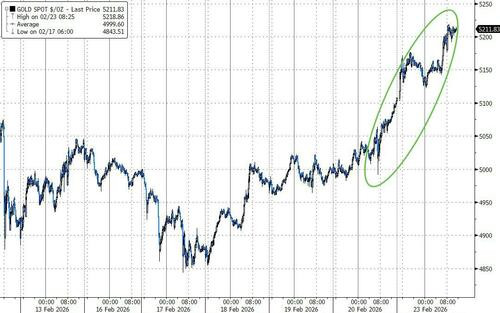
"The increase in trade uncertainty over the past few days has driven risk-aversion in equities and safe-haven buying in Treasuries," said Priya Misra, portfolio manager at J.P. Morgan. "In the face of uncertainty, investors should reduce risk exposure."
Traders are currently weighing the impact of the latest threat of a 15% universal tariff, following the U.S. Supreme Court’s ruling to vacate the broad tariff measures introduced by Trump last April. Last Friday, the Court ruled 6-3 that the tariffs implemented under the International Emergency Economic Powers Act (IEEPA) exceeded presidential authority.
Trump strongly condemned the ruling and subsequently threatened a 15% temporary tariff on all imports—despite existing agreements with numerous trade partners.
Notably, the safe-haven sentiment triggered by new tariffs has, at least temporarily, masked a major anxiety that gripped the Treasury market late last week: the possibility that the government might need to issue more debt to cover revenue losses or refund a portion of the $170 billion in tariffs already collected.
Gennadiy Goldberg, head of U.S. rates strategy at TD Securities, noted that while the market previously fretted over revenue losses and refunds, the fact that refunds may take a long time—coupled with the current increase in tariff revenue—has mitigated some concerns in the fixed-income market.
In contrast, the impact on U.S. stocks has been more direct. Broad selling saw all three major indices close down over 1% on Monday. Risk appetite was battered by multiple factors: persistent fears that emerging AI technology could upend traditional business models and Trump’s volatile trade policy statements—both of which have driven significant market fluctuations in the first year of his second term.
On Monday, a "research report from June 2028" published by Citrini Research and new use cases for Anthropic’s AI products exacerbated fears of AI’s impact on conventional business. The former’s hypothetical scenario of mass white-collar unemployment, software-related loan defaults, and economic contraction by 2028 directly fueled the decline in delivery, payment, and software stocks.
"The questions raised by AI are two-fold: how high will the costs be, and which sectors will be hit?" noted Tom Hainlin, investment strategist at U.S. Bank Wealth Management. "We are seeing a 'sell first, evaluate later' reaction to the headlines. This is a forestalling of what might happen, rather than an acknowledgment of what has happened."
Furthermore, analysts pointed out that Treasuries and gold are being sought after as U.S.-Iran tensions escalate.
With one of the largest U.S. military deployments in the Middle East in recent years, Trump warned last Thursday that "something very bad will happen" if a deal on the long-standing nuclear dispute is not reached. Iran has threatened to strike U.S. bases in the region if attacked.
Amid this geopolitical tension, investors are closely watching Trump’s State of the Union address on Tuesday—a sensitive timing that has further boosted safe-haven demand for U.S. debt. Subadra Rajappa, head of U.S. rates strategy at Société Générale, remarked: "To me, it’s about geopolitics, the uncertainty over Iran, and the sense of the unknown ahead of the State of the Union. Despite relatively strong economic data, uncertainty is rising on multiple fronts."
The 10-year Treasury yield, often called the "anchor of global asset pricing," has now dropped to its lowest level since last Thanksgiving, nearing the 4.00% psychological threshold. In terms of rate expectations, while traders have largely ruled out a rate cut at next month's Fed meeting, U.S. interest rate futures on Monday reflected nearly 60 basis points of easing this year—equivalent to two 25-basis-point cuts—up from the 55 basis points expected last Friday.
Torsten Slok, chief economist at Apollo Global Management, described his forecasts as a "rollercoaster" following the Supreme Court ruling and the subsequent new tariff announcement. He concluded that while the economy remains on solid footing, tariffs will continue to exert upward pressure on U.S. inflation.
"There is certainly more uncertainty now," Slok said. "It’s like a tug-of-war: on one hand, increased bond issuance could push rates up; on the other, the uncertainty caused by high tariff levels creates an opposing pull—slower economic growth leading to weaker demand."
In precious metals, Jeffrey Christian, managing partner at CPM Group, stated: "There are so many economic and political issues globally right now. With the market quiet during the Lunar New Year, we expect gold prices could surge significantly as full trading activity resumes this week."