
Flash Storage Giant Hit by "Short Attack"! SanDisk Shares Plunge Over 8%: Is the NAND Demand Myth Over?

On Tuesday, SanDisk, a recently favored high-flyer in the storage sector, faced a sudden short attack that sent its shares down more than 8% intraday.
Earlier in the day, the renowned short-selling firm Citron Research announced it had established a short position in the chipmaker. Citron detailed its bearish thesis, emphasizing the cyclical pressures inherent in the storage industry. This news hit investors hard, as SanDisk's recent rally was built on the bet that AI-driven demand would allow the NAND industry to decouple from its traditional boom-and-bust cycles.
SanDisk’s stock has soared 175% year-to-date and over 1,200% in the last 12 months.
Citron’s High-Profile Bear Case
Citron’s thesis, posted on X (formerly Twitter), centers on three primary arguments: cyclical market pressure, intensifying competition from Samsung, and the exit of long-term investors.
First, Citron highlighted the recent move by Western Digital, a long-term investor, to sell a significant stake in SanDisk at a 25% discount to current prices as a major warning sign.
"While TV pundits are pounding the table for retail to jump in, Western Digital—the long-term insider—dumped a massive chunk of holdings just days ago at a 25% discount. Why? Because they know the cycle is peaking, and they aren't waiting for the alarm to go off."
Citron then addressed the inescapable cyclicality of the NAND sector, noting that similar patterns played out in 2008, 2012, and 2018.
"The current shortage is a mirage, with capacity now double the 2018 peak. This is a supply-side illusion that could vanish in a single earnings call," the firm noted, suggesting that current constraints are temporary.
The firm argued that while the market is pricing SanDisk like NVIDIA, there is a fundamental difference: "NVIDIA has a moat. SanDisk sells a commodity."
Citron also underscored the threat from Samsung, noting the tech giant's history of prioritizing market share over margins. According to Citron, Samsung typically waits for pure-play flash makers like SanDisk to get comfortable with 50% margins before flooding the market to drive down prices.
Furthermore, Samsung has pivoted its strategy to target the premium SSD market—SanDisk's stronghold—with newer technology. "The only thing causing the current 'tightness' is a temporary yield issue on a different Samsung product line. That bottleneck has an expiration date."
Product Update Disappoints the Market
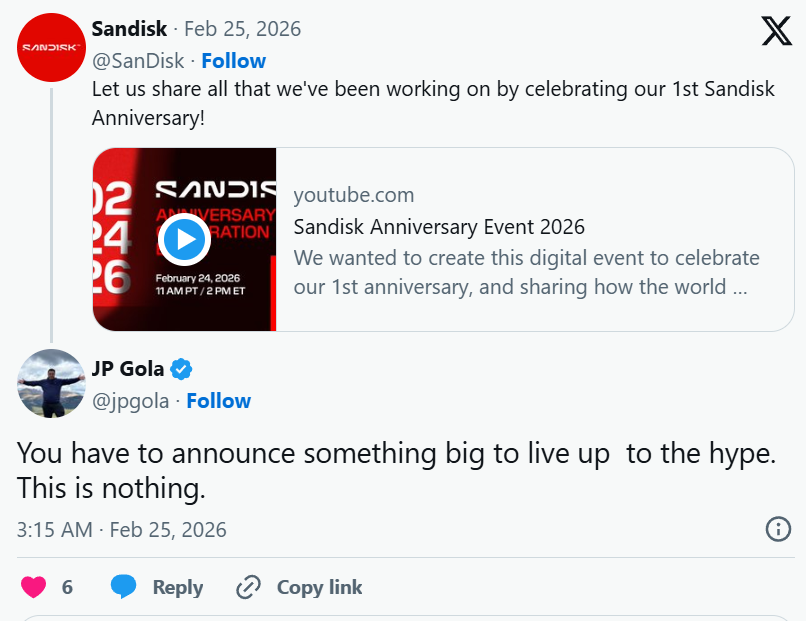
Shortly after Citron's announcement, SanDisk held an online event celebrating its first anniversary as a standalone company following its spin-off from Western Digital. The company unveiled a new lineup of portable SSDs, but the launch failed to impress. X users responded critically to the official post, with one commenting: "We were all counting on a big announcement, and this is it?"
Investors are now looking to SanDisk executives for a rebuttal. Management is scheduled to speak at the Bernstein "Future Trends in Tech" forum on February 25, followed by the Morgan Stanley TMT Conference on March 3.
Can NAND Escape its Cyclical Nature?
The core of Citron’s skepticism lies in the sustainability of the current memory shortage. While analysts at Counterpoint Research and TrendForce have reported massive price hikes of 40% to 50% in late 2025 and predict further increases, the industry has historically struggled with oversupply following such peaks.
SanDisk executives, however, argued during their February earnings call that AI is driving a "sustainable structural shift" that will reduce cyclicality and create higher long-term returns. CEO David Goeckler pointed out that AI-driven demand for data center storage is expected to grow by over 60% by 2026, supporting pricing power well into the future.
This narrative has led many on Wall Street to bet that AI demand and multi-year supply contracts will transform the NAND sector into a stable, high-return industry. Citron’s high-profile attack now threatens to puncture that optimism. Whether the storage industry has truly evolved or is simply repeating old cycles remains to be seen.