
Middle East Escalation Jolts South Korean Markets: Kospi Plunges Nearly 20% in Two Days as Short Selling Surges

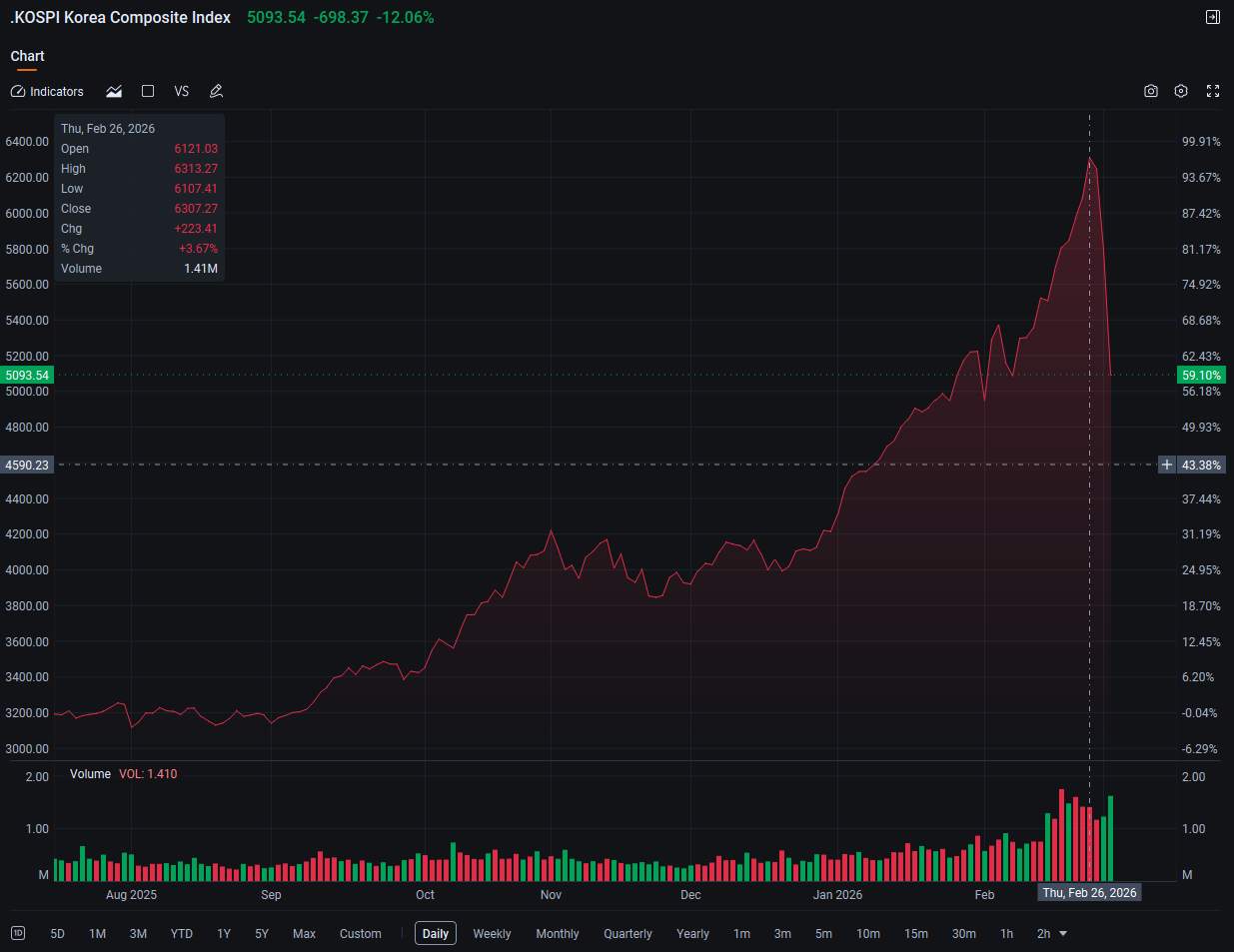
According to the latest data from the Korea Exchange (KRX), short-selling volume in the South Korean stock market reached 2.46 trillion won (approx. $1.66 billion) on Tuesday, March 3—the first trading day following U.S. and Israeli strikes on Iran (the market was closed Monday). This represents an increase of 518 billion won (approx. $350 million) compared to the previous trading session.
As the Middle East situation continues to deteriorate, risk-aversion has intensified. As of press time on Wednesday, March 4, the KOSPI index fell 11.04% to 5,152.48 points, triggering a circuit breaker during the session. Following a decline of more than 7% the previous day, this marks the largest two-day drop since the 2008 global financial crisis.
Short selling is an investment strategy where securities are borrowed and sold in anticipation of buying them back later at a lower price to repay the lender, with the short seller profiting from the decline. Tuesday's short-selling volume showed a marked upward trend compared to the 2025 daily average of 1.9 trillion won.
Volatility Set to Increase
Over the past year, South Korean equities performed strongly, fueled by the AI boom. Earlier this year, the KOSPI index surged nearly 50% at its peak, making it one of the world's best-performing major markets, driven by soaring demand for memory chips that boosted shares of Samsung Electronics and SK Hynix.
However, recent Middle East hostilities have driven up oil prices. As the world’s eighth-largest crude oil consumer, South Korea faces mounting import cost pressures from rising energy prices, prompting investors to re-evaluate risk assets.
Analysts suggest that volatility in the local stock market is expected to increase further, while the Korean won—which recently hit its lowest level since 2009—is expected to decline sharply. These factors have stimulated demand for short-selling. Lee Kyoung-min, an analyst at Daishin Securities, noted: "Given the sharp gains in the KOSPI throughout January and February, the market is currently in a phase where a temporary policy easing is needed to prevent overheating."
An Hyungjin, CEO of Billionfold Asset Management in Seoul, remarked: "Market volatility is so extreme that price movements are almost unpredictable; traditional analysis is struggling to remain relevant. Retail investors have also become hesitant, leading to a significant decrease in buying activity."
Notably, retail investors had previously used significant leverage to purchase stocks. Data shows that margin balances reached record highs before the market correction. With the current collapse in stock prices, these leveraged positions face the risk of margin calls or forced liquidations.
Kim Dojoon, CEO and CIO of Zian Investment Management in Seoul, pointed out that many investors were buying stocks with only 30% to 40% margin; if prices continue to slide, it could trigger a wave of forced liquidations.