
No More 25-Day Buffer: J.P. Morgan Revises Hormuz Impact as Output Cuts Set to Double Within Three Days

While the market is well aware of the catastrophic damage a Strait of Hormuz blockade could inflict on the global economy—effectively halting the demand side as crude fails to reach end-users—the more alarming downstream effect may lie elsewhere:
What happens to the supply side if global oil transit remains paralyzed?
As the Iranian blockade tightens, Middle Eastern producers are facing a frantic countdown. Crude is rapidly filling short-term storage tanks; if the situation persists, producers face the imminent threat of production cuts or total shut-ins. Unlike the demand side—which can restart almost instantly once product arrives—forcing a well to shut down takes weeks to execute and weeks more to recover. This creates a substantial supply-side lag with profound long-term implications.
This shift in focus stems from a report authored earlier this week by Natasha Kaneva, Head of Global Commodities Strategy at J.P. Morgan. As previously reported, J.P. Morgan initially estimated that the oil market had roughly a 25-day buffer before Gulf producers would hit storage limits and be forced to slash output. However, while that estimate reflected an average, it masked a volatile reality: storage capacity varies drastically by country. Some nations have ample facilities, while others are nearly exhausted.
Consequently, J.P. Morgan has revised its forecast based on storage data from the onset of the conflict. The bank now believes that as of Wednesday, crude supplies from Iraq and Kuwait exported via the Strait have buffers of only about two days and 13 days, respectively. Worse, these are considered conservative estimates.
J.P. Morgan’s new calculations are as follows: setting aside the 25-day assumption, supply losses will accelerate rapidly if the blockade continues.
-
Day 8 (3 days from now): Forced shut-ins of approximately 3.3 million bpd;
-
Day 15: Rising to 3.8 million bpd;
-
Day 18: Reaching 4.7 million bpd.
-
These figures apply only to crude oil and exclude refined products.
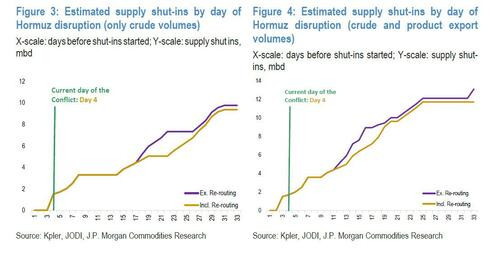
In other words, according to J.P. Morgan’s new storage countdown model, the scale of production shut-ins could double within three days. At that point, the fallout in energy markets becomes almost impossible to predict.
Antoine Halff, co-founder and chief analyst at geospatial firm Kayrros, stated that if producers’ storage tanks reach capacity due to a lack of export routes, they have no choice but to cut production. He added that even in Saudi Arabia, "spare capacity is depleting rapidly" at the Ju'aymah terminal on the East Coast as of March 1.
He revealed that four out of six storage tanks at the Ras Tanura refinery, which halted production following Iranian attacks this week, are already full. "Storage capacity is not fungible," Halff explained. "Certain tanks have higher strategic value due to their proximity to fields or loading facilities. Because the storage system is not fully interconnected, there are massive efficiency gaps across the network."
These estimates align with reports earlier this week indicating that Iraq has already cut approximately 1.5 million bpd of production—including a 700,000 bpd reduction at Rumaila (the world’s second-largest field), 460,000 bpd at West Qurna-2, and 325,000 bpd at Maysan. Meanwhile, shipping through the Strait of Hormuz remains at a virtual standstill.
Time is Running Out
Currently, no crude tankers have been confirmed entering or exiting the Strait except for Iranian vessels, though some ships are suspected of transiting with transponders turned off. For example, an empty Suezmax tanker, the Pola (1-million-barrel capacity), disabled its signal at 2:00 AM local time after entering the Strait.
Analysts point out that while the Trump administration could help restore flows by combining naval escorts with government-backed war-risk insurance—thereby reducing physical and financial risks—transit issues may persist. Speed and decisiveness are paramount, as tightening storage constraints mean delays will rapidly translate into forced well closures.
Meanwhile, oil infrastructure remains a target: the UAE reported a fire at its Fujairah hub—which houses multiple refineries and storage facilities—following the interception of a drone. The fire at Fujairah and potential shut-ins in Iraq have continued to drive oil prices higher this week, with Brent crude now approaching $85 per barrel.
The surrounding waters remain on edge; as reported Thursday, a tanker anchored off the Kuwaiti coast suffered an explosion, leaking crude into the sea. Industry insiders fear that if Iran begins attacking loaded tankers anywhere in the Persian Gulf (not just the Strait), the situation will spiral out of control, accelerating production halts as nations may cease all loadings.
Granted, amid the bearish news, a silver lining remains: there are early signs of Saudi Arabia rerouting crude through its East-West Pipeline to the Red Sea. While this is far from enough to offset the total blockade of the Strait, it offers some relief.
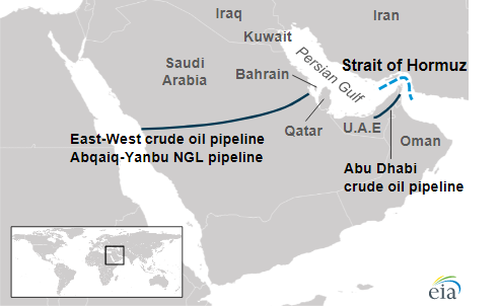
According to Saudi Aramco data, the East-West Pipeline has a design capacity of approximately 7 million bpd. Prior to the conflict, it was operating at less than half capacity, meaning it could potentially release an additional 5 million bpd of throughput to absorb the inventory backlog.