
Global Highlights for This Week: Oil Eyes $100 as Inflation Data Looms—Can Middle East Chaos Shake the Fed’s Rate Path?

Investors will closely monitor the potential spread of the Middle East conflict and its impact on energy supplies during the coming week, while also digesting the latest U.S. inflation data.
Following the U.S. and Israeli strikes on Iran and the subsequent spread of conflict across multiple Middle Eastern nations, global markets are laser-focused on the latest developments. This conflict has become the core variable for financial markets; surging oil prices have triggered significant volatility across asset classes and prompted investors to sharply lower expectations for Federal Reserve rate cuts.
Last week, the S&P 500 fell 2% cumulatively, while Wall Street’s "fear gauge," the VIX, hit a near one-year high on Friday. A weak U.S. non-farm payrolls report added further pressure to equities. Investors are currently weighing two forces: historical precedent suggests markets often rebound after major geopolitical shocks, yet the future trajectory of the situation in Iran remains highly uncertain.
"This is a major event with an extremely uncertain direction," said Rick Meckler, partner at Cherry Lane Investments. "To some extent, it leaves investors reluctant to either sell or buy."
A primary focus remains the surge in energy prices and its impact on inflation and economic output. The conflict has paralyzed shipping in the Strait of Hormuz, a waterway that handles roughly one-fifth of the world’s oil and LNG supply. Brent crude surpassed $90 per barrel on Friday, a massive jump from $70 before the conflict began. Higher oil prices threaten the stock market outlook by translating into higher gasoline costs, which can dampen consumer spending.
"In the short term, oil price trends will be a critical barometer for risk asset performance," said Michael Arone, Chief Investment Strategist at State Street Global Advisors. He added that $100 per barrel represents a psychological threshold that could trigger intensified market panic.
Dominic Pappalardo, Chief Multi-Asset Strategist at Morningstar Wealth, noted that heading into this week, "Middle East developments will truly drive all financial markets."
Inflation data will also be a central focus for Wall Street. The U.S. February CPI is scheduled for release this Wednesday, following January data that unexpectedly came in below market forecasts. The Fed’s preferred inflation gauge, the PCE Price Index, will also be released this Friday.
While mild inflation data might be overlooked—since the reporting period occurred almost entirely before the Middle East conflict erupted—any unexpected spike would present a particularly thorny problem.
"The combination of an unexpected dip in employment and mounting inflationary pressures creates a difficult trade-off for policymakers," said Isaac Stell, Investment Manager at Wealth Club. "Uncertainty continues to dominate the market environment, making it harder for businesses to plan and clouding the outlook for policymakers."
Due to fears that energy prices will drive inflation higher, investors have recently pushed back expectations for the Fed’s next rate cut. However, Friday’s weak employment data partially restored some of those expectations. Currently, markets see a 45% probability of at least a 25-basis-point cut at the Fed's June meeting.
"If energy prices continue to rise and fuel inflation concerns, the difficulty for the Fed to implement two rate cuts in 2026 will increase significantly," Pappalardo added.
On the corporate front, the Q4 earnings season is nearing its end. This week, investors should watch for results from companies including Li Auto, NIO, Kohl's, Futu Holdings, and Oracle.
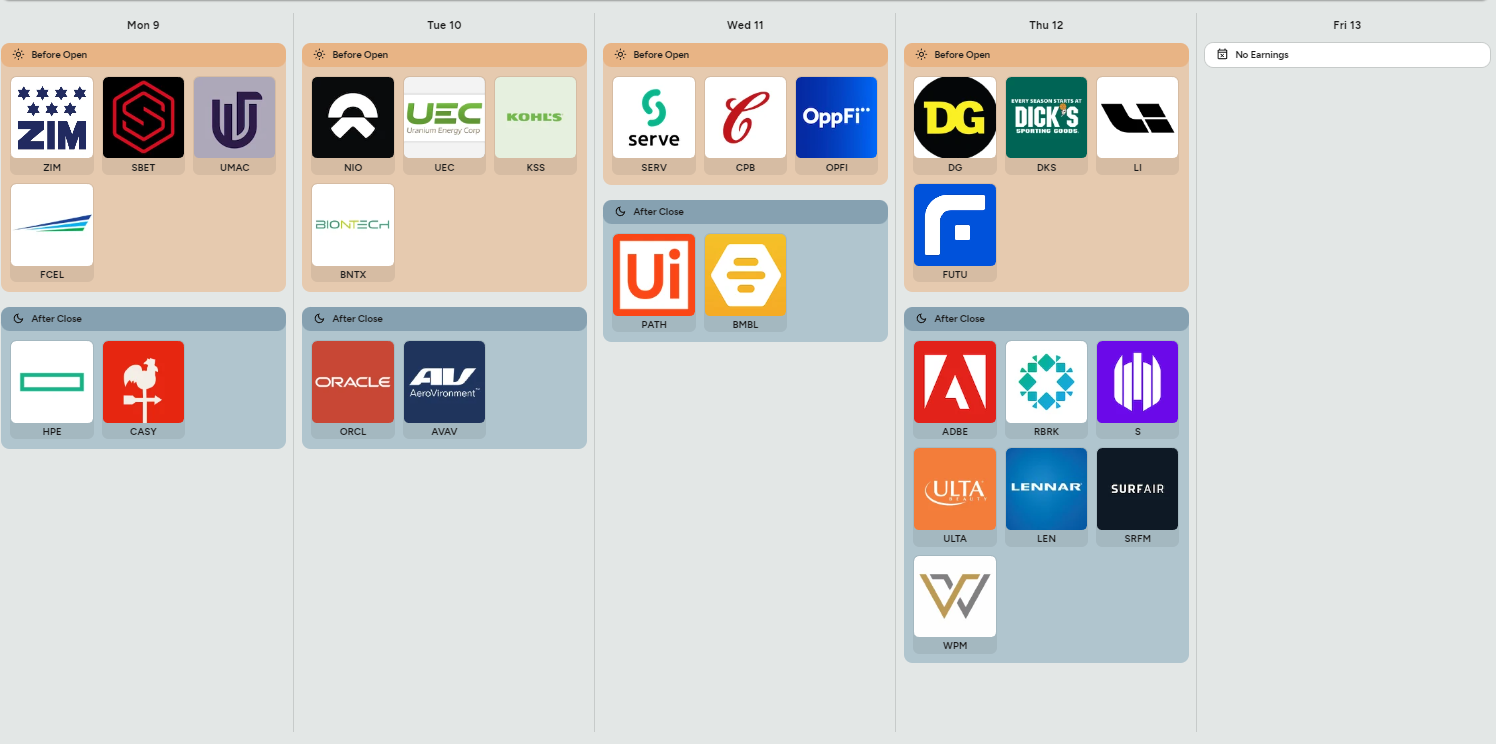
Notably, starting this week, North America begins Daylight Saving Time. Trading hours for U.S. and Canadian financial markets, as well as the release times for economic data, will move forward by one hour compared to standard time.
Key Events for This Week:
Monday (Mar 9): Japan Jan Trade Balance, China Feb CPI (YoY), Eurozone Mar Sentix Investor Confidence, U.S. Feb NY Fed 1-Year Inflation Expectations, New domestic refined oil price adjustment window opens.
Tuesday (Mar 10): Germany Jan Adjusted Trade Balance, U.S. Feb NFIB Small Business Optimism, U.S. Feb Existing Home Sales, China Feb M2 Money Supply (YoY), U.S. Commerce Department hosts Roundtable with American Robot Manufacturers.
Wednesday (Mar 11): U.S. API Crude Oil Stockfalls (w/e Mar 6), U.S. Feb CPI (YoY/MoM), U.S. EIA Crude Oil Inventories (w/e Mar 6), OPEC Monthly Oil Market Report.
Thursday (Mar 12): U.S. 10-Year Treasury Note Auction, U.S. Weekly Initial Jobless Claims (w/e Mar 7), U.S. Jan Trade Balance, U.S. EIA Natural Gas Storage (w/e Mar 6), IEA Monthly Oil Market Report.
Friday (Mar 13): UK Jan 3-Month GDP (MoM), Eurozone Jan Industrial Production (MoM), U.S. Jan Core PCE Price Index (YoY), U.S. Jan Personal Spending (MoM), U.S. Q4 Real GDP (Annualized QoQ Revision), U.S. Jan Durable Goods Orders (MoM), U.S. Jan JOLTs Job Openings, U.S. Mar Michigan Consumer Sentiment (Preliminary).