
The $2 Trillion Private Credit Crisis: A Deep Dive into the Liquidity Trap and Eroding Trust

Behind the fog of war in the Middle East, a long-simmering crisis of confidence in the private credit market is spreading, sending shockwaves through secondary markets.
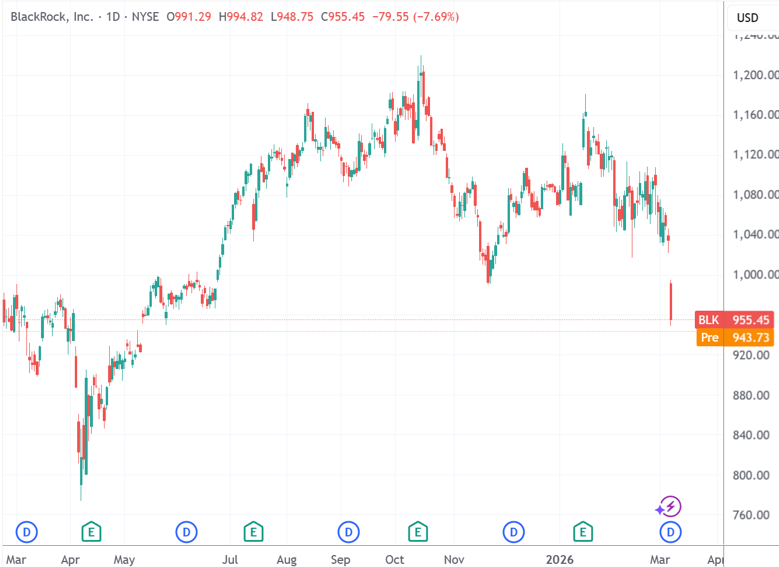
By Monday evening, asset management giant BlackRock extended its losses following a 7% plunge last Friday. Other industry titans—Blackstone, KKR, TPG, and Apollo Global Management—along with Blue Owl Capital, which remains at the "epicenter" of the storm, continue to face severe scrutiny from investors.
The Rise of Shadow Banking
Private credit has evolved into a cornerstone of the shadow banking system. In this model, investors bypass traditional banks to provide direct loans to private companies. These borrowers, often smaller firms with limited access to conventional credit, accept higher interest rates in exchange for capital.
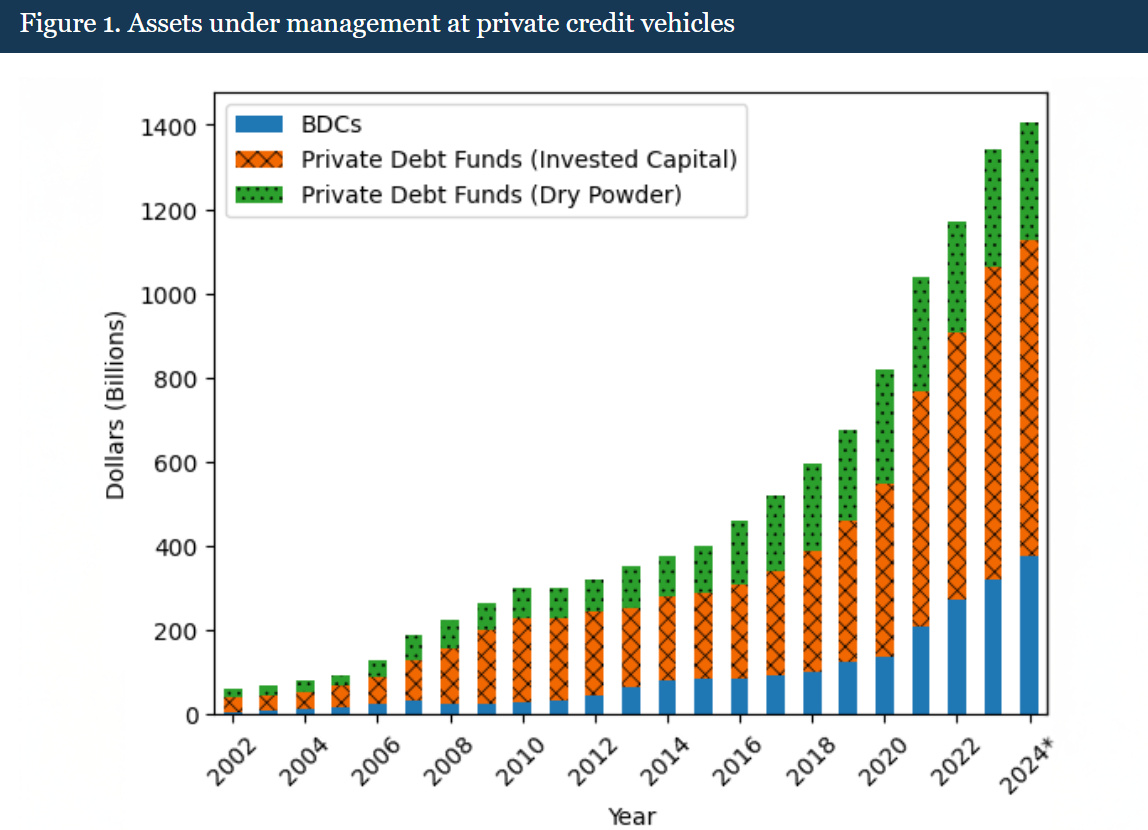
Data from the IMF, BIS, and the Federal Reserve estimate the global private credit market at approximately $2 trillion. In the U.S. alone, this sector has transformed from a niche asset class in the early 2000s into a $1.3 trillion juggernaut. However, over the past six months, the cracks in this foundation have become impossible to ignore.
Fracturing Trust and "The Prisoner’s Dilemma"
The crisis reached a tipping point last September when auto lender Tricolor and manufacturer First Brands collapsed. Creditors soon discovered a pattern of fraud: the same receivables had been pledged multiple times to different lenders. In February, British mortgage firm MFS followed suit, revealing that its £1.16 billion loan book was backed by assets worth a mere £230 million.
The recent rout in global software services—fueled by fears of AI displacement—has further unnerved investors, leading to a surge in redemption requests. Because these assets are inherently illiquid, massive withdrawals may force managers into fire sales during periods of market volatility.
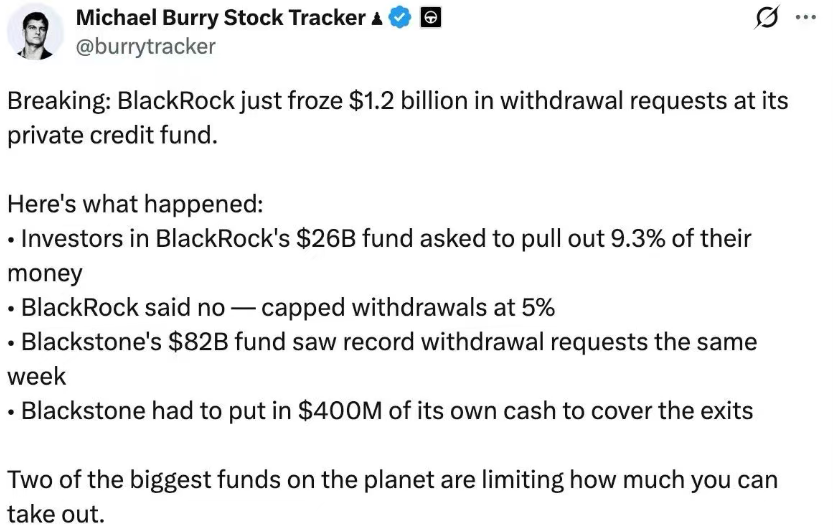
- BlackRock: Last Friday, it capped redemptions at 5% for its $26 billion HPS corporate loan fund after investors sought to pull 9.3% of their capital.
- Blackstone: To meet a 7.9% redemption demand for its flagship BCRED fund, 25 executives personally contributed $150 million in cash, supplemented by $250 million in corporate funds. This move shattered the standard 5% quarterly cap and the unofficial 2% "buffer."
- Blue Owl: A tech-focused fund saw a 15% quarterly redemption rate, while another fund was forced to "gate" (halt all redemptions).
"You cannot create liquidity from an illiquid asset class," warned John Cocke, Deputy CIO of Credit at Corbin Capital. He noted that failing to enforce redemption limits creates a "first-mover advantage" and leaves remaining investors in a Prisoner’s Dilemma.
The Next "2008"?
For some of Wall Street’s most prominent figures, the parallels to the subprime mortgage crisis are striking.
JPMorgan CEO Jamie Dimon famously coined the term "Credit Cockroaches" last year to describe the hidden rot in the sector. He recently reiterated concerns over "bad actors" doing "stupid things." Howard Marks, Co-Founder of Oaktree Capital, echoed this sentiment, suggesting that a decade of rapid expansion has diluted professionalism and masked the severity of emerging fractures.
Ultimately, it is a crisis of transparency. Steve Sosnick, Chief Strategist at Interactive Brokers, noted: "These loans are opaque, and the companies behind them are often equally so. You can imagine a scenario where things are unpleasant but contained—or one where massive errors are being 'papered over' until they can’t be anymore."
Despite the panic, some remain sanguine. Bruce Flatt, CEO of Brookfield, urged the market to "cool down," asserting that this is "absolutely not 2008."
Similarly, John Bringardner of Debtwire pointed out that the current scale of private credit is far smaller than the pre-2008 housing market, though he admitted the "irrational exuberance" of the last five years is eerily familiar.
As Sosnick concludes, citing Ernest Hemingway: "How did you go bankrupt? Two ways. Gradually, then suddenly." Financial crises often follow the same trajectory—slowly accumulating until control is lost in an instant.