
No Longer Pushing for Low Oil? Trump Pulls "180-Degree Pivot": High Oil Prices Making U.S. a Fortune!

Since taking office, President Trump has consistently championed low oil prices, often taking credit for their decline. However, as the U.S.-Iran conflict drives crude significantly higher, Trump has executed a 180-degree turnaround in rhetoric, now portraying high oil prices as a positive development.
This shift in stance comes as the Trump administration struggles to present a clear strategy for reopening the Strait of Hormuz—a critical Middle Eastern chokepoint—leaving vessels laden with oil and natural gas stranded in the Gulf region.
"The U.S. is now the largest producer of oil in the world, so when oil prices go up, we make a fortune," Trump posted Thursday on his social media platform, Truth Social.
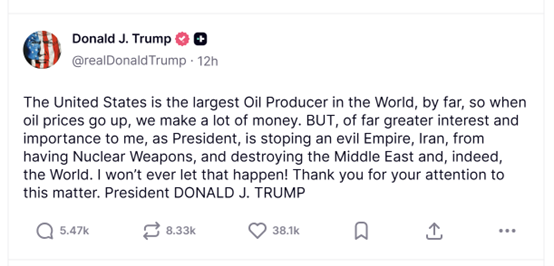
While he did not specify who "we" refers to, major U.S. oil companies are reaping profits from the war-induced price surge, even as ordinary citizens grapple with rising fuel costs at the pump. Trump’s remarks drew criticism from some members of Congress, who accused him of prioritizing the wealthy over average workers.
In his State of the Union address just last month, Trump boasted of gasoline prices at $2.30 per gallon. According to AAA data, gasoline prices have since skyrocketed by over 50%, with the national average reaching $3.60 per gallon. With the U.S. midterm elections approaching in November, sustained high oil prices could weigh heavily on the Republican Party's electoral prospects.
Goldman Sachs stated on Thursday that based on its forecasts and historical precedent, rising oil prices will lead to higher inflation, slower economic growth, and increased unemployment.
Nevertheless, Trump has remained nonchalant about the price spike, repeatedly asserting that oil will plummet once the war concludes. While he initially downplayed the necessity of tapping the Strategic Petroleum Reserve (SPR), he announced on Wednesday that the U.S. would coordinate with other nations to release reserves. The U.S. government subsequently announced a release of 172 million barrels. Analysts note that such a coordinated release is unlikely to slash prices significantly; its primary function is market stabilization.
Since the outbreak of the U.S.-Iran conflict, international oil prices have surged due to the near-total closure of the Strait of Hormuz. Influenced by production cuts from Gulf nations, news regarding the status of the strait, Trump’s wartime timetable, and the multilateral SPR release, international benchmarks have seen extreme volatility. Prices briefly approached $120 per barrel on Monday before retreating to settle near the $100 mark.
Reports indicate the Trump administration is considering a temporary waiver of the century-old Jones Act to ensure energy and agricultural products can be transported freely between U.S. ports. White House Press Secretary Karoline Leavitt stated Thursday that the move aims to address supply disruptions triggered by the situation in Iran.
The Jones Act is the common name for core provisions of the Merchant Marine Act of 1920. It mandates that maritime trade between U.S. ports be conducted on vessels that are built in the U.S., owned by U.S. citizens, and operated by U.S. crews.