
Global Highlights for This Week: Markets Focused on Middle East Conflict; Central Bank Super Week Commences

Investors will seek clear signals in the current week to judge the extent to which the Middle East conflict has disrupted rate cut expectations for the Federal Reserve and other central banks, while bracing for the latest developments in the Iran war that could rattle markets.
Against the backdrop of an escalating Iran war that has triggered a surge in oil prices and a ripple effect across global asset classes, Federal Reserve policymakers will convene this week.
During the two-day meeting, Fed officials will assess the impact of this energy shock on inflation and economic growth. The Fed will also release its latest economic projections. Currently, due to the war, market expectations for rate cuts this year have cooled significantly—a sharp reversal from the optimism that previously fueled bullish sentiment in the equity markets.
"The Fed will be the center of market attention, especially now that the market has significantly dialed back its rate cut expectations," said Angelo Kourkafas, Senior Global Investment Strategist at Edward Jones.
Since the outbreak of the Iran war, U.S. stock indices have trended lower while market volatility has spiked. Investors are closely monitoring the violent swings in oil; U.S. crude prices neared $120 per barrel early last week before retreating to the closely watched $100 level on Friday.
Iran has stated that the world should prepare for oil prices to hit $200. The U.S. bombed Iran's Kharg Island oil export hub on Friday, though it reportedly targeted only military installations. Trump has threatened to destroy the island's oil infrastructure if Iran continues to interfere with vessel passage in the Strait of Hormuz.
Analysts point out that Kharg Island is a critical source of fiscal revenue for the Iranian government and military. If the energy facilities on the island are struck, it would have a massive economic impact. Iranian Foreign Minister Araghchi warned that any attack on Iranian energy facilities would be met with a response, potentially targeting U.S. corporate facilities or companies with U.S. shareholdings in the region.
"The market is moving violently, and traders are reacting instantly to almost any news—positive or negative—regarding the Iran conflict," said Sid Vaidya, Chief Investment Strategist at TD Wealth.
The market widely expects the Fed to keep interest rates unchanged for the second consecutive meeting in the policy statement scheduled for Wednesday (local time). Last year, the Fed lowered rates to support a weakening labor market but paused the easing cycle in January, believing both employment and inflation risks had mitigated.
Investors had previously expected more rate cuts this year, usually seen as a boon for risk assets like stocks. However, as soaring energy prices threaten to push inflation higher, the market has lowered its rate cut expectations. As of Friday, Fed Funds futures pricing suggests the market expects slightly less than one standard 25-basis-point cut by December. In late February, before the war broke out, the market had expected two cuts this year.
At this meeting, the Fed will also release its updated Summary of Economic Projections (SEP), including forecasts for future interest rates, inflation, and the labor market.
"This meeting will likely set the tone for the year's policy direction, particularly regarding how inflationary pressures from rising oil prices are viewed," said Paul Nolte, Market Strategist at Murphy & Sylvest.
For Jerome Powell, this will be his penultimate meeting as Chair, as his term expires in May. The next rate adjustment may not occur until Kevin Warsh, the former Fed Governor nominated by Trump to lead the central bank, officially takes over.
In addition to the Fed, the European Central Bank (ECB), Bank of Japan (BoJ), Bank of Canada (BoC), Reserve Bank of Australia (RBA), and Bank of England (BoE) will all release interest rate decisions. The energy price surge caused by the Middle East war has left central bank policymakers deeply concerned.
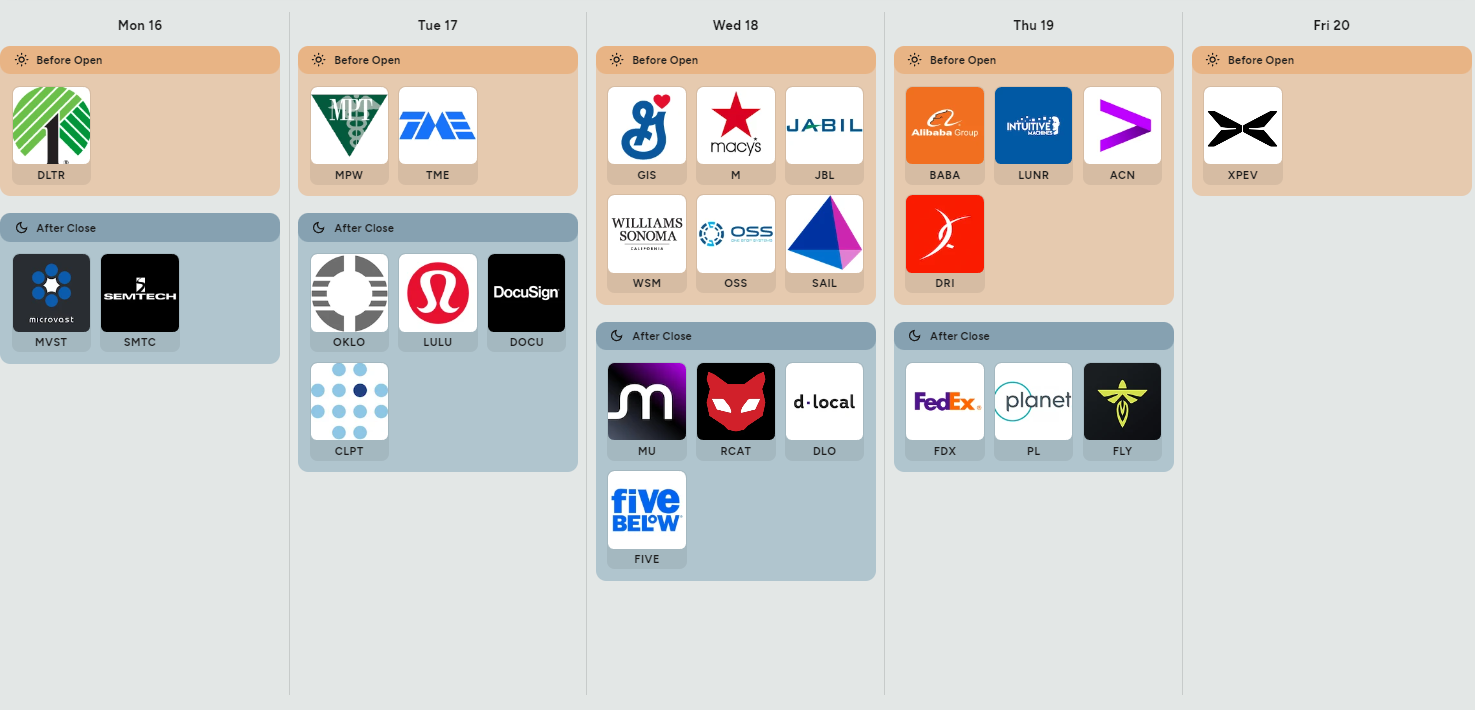
On the earnings front, only a few companies are of note, including Alibaba, XPeng, Micron Technology, FedEx, and Accenture.
From Monday to Thursday, Nvidia will hold its annual GTC conference, which may pull market focus back toward AI-themed trades. Earlier this year, AI concepts triggered significant volatility in tech and other stocks. Nvidia is expected to reveal new details about its AI agent-optimized CPUs, and a pure-CPU rack is likely to be showcased.
Despite this, investors generally expect that geopolitical headlines related to Iran will remain the dominant market factor.
Important Events Overview for the Week:
Monday (March 16): China Retail Sales (Jan-Feb), China Industrial Production (Jan-Feb), Canada CPI (Feb), NY Fed Manufacturing Index (Mar), U.S. Industrial Production (Feb).
Tuesday (March 17): RBA Interest Rate Decision, Eurozone ZEW Economic Sentiment (Mar), U.S. Leading Index (Feb), U.S. Pending Home Sales (Feb).
Wednesday (March 18): API Crude Oil Inventories, Eurozone CPI Final (Feb), U.S. PPI (Feb), Bank of Canada Interest Rate Decision, U.S. Factory Orders (Jan), EIA Crude Oil and SPR Inventories.
Thursday (March 19): Federal Reserve Interest Rate Decision, Fed Chair Powell Press Conference, UK Unemployment Rate (Feb), Swiss National Bank (SNB) Interest Rate Decision, European Central Bank (ECB) Interest Rate Decision, Bank of Japan (BoJ) Interest Rate Decision, BoJ Governor Kazuo Ueda Press Conference.
Friday (March 20): Tokyo Stock Exchange closed, China 1-Year Loan Prime Rate (LPR), Germany PPI (Feb), Russian Central Bank Interest Rate Decision.