
"Memory" Momentum Peaks! Micron's Market Cap Surpasses $500B: What to Expect from Tomorrow's Earnings?

Micron Technology ($MU) is set to release its fiscal second-quarter earnings (ending in late February) after the bell on Wednesday ET. Amid the current surge in global memory chip demand, investors are clearly full of anticipation for this report, and Micron's share price has already hit a record high on the eve of the release.
Investors Hold High Expectations for Micron’s Earnings
Three months ago, Micron’s fiscal Q1 2026 results stunned Wall Street—with both revenue and earnings beating expectations, the report was even hailed as "one of the biggest surprises in U.S. chip history." Three months later, the market remains equally optimistic about the new quarterly report.
According to analyst estimates compiled by Visible Alpha, revenue for the second fiscal quarter is expected to more than double year-over-year to $19.27 billion. Adjusted earnings per share are projected at $8.75, more than a four-fold increase from the $1.56 reported in the same period last year.
Micron’s Market Cap Breaks $500 Billion Ahead of Schedule
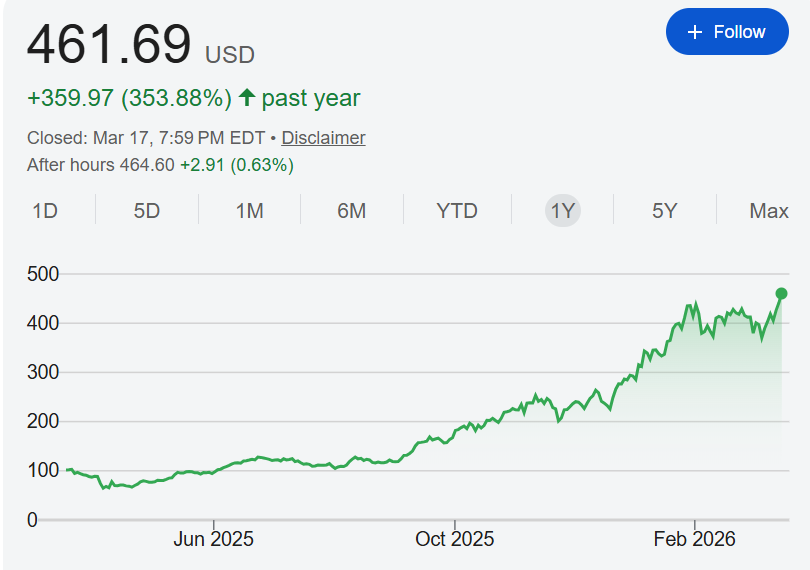
Driven by this fervor, Micron's stock has already hit a new high. On Monday and Tuesday ET, Micron shares surged 3.7% and 4.5% respectively, pushing the company's market capitalization past the $500 billion milestone to an all-time high. This breakthrough is significant: of the 500 constituents in the S&P 500, only 15 companies currently have a market cap exceeding $500 billion.
Options pricing indicates that by the end of this week, Micron's stock could swing 9% in either direction from last Friday's close. This means the price could potentially be pushed to a new high of $466 (a 1% gain from Tuesday's close) or dragged down to approximately $364 (a 21% decline). Following a strong 2025, Micron has become one of the top performers in the S&P 500 this year, with its share price soaring nearly 50% year-to-date and tripling over the past 12 months.
The catalyst is, of course, the robust demand for AI, which has fueled a surge in Micron's revenue; the company has also hiked chip prices amid the "chip famine." Additionally, a direct trigger for this week's rally was Micron’s disclosure after the bell on Monday that it has begun mass production of next-generation HBM chips for Nvidia’s upcoming Vera Rubin AI platform. This move dispelled speculations and concerns that Micron would fail to supply HBM4 products for Nvidia's new chips.
Buoyed by strong chip demand and the positive news from Nvidia, Micron's memory peer, Samsung Electronics, also gapped higher on Wednesday, with gains extending to 6% at one point. Samsung's stock has risen over 11% so far this week, bringing its market cap to over 1,370 trillion KRW (approximately $921.2 billion).
Focus of the Micron Earnings Call
For this latest report, the market's primary focus will be how the company balances capacity expansion with price preservation amid sizzling demand. For a long time, Micron and other chipmakers were reluctant to expand capacity aggressively, fearing that memory demand would eventually slow due to the cyclical nature of the market.
However, an increasing number of market participants now judge that the current memory chip shortage is expected to persist for the foreseeable future. Consequently, Micron and other memory firms have recently committed to expanding DRAM and NAND production scales, a resolve evident in Micron's recent acquisition activities.
On Monday, Micron stated it had completed the previously announced $1.8 billion acquisition of a fabrication plant in Taiwan from Powerchip Semiconductor Manufacturing Corp (PSMC). The company also announced plans to build a second factory at the acquired site. However, Micron noted that the new Taiwan facility is not expected to provide "meaningful" shipment support to existing production lines until fiscal year 2028.
Kevin Cassidy, an analyst at Rosenblatt, judges that the price growth cycle for memory chips will last at least until the fourth quarter of fiscal 2026, as "meaningful wafer capacity increments" will not appear until at least mid-next year. Earlier this month, UBS analysts raised Micron’s price target from $450 to $475, citing strong product demand and improved profitability due to rising prices.
UBS analyst Srini Pajjuri stated in a report that the memory chip shortage is expected to last until 2027 and potentially extend into 2028, which will support Micron’s strong pricing performance. He also predicted that any potential demand contraction in the PC and smartphone markets in the future "will be largely offset by demand from AI and data centers." Currently, global data centers already contribute more than half of the DRAM market revenue, and he expects demand for HBM and DDR memory to continue growing throughout 2027.