
S&P 500 Haunted by "Thursday Slump" as Wall Street Warns Mid-Week Rallies are Unsustainable

The Middle East conflict has entered its fifth week, and with it, five weeks of chaotic global market trading. Wall Street analysts have noted a predictable pattern in U.S. equities during this period: a strong start to the week, sideways movement mid-week, followed by a sharp sell-off on Thursdays and Fridays.
While European and emerging markets have exhibited similar trends, the cyclicality of the S&P 500 has been particularly pronounced. Since the outbreak of the U.S.-Iran conflict, the index has posted cumulative gains during the first three days of each trading week, only to retreat sharply on Thursday and Friday. Over the past five weeks, the cumulative decline for those final two days has reached 9%.
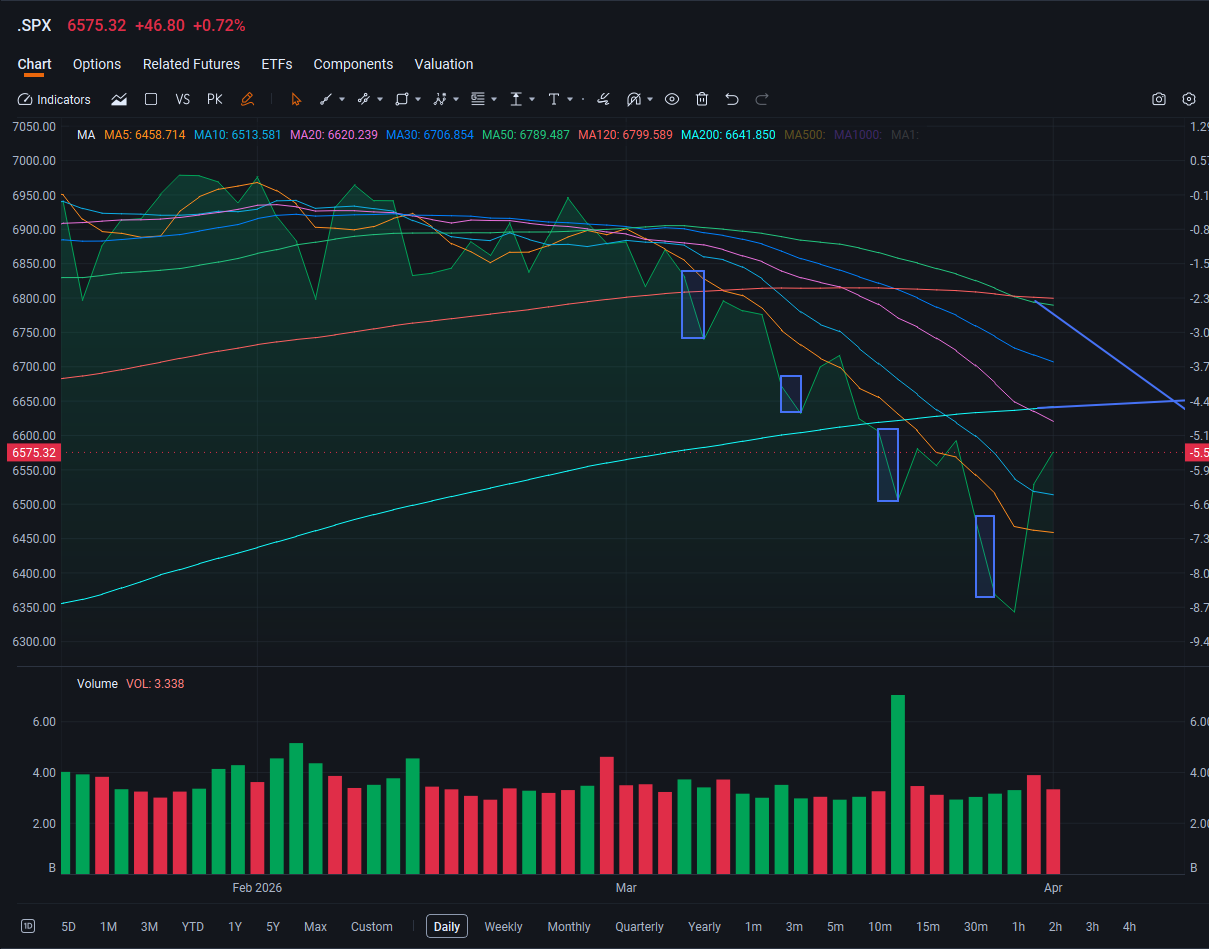
Given President Trump’s tendency to announce pivotal policies over the weekend when markets are closed, many investors are opting to trim their equity holdings ahead of time. Joe Gilbert, Portfolio Manager at Integrity Asset Management, told the media that entering a weekend with unknown risks is "unsettling," noting that reducing risk exposure is currently more important than maintaining positions.
Steve Sosnick, Chief Strategist at Interactive Brokers, observed that early-week optimism is typically replaced by risk aversion as the week progresses. He believes this downward trend will persist until the economy returns to a state of normalcy.
Misplaced Optimism
This week presents a unique case. U.S. markets are closed this Friday for Easter, meaning investors face a three-day non-trading window. Over the past two weeks, Trump’s repeated signals of a willingness to negotiate with Iran significantly boosted market sentiment, driving the S&P 500 up by more than 3% in the first three days of the week.
However, the mood soured Wednesday evening after Trump pledged in a televised address to continue strikes against Iran in the coming weeks. The news caused S&P 500 futures to drop 1% in after-hours trading while oil prices surged, suggesting a likely downturn for U.S. stocks on Thursday.
Benjamin Picton, an analyst at Rabobank, pointed out that the optimism seen in the past 24 hours was likely misplaced. He suggested that Trump’s subtext is that NATO and Gulf nations must participate in the conflict to reopen the Strait of Hormuz, or else face the global economic consequences of a U.S. withdrawal.
Asian markets have already felt the shift. On Thursday, the Nikkei 225 closed down 2.38%, while the South Korean Kospi tumbled 4.47%. Meanwhile, spot gold prices plunged, falling from Wednesday's close of $4,783 per ounce to below $4,600.
Rich Privorotsky, head of Delta-One at Goldman Sachs, previously warned in a report that sentiment and positioning in global equity markets have reached extreme bearishness. While technical conditions for a short-term recovery exist, he argued that the macro and earnings logic remain insufficient to support a confident "long" stance.