
NFP Preview: First Post-War Jobs Report Due Tonight—Will the Fed Lean Toward Cuts or Hikes?

The U.S. Bureau of Labor Statistics (BLS) is set to release March non-farm payroll (NFP) data. As the first U.S. employment report to capture the impact of the Middle East hostilities, investors will undoubtedly scrutinize the granular details of the report to assess the Federal Reserve’s specific interest rate trajectory for later this year.
It is worth noting that the U.S. stock market will be closed tonight for the Good Friday holiday; therefore, the broader impact of the NFP release may not fully manifest until next Monday. However, foreign exchange and bond markets will remain in normal trading sessions tonight during the data release. In a low-liquidity holiday environment, currency and bond traders may need to be particularly wary of amplified market volatility.
What are Market Expectations for Tonight’s NFP?
According to economists surveyed by media outlets, U.S. non-farm payrolls are expected to increase by 60,000 in March, reversing February's unexpected decline of 95,000 positions caused by massive healthcare worker strikes.
If the data aligns with expectations, this monthly increase will be roughly on par with March of last year and may be sufficient to reach the current "breakeven point" for the U.S. labor market—the number of jobs required to maintain a stable unemployment rate amid a sharp decline in immigration.
Currently, Wall Street institutions remain deeply divided over tonight’s data—the most optimistic forecast predicts a gain of 150,000, while the most pessimistic expects a decrease of 15,000, marking a second consecutive month of "negative NFP."
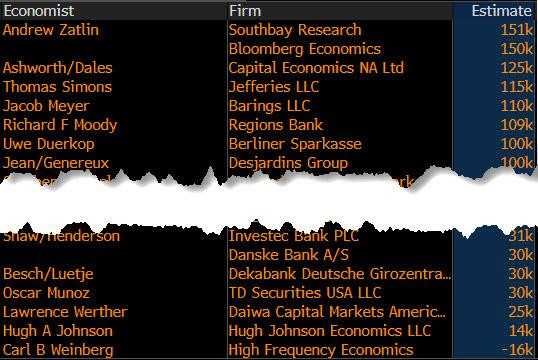
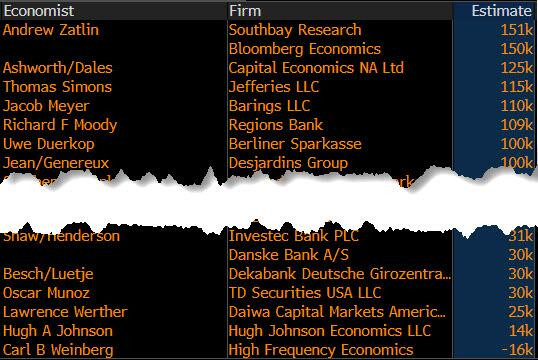
Regarding the unemployment rate, economists expect the U.S. jobless rate to hold steady at 4.4% in March. Although by historical standards, a "mid-single-digit" growth figure would appear quite weak, such a number today might already be enough to keep the unemployment rate stable and could even be considered a decent performance.
Guy Berger, Chief Economist at Homebase, which provides labor management services for small businesses, stated: "We must recalibrate our understanding of what constitutes good or bad employment data."
Fed Chair Jerome Powell noted during the press conference following last month’s FOMC resolution that the breakeven point for U.S. job growth is currently low; previously, the Fed cited a figure of about 50,000, but he hinted it could now be as low as zero, which is plausible in the context of a collapse in undocumented immigration (affecting both the number of employed individuals in the numerator and the labor force size in the denominator).
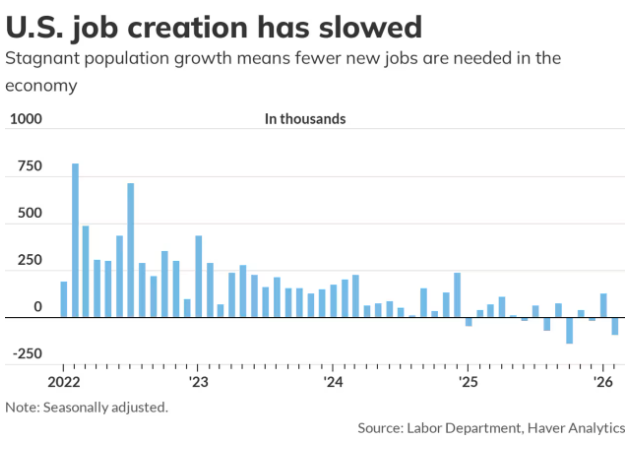
It should be pointed out that the volatility of U.S. NFP reports over the past two months has been extreme—January saw an addition of 126,000 (significantly stronger than expected), while February recorded an unexpected loss of 92,000. Therefore, how the data for the previous two months is revised in tonight’s report will also be a major point of interest for market participants.
Was the Abnormal Slump in February Distorted?
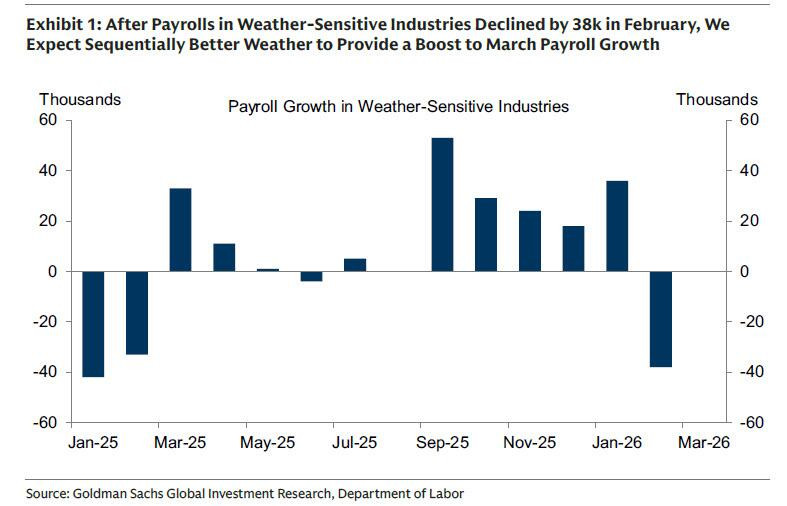
Overall, industry insiders generally believe that the February data showing a loss of 92,000 jobs was indeed poor—but there may be certain distortions behind it: approximately 30,000 Kaiser Permanente and Starbucks workers were on strike at the time and were not counted in the labor force, while severe winter weather heavily impacted construction as well as the leisure and hospitality sectors.
Excluding these two effects, underlying job creation was actually closer to a loss of 30,000 to 40,000. While still weak, it would not be as exaggerated.
In looking forward to the March NFP, many investment banks now expect that many of the aforementioned adverse factors in the February data will be mitigated, potentially even boosting the March figures to some extent. Analysts at TD Securities pointed out that they expect a modest increase of 30,000 in March non-farm payrolls.
"The reversal of weather and strike impacts should lead to a employment composition similar to late 2025, with the healthcare industry providing significant support this month. We also expect the unemployment rate to remain at 4.4%, although upside risks exist. Average hourly earnings may grow modestly by 0.2% month-over-month, equivalent to a 3.6% year-over-year increase," TD added.
Automatic Data Processing (ADP) reported earlier this week that private-sector employment increased by 62,000 in March. Nela Richardson, Chief Economist at ADP, noted in the report evaluation that overall hiring remains stable, with job growth shifting toward certain sectors, including healthcare (which saw a sharp decline in February).
Goldman Sachs estimates that March NFP will be slightly above the market consensus—reaching 70,000.
Goldman’s assessment of favorable factors for NFP includes a 32,000 boost from the end of worker strikes; a seasonal recovery following the drag from severe weather in February; and a decline in average initial jobless claims to 211,000 in March, down from 220,000 in February.
On the negative side, Goldman expects government employment to decrease by 5,000 (a 10,000 decrease in the federal government partially offset by a 5,000 increase at the state and local levels).
Mixed/neutral factors include a varied performance in other indicators measuring job growth in March. The average of employment indicators tracked by Goldman suggests a job growth of 69,000 for March.
Limited Immediate Impact from the Middle East Conflict?
As the first NFP report under the impact of the Middle East conflict, many investors also want to understand the extent to which this war has affected the U.S. workforce. However, industry insiders generally believe it may be too early to judge the impact of the hostilities on the fragile U.S. labor market; at the very least, the March report is unlikely to show much of a shock.
Nancy Vanden Houten, Lead Economist at Oxford Economics, stated in a release on Thursday: "The war between the U.S./Israel and Iran has made the labor market more fragile, but any impact will take time to manifest. The latest jobless claims confirm this, as these data suggest stable labor market conditions."
Goldman Sachs is currently the only institution to explicitly model the impact of the oil shock on the labor market—the firm estimates that by the end of the year, U.S. employment will be dragged down by about 10,000 people per month on average, primarily concentrated in the leisure, hospitality, and retail sectors, as energy costs erode real household income.
However, Goldman pointed out that the key lies in the fact that the transmission of conflict impacts usually lags by 4 to 8 weeks. Hiring during the March NFP survey week primarily reflected sentiment from late February to early March—therefore, the March data may look acceptable, while the real damage will manifest in April and May.
Of course, given that this Middle East conflict has already caused market expectations for the Fed's interest rate path to swing between hikes and cuts, the quality of tonight’s NFP data will likely still influence the lean of the Fed’s interest rate scales.
From the perspective of interest rate pricing, before the outbreak of the U.S.-Iran conflict on February 28, Overnight Index Swaps (OIS) had priced in more than two rate cuts (25 basis points each) for the Fed this year. Subsequently, these expectations were erased due to inflation concerns, and traders began pricing in the possibility that the Fed's next move would be a rate hike. Recently, however, the market has started pricing back in the possibility that the Fed may be closer to a cut.
Tom di Galoma, Managing Director at Mischler Financial Group, stated, "There is a strong possibility that this NFP data will be stronger than the bond market expects, as risk-aversion and position squaring occurred throughout the week ahead of the four-day Easter break in the UK and Europe."
The analyst team at Fxstreet pointed out that if NFP shows an unexpectedly strong performance above 70,000, it could prompt the market to re-evaluate the possibility of a Fed rate hike and boost the USD. Conversely, if the data falls below 50,000, especially accompanied by an increase in the unemployment rate, the USD may struggle to outperform other currencies.