
The Death Spiral Has Begun! Markets Face Hidden Risks Amid Surface Strength

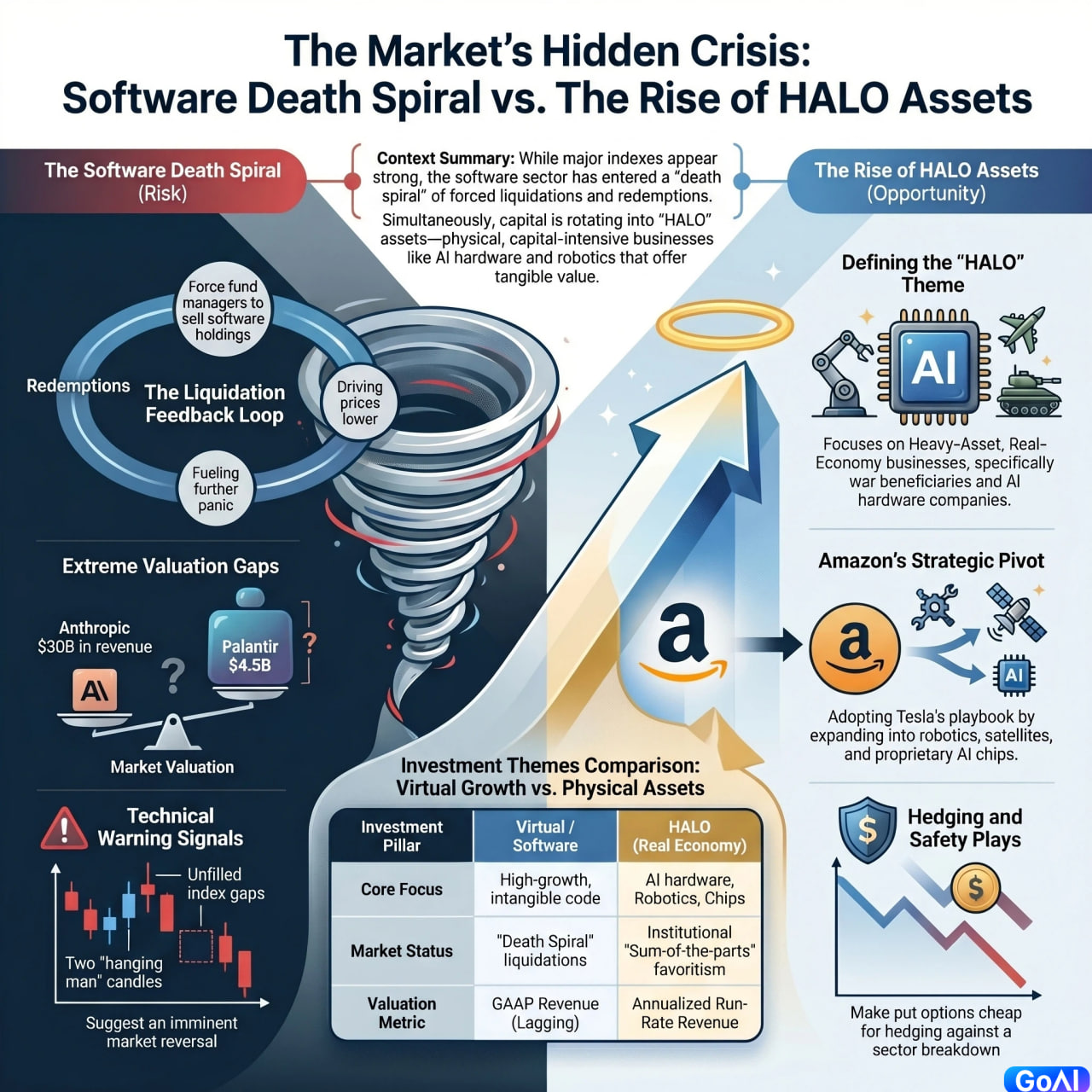
While major averages continue to grind higher, the market’s surface-level resilience masks a deepening structural rot.
Yesterday’s acceleration in the software sell-off was no outlier; it was a textbook "liquidity cascade" driven by a confluence of redemptions and shifting industrial fundamentals.
We have repeatedly urged caution in this sector, and the early warning signs have now matured into a full-scale rout.
The catalyst for this latest leg down was a 15.4% redemption hit at a high-profile private credit fund. With these funds heavily concentrated in software, the resulting forced liquidation created a "sell-at-any-price" environment.
Compounding this technical pressure is the fundamental threat from OpenAI’s new safety suite, which is aggressively cannibalizing the moats long held by traditional SaaS providers.
The result is a decisive shift in Wall Street’s "North Star."
Capital is fleeing "virtual" high-growth software in favor of HALO assets (Heavy-Asset, Real-Economy).
The 2026 investment playbook has narrowed to two pillars: defense-linked beneficiaries and AI hardware.
Amazon’s (AMZN) resurgence is the clearest barometer of this trend. CEO Andy Jassy’s annual letter effectively repositioned the company as a "HALO" powerhouse by mirroring the Tesla strategic playbook.
From autonomous driving and robotics to the satellite ambitions of Project Kuiper, Amazon is decoupling from the pure-play cloud narrative.

Should SpaceX move forward with a widely anticipated IPO, the transparency of that valuation will force a massive "Sum-of-the-Parts" (SOTP) re-rating for Amazon’s own aerospace and hardware units.
Conversely, Palantir (PLTR) is facing a "reckoning of the narratives."
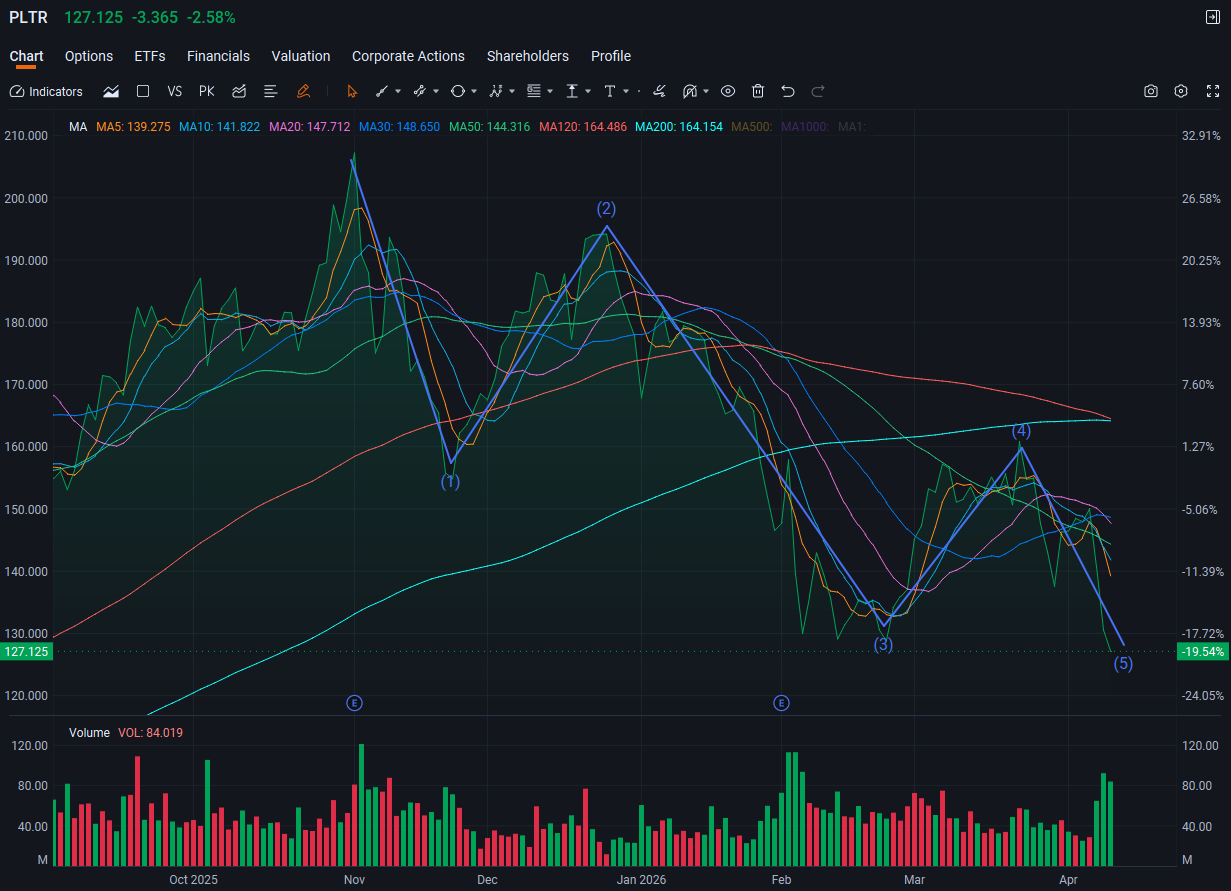
The bear case reaffirmed by Michael Burry highlights a devastating growth disparity: Anthropic reportedly scaled to $30 billion in annualized revenue in a matter of months—capturing an estimated 73% of new enterprise AI spend—while Palantir has spent 20 years reaching the $5 billion mark.
In a market that has pivoted from "potential" to "payback," Palantir’s valuation looks increasingly untethered from reality.
The software sector is now trapped in a self-reinforcing death spiral.
Fund managers are caught in a loop where price declines trigger redemptions, which in turn force more liquidations. We are approaching a potential "Archegos moment"—a single-day, 15% across-the-board capitulation that would flush out the remaining weak hands.
For the patient investor, this washout will eventually present high-conviction bottom-fishing opportunities, but for now, Microsoft (MSFT) remains the only safe harbor for tech exposure.
Technically, the "bull defense" is reaching its limit. Major indexes have printed back-to-back "hanging man" candles, a classic signal of trend exhaustion.
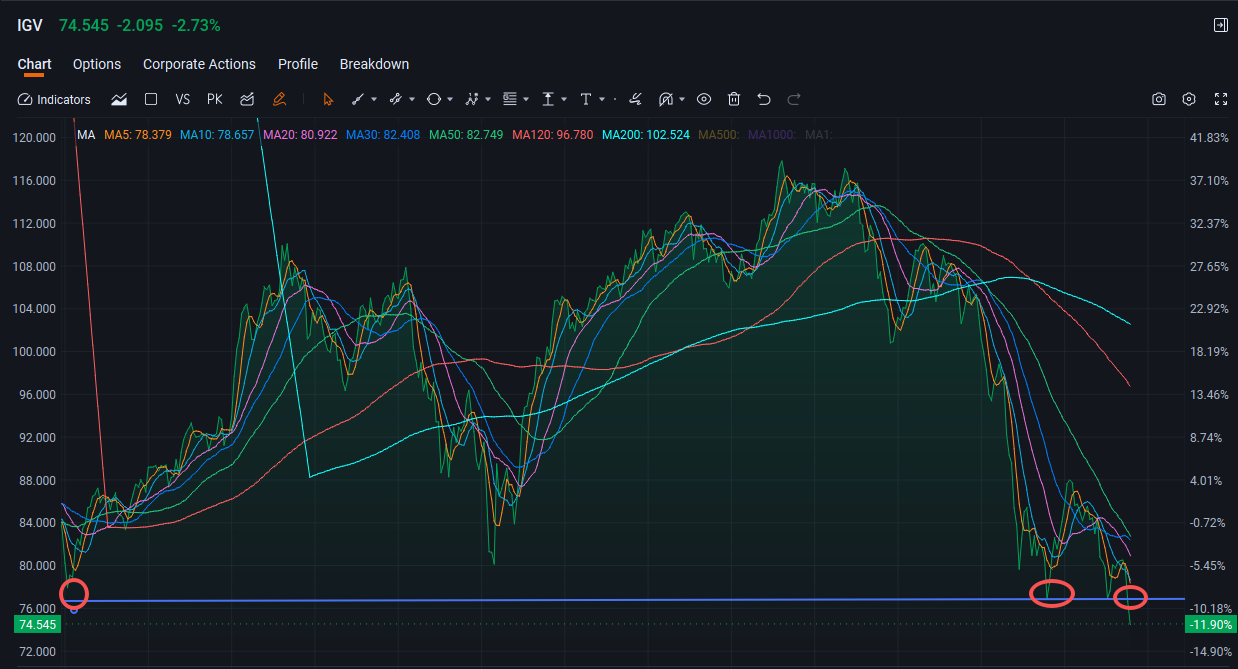
Yesterday, the bulls managed to save the IGV software ETF from a technical breakdown only by aggressively bidding up Microsoft and Google—a strategy of "patchwork support" that rarely holds for long.
With the VIX dipping below 20, the cost of protection is remarkably cheap.
As we head into next week’s earnings season and the high-stakes U.S.-Iran negotiations led by JD Vance, hedging with puts is no longer just prudent—it is essential.
The market is holding its breath for a catalyst, but beneath the surface, the rot is already well underway.