
Wall Street Rundown: Failed U.S.-Iran Talks May Trigger Risk Market Meltdown

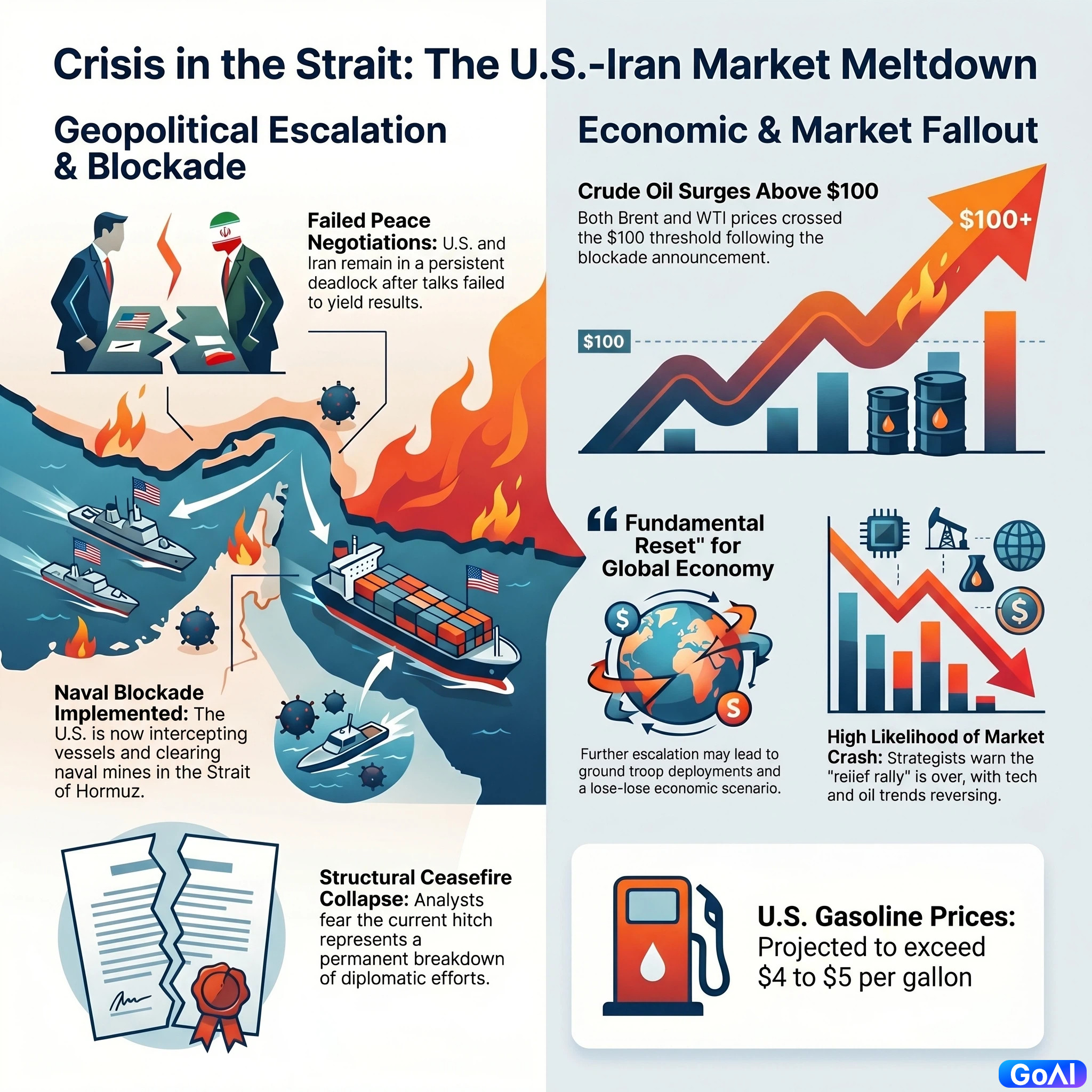
Peace negotiations between the U.S. and Iran have failed to yield results, leaving the two nations in a persistent deadlock. Over the weekend, President Trump announced a naval blockade of the Strait of Hormuz to intercept and inspect all vessels paying transit fees to Iran.
The mandate includes clearing Iranian naval mines in international waters, an escalation poised to further disrupt global energy supplies. On Monday, Brent and WTI crude prices both surged back above the $100 per barrel threshold.
Iranian Parliament Speaker Qalibaf posted on social media that the blockade would send U.S. gas prices soaring. He suggested that American consumers would soon "long for the days of $4 to $5 gasoline."
Wall Street appeared to have anticipated this outcome. Marko Kolanovic, former JPM strategist, noted he always viewed a peace deal as unrealistic despite the market's previous optimism.
Kolanovic warned that while deal hopes previously drove oil down 15% and tech up 25%, a market crash is now "highly likely." Capital.com analyst Kyle Rodda added that the key is whether markets see this as a temporary hitch or a structural collapse of the ceasefire.
This distinction will determine whether the current flight to safety fades quickly or spreads as a contagion. Saxo Bank’s Charu Chanana stated the relief rally is likely over, with oil potentially hitting new highs as risk sentiment takes a hit.
Chanana added that while the Strait is not fully closed, the associated risks are rising relentlessly. GasBuddy’s Patrick De Haan concurred, noting that without a deal, the Strait will likely remain under Iranian control.
He warned that prices for crude, gasoline, diesel, and jet fuel will continue to climb as long as the closure remains a threat. Don Johnson of Macro Edge Advisory Group issued a final, more dire warning.
Johnson suggested further escalation could imply ground troop deployments and a worsening situation in the Red Sea. He concluded this would be a "lose-lose" scenario—or a "fundamental reset" for the global economy.