
FAO Warning: U.S.-Iran Standoff Threatens Global Food Security Crisis

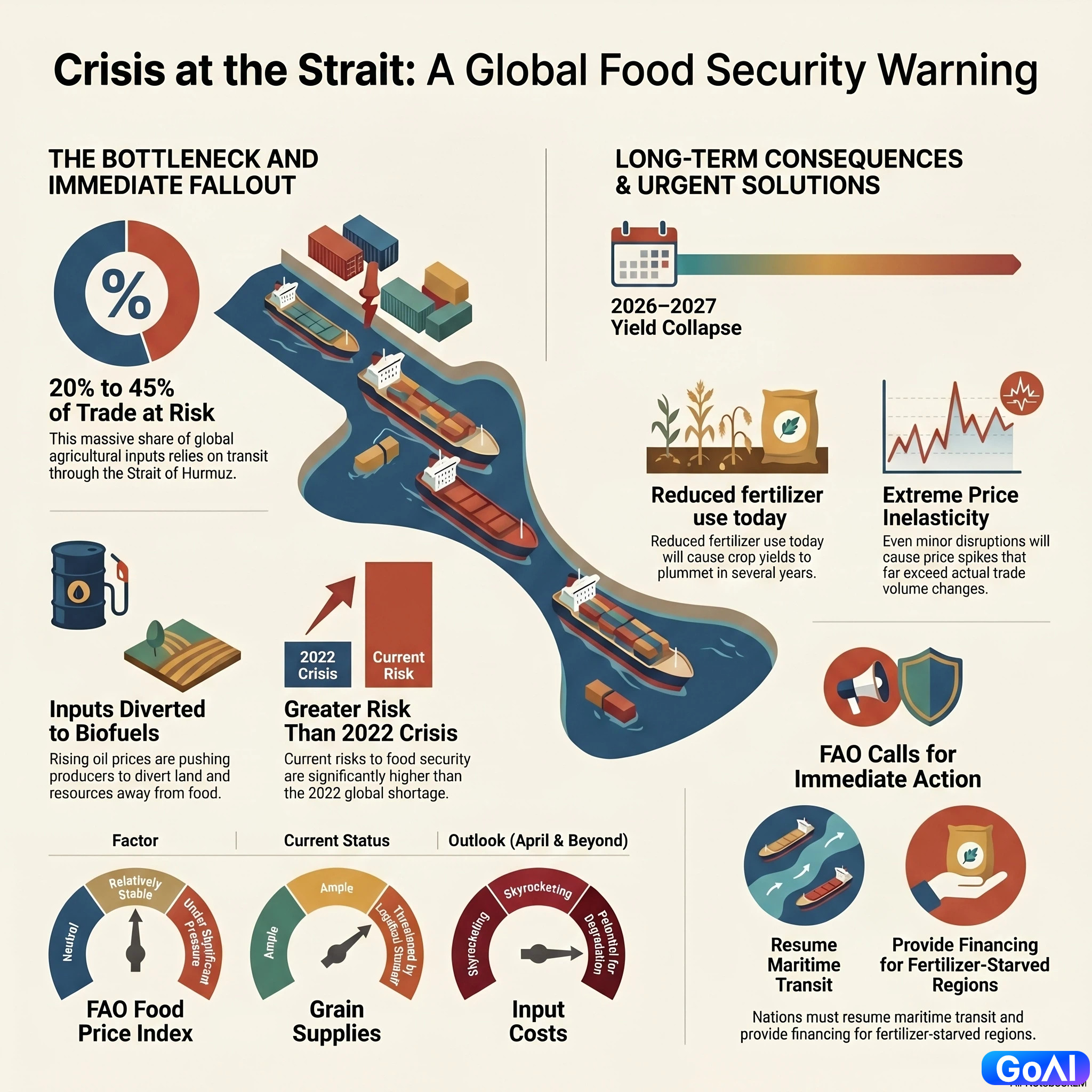
The Food and Agriculture Organization (FAO) of the United Nations has issued a stark warning: maritime transit for critical agricultural supplies through the Strait of Hormuz must resume immediately. Failure to do so risks a dangerous inflationary spike in global food prices.
FAO Chief Economist Maximo Torero emphasized that time is of the essence. Poor nations are currently facing severe shortages of fertilizers and energy, coupled with skyrocketing costs that align poorly with critical planting schedules.
Torero warned that a decline in crop yields next year would inevitably drive up commodity prices and food inflation. This could force governments to implement price controls, potentially triggering higher interest rates and dragging down global economic growth.
While the FAO Food Price Index for March remained relatively stable due to ample grain supplies, the outlook for April and beyond is under significant pressure. Farmers are already reacting to the current logistical challenges.
Some producers are adjusting planting patterns based on fertilizer availability, while others are diverting land and resources toward biofuels to capitalize on rising oil prices. Both trends threaten to tighten the global food supply.
Approximately 20% to 45% of the trade in critical agricultural inputs relies on maritime transit through the Strait of Hormuz. The ongoing standoff continues to paralyze these essential supply chains.
The FAO is urging nations to refrain from imposing export restrictions on energy and fertilizers. It also advised multilateral institutions to provide financing for countries whose planting seasons have begun without secured fertilizer supplies.
If farmers are forced to operate with fewer inputs, crop yields for late 2026 and 2027 will likely plummet. This would drive up food commodity prices and retail inflation for years to come.
Due to the extreme price inelasticity of fertilizer and energy markets, price increases may far exceed what actual changes in trade volume would suggest. The market is highly sensitive to even minor disruptions.
Most farmers operate on razor-thin margins. A wave of widespread bankruptcies could lead to a permanent degradation of the global food supply chain that may be impossible to repair.
The FAO noted that current risks are significantly higher than those seen during the 2022 food shortage crisis. Without a swift restoration of transit, the world faces a systemic global food supply catastrophe.