
Emerging Market Debt Sales Bounce Back as Investors Shake Off Middle East Tensions

Emerging market bond issuance is rebounding sharply from last month’s slump, with issuers from Brazil to Turkey tapping a market rally to raise fresh capital.
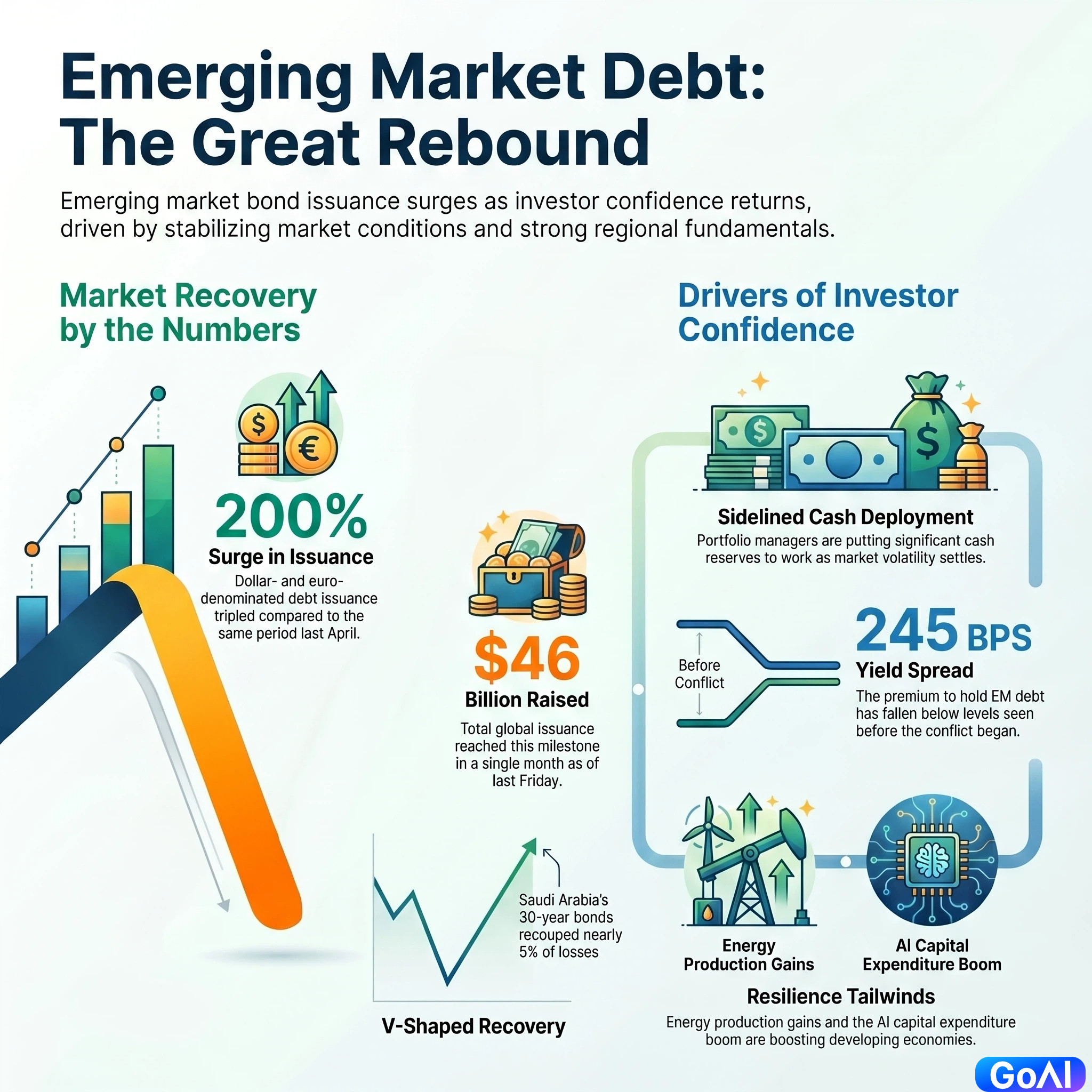
As of last Friday, global issuance for the month reached $46 billion. Dollar- and euro-denominated debt from developing nations has surged approximately 200% compared to the same period last April, marking a significant recovery from the previous month.
Sovereign debt prices across the Gulf have also rallied. Saudi Arabia’s 30-year bonds, which plunged nearly 7% following the flare-up in U.S.-Iran tensions, have since recouped nearly 5% of those losses.
Amol Shitole, head of fixed income at Dubai-based Mashreq, noted that improving credit conditions in the region have helped MENA (Middle East and North Africa) bonds claw back gains from their March lows.
Laura Reardon, a portfolio manager at MFS Investment Management, observed that deals previously shelved due to the conflict are now hitting the market. "As markets have stabilized recently, investors find themselves with cash ready to deploy," she said.
A Boom in Bonds
Reardon highlighted the resilience emerging economies have demonstrated in recent years, recovering swiftly from crises ranging from the pandemic to the Russia-Ukraine conflict.
While surging oil prices hit many nations hard, energy producers across Africa and Latin America have benefited. Additionally, the capital expenditure boom in Artificial Intelligence is increasingly viewed as a tailwind for the developing world.
The average yield spread—the premium investors demand to hold EM sovereign dollar bonds over U.S. Treasuries—has retraced to approximately 245 basis points, falling below levels seen before the conflict began.
Mohieddine Kronfol, Chief Investment Officer of Global Sukuk and MENA Fixed Income at Franklin Templeton in Dubai, suggested the market’s optimism may be outpacing reality. Investors appear to be betting on a swift resolution to the conflict with no long-term fallout.
Shitole further noted that MENA bonds have staged a "V-shaped recovery," moving in lockstep with other global risk assets.
Carmen Altenkirch, an EM sovereign analyst at Aviva Investors, argued that current spreads make sovereign issuance sensible. "Sovereigns typically wait for windows of relative calm to issue, particularly frequent borrowers like Turkey," she said.
Kieran Curtis, head of EM local currency debt at abrdn, added that emerging markets aren't alone in their relative indifference to geopolitical noise. "Portfolio managers raised significant cash last month, but actual outflows were very limited," Curtis analyzed. "Investors now need to put that money to work, and issuers are seizing the opportunity."