
Wall Street Veteran Urges Energy Overweight: Oil Prices Won't Retreat Even if Conflict Ends

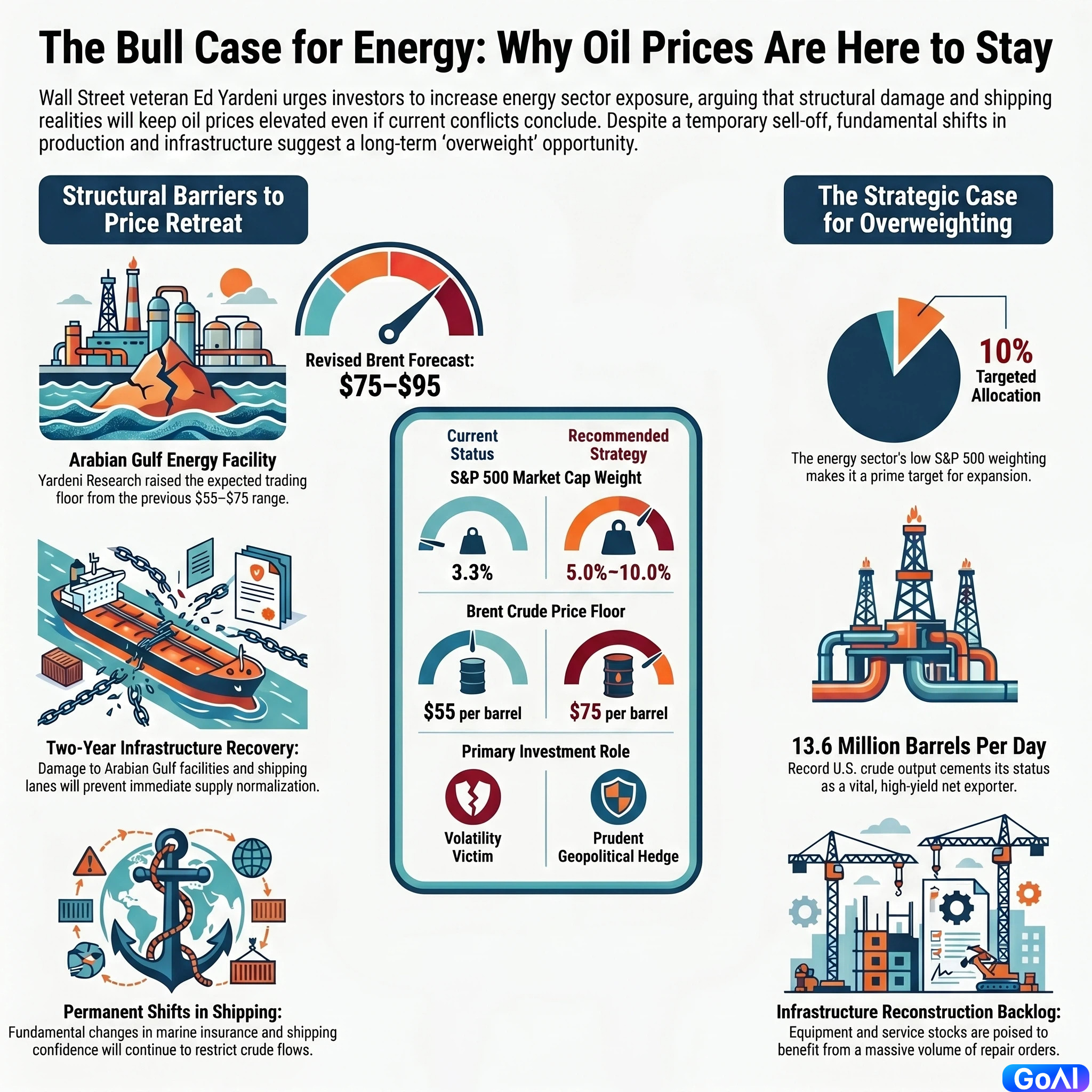
Ed Yardeni, Wall Street veteran and founder of Yardeni Research, is bullish on the S&P 500 energy sector, advising investors to increase their exposure following a sell-off fueled by optimism over a U.S.-Iran ceasefire.
“We are inclined to use the recent sell-off to overweight the sector,” Yardeni wrote in his latest report. Crucially, he maintains that oil prices are unlikely to return to pre-conflict levels even if the war concludes.
Yardeni Research currently expects Brent crude to fluctuate between $75 and $95 per barrel, a significant upward revision from its previous range of $55 to $75.
The call comes as international oil prices retreated sharply following U.S. President Trump’s announcement on Tuesday to extend the two-week ceasefire at the request of Pakistani leadership, pending a unified negotiation proposal from Tehran.
As of publication, Brent futures are hovering near $98 per barrel.
Structural Damage and Shipping Realities
Yardeni points out that physical damage to energy infrastructure around the Arabian Gulf, coupled with "fundamental shifts in marine insurance and shipping confidence," means crude flows will not immediately normalize even if the Strait of Hormuz fully reopens.
This sentiment is echoed by Fatih Birol, Executive Director of the International Energy Agency (IEA), who recently stated that disruptions to oil and gas production caused by the conflict could take up to two years to fully recover.
In a recent interview, Birol dismissed the notion that supply would snap back once shipping lanes clear. He emphasized that reopening the Strait does not equate to restoring pre-war output: facilities require extensive repairs and production cycles must be restarted—both of which are time-intensive processes.
The Case for the Overweight
Yardeni Research notes that the energy sector’s low weighting makes it an easy target for an overweight rating; the sector currently accounts for just 3.3% of the S&P 500’s market capitalization. The firm recommends an allocation between 5% and 10%.
Within the industry, Yardeni highlights oil and gas equipment and services stocks as those most levered to price volatility, citing a massive backlog of infrastructure reconstruction orders.
The firm also cited structural tailwinds for the domestic industry:
- Production Strength: U.S. crude output now stands at 13.6 million barrels per day, cementing its status as a vital net exporter.
- Shareholder Returns: Many energy equities continue to offer attractive dividend yields.
"Overweighting energy stocks serves as a prudent hedge against a resumption of hostilities," Yardeni concluded. He noted that the current ceasefire is set to expire on April 22, with Iran firmly rejecting further talks unless the U.S. lifts its blockade of Iranian ports.