
APAC Market Wrap — Apr 22

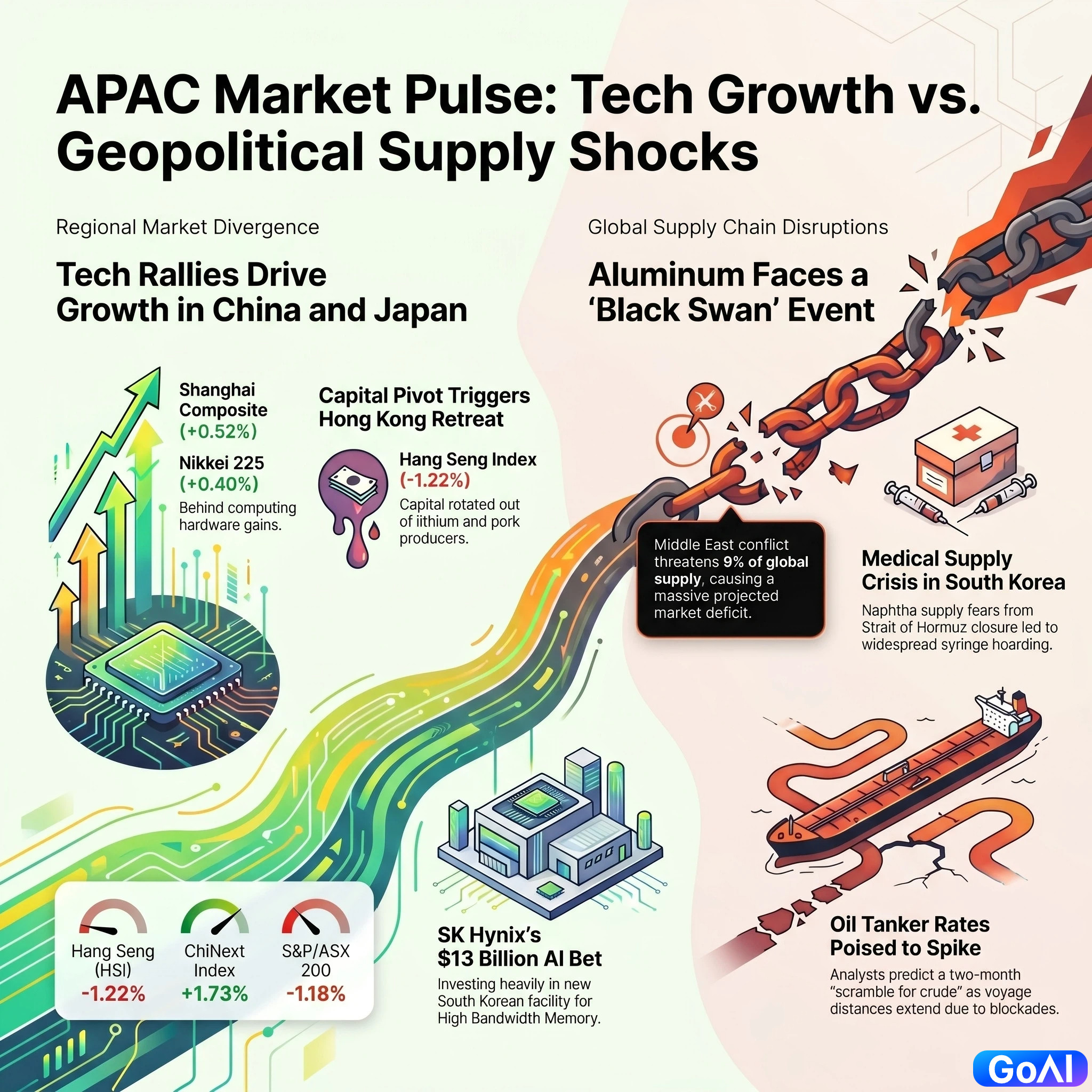
Chinese Equity Markets: The Shanghai Composite gained 0.52%, the Shenzhen Component rose 1.3%, and the ChiNext Index climbed 1.73%.
Sector-wise, computing hardware saw a broad rally, while fiber optic concepts remained active and computing power leasing continued its upward momentum.
Hong Kong Equity Markets: Major Hong Kong indices faced a collective retreat. The Hang Seng Index (HSI) fell 1.22% to close at 26,163.24, the Tech Index dropped 1.93% to 4,963.94, and the HSCEI slid 1.59% to 8,801.78.
The session was characterized by a distinct structural rotation: capital pivoted toward tech growth stocks, with optical communications, memory chips, and AI gaining ground against the trend. Conversely, lithium battery and pork producers traded lower.
Japan: The Nikkei 225 rose 0.40% to 59,585.86. Leading sectors included venture capital and electronics, while textiles, real estate, and rubber products saw modest declines.
South Korea: The KOSPI advanced 0.46% to 6,417.93, led by electrical appliances and paper, though life insurance and biotech weighed on the index.
Australia: The S&P/ASX 200 (.XJO) fell 1.18% to 8,843.60, as losses in medical equipment and capital markets offset gains in beverages and waste management.
Singapore: The STI edged down 0.24% to 5,002.72, with personalized services and credit seeing sharp gains despite weakness in retail and interactive media.
Malaysia: The FTSE Bursa Malaysia KLCI dipped 0.29% to 1,710.39, as energy and transportation gains failed to offset broad declines in financial services and consumer products.
Key Events
Mercuria Warns of "Black Swan" in Global Aluminum Market
Supply chains across the Middle East are in disarray.
Beyond oil and gas, the aluminum market is facing a severe supply shock. Nick Snowdon, Chief Metals Analyst at Mercuria, stated that the Middle East conflict has triggered a "black swan" event, likely resulting in a massive deficit this year.
The region accounts for roughly 9% of global supply (7 million tons annually). Snowdon noted this could be the largest single supply shock to base metals since 2000. LME aluminum prices hit a four-year high of $3,672 per ton on April 16.
Syringe Hoarding Grips South Korea Amid Naphtha Supply Fears
The closure of the Strait of Hormuz has triggered an unlikely crisis: a shortage of medical supplies. South Korean regulators are cracking down on syringe hoarding as raw material (naphtha) supply lines are threatened.
While daily production remains stable at 4.5 million units, hospitals report dwindling inventories and soaring online prices. The MFDS has deployed 35 inspection teams to investigate wholesalers suspected of price gouging.
SK Hynix to Invest $13 Billion in Advanced Packaging Plant
SK Hynix announced plans to invest 19 trillion won ($12.85 billion) to build a new advanced packaging facility in South Korea.
The move aims to meet skyrocketing demand for AI memory, specifically High Bandwidth Memory (HBM).
Construction is slated to begin this month as the Nvidia supplier accelerates its capacity expansion to keep pace with the AI data center boom.
Institutional Views
MUFG: Analyst Lloyd Chan suggests the U.S.-Iran conflict has shifted into a "prolonged stalemate." The U.S. appears to be using the blockade of Iranian ports as leverage for a peace deal.
This environment implies continued disruption to energy transit through the Strait of Hormuz, with particular pressure on oil-sensitive currencies like the Philippine peso and Thai baht.
ANZ: The bank expects the Bank of Japan (BoJ) to maintain its hawkish bias but hold rates steady at the April 27-28 meeting.
Recent official commentary suggests the BoJ is wary of downside risks to growth stemming from Middle East tensions. A 25-basis-point hike is now viewed as more likely in June.
CSC Financial: The brokerage maintains that the upside logic for oil tankers remains intact. Despite a brief reopening on April 17, the subsequent re-closure by Iran indicates the situation is far from stable.
Analysts project a three-stage evolution: initial price spikes, extended voyage distances, and a post-blockage "scramble for crude" that will drive tanker rates higher for over two months.