
Goldman Sachs Warns Against Chasing Record Highs: Near-Term Pullback Likely as Asymmetric Risks Loom

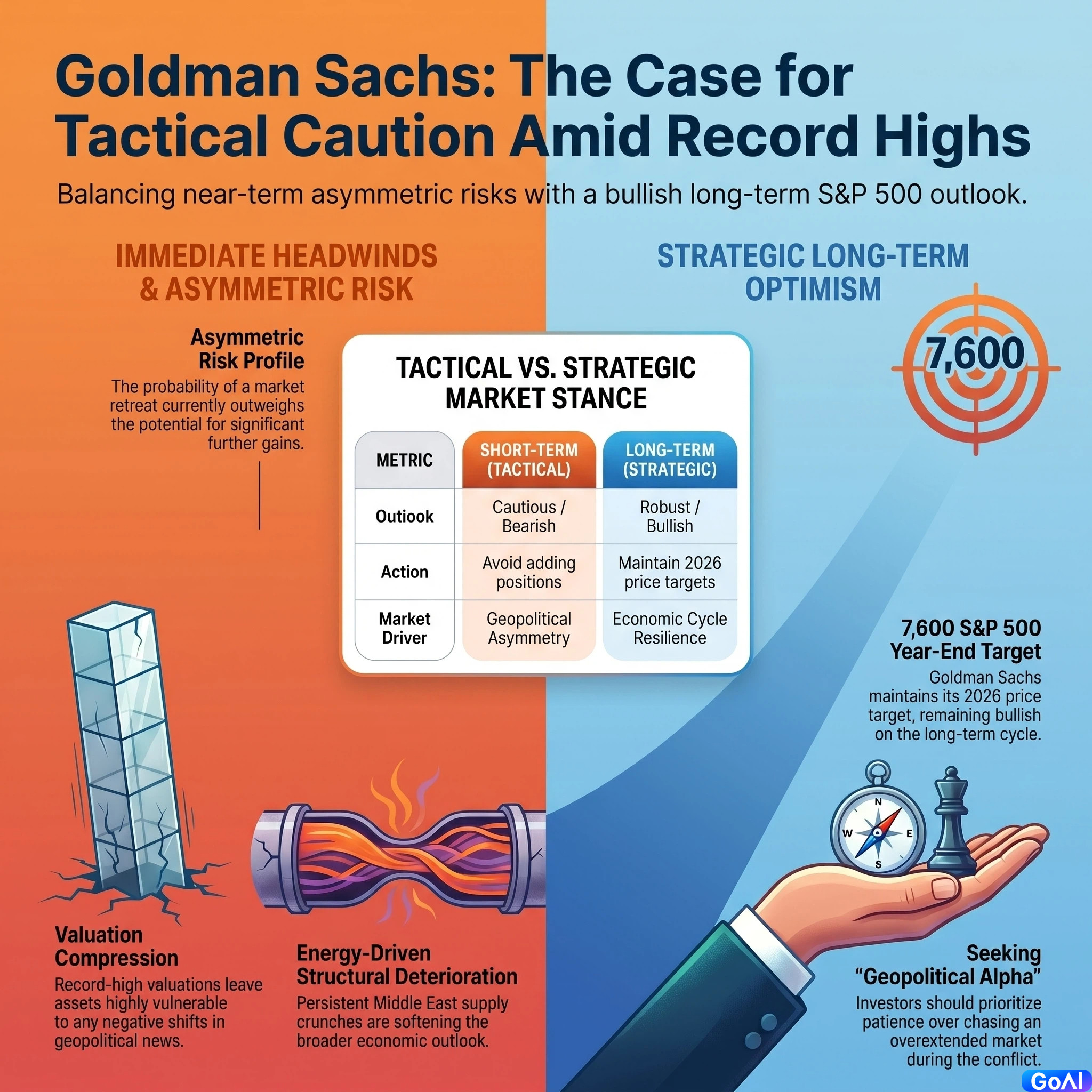
As U.S. equities reclaim historical peaks, Goldman Sachs is sounding a cautionary note, advising investors against aggressively adding to positions as the risk of a near-term correction intensifies.
The Asymmetry of Risk
Since President Trump’s April 8 announcement of a temporary ceasefire between the U.S. and Iran, market sentiment has undergone a rapid "risk-on" shift.
The S&P 500 has not only erased all war-induced losses but notched fresh record highs, fueled further by the recent extension of the truce.
However, Goldman Sachs warns that the path of least resistance may now be lower. In a recent note to clients, the bank stated:
"According to our equity asymmetry framework, the risk of a market decline remains elevated while the probability of a significant further upside is diminishing. This suggests that increasing risk exposure at these levels is currently unwise."
Bullish Long-Term Outlook; Cautious Short-Term Tactics
Despite the tactical warning, Goldman’s strategic outlook remains robust.
Unlike many Wall Street peers who wavered at the onset of the conflict, Goldman has maintained its year-end 2026 price target for the S&P 500 at 7,600—a forecast it has held steadfastly throughout the crisis.
The bank’s caution is rooted in several immediate headwinds:
- Energy Shocks: The persistent supply crunch in the Middle East continues to cloud the economic cycle.
- Valuation Compression: Following the recent rally, high valuations have left risk assets vulnerable to any deterioration in geopolitical news.
- Structural Deterioration: Analysts noted that the broader economic outlook has softened due to energy-related pressures, making the downside risk increasingly difficult to ignore.
Goldman concludes that unless a definitive end to the Iran conflict is reached, the probability of a market retreat outweighs the potential for further gains.
While the firm remains a long-term bull, it emphasizes that "geopolitical alpha" now requires patience rather than a headlong rush into an overextended market.