
APAC Market Wrap - Apr 24

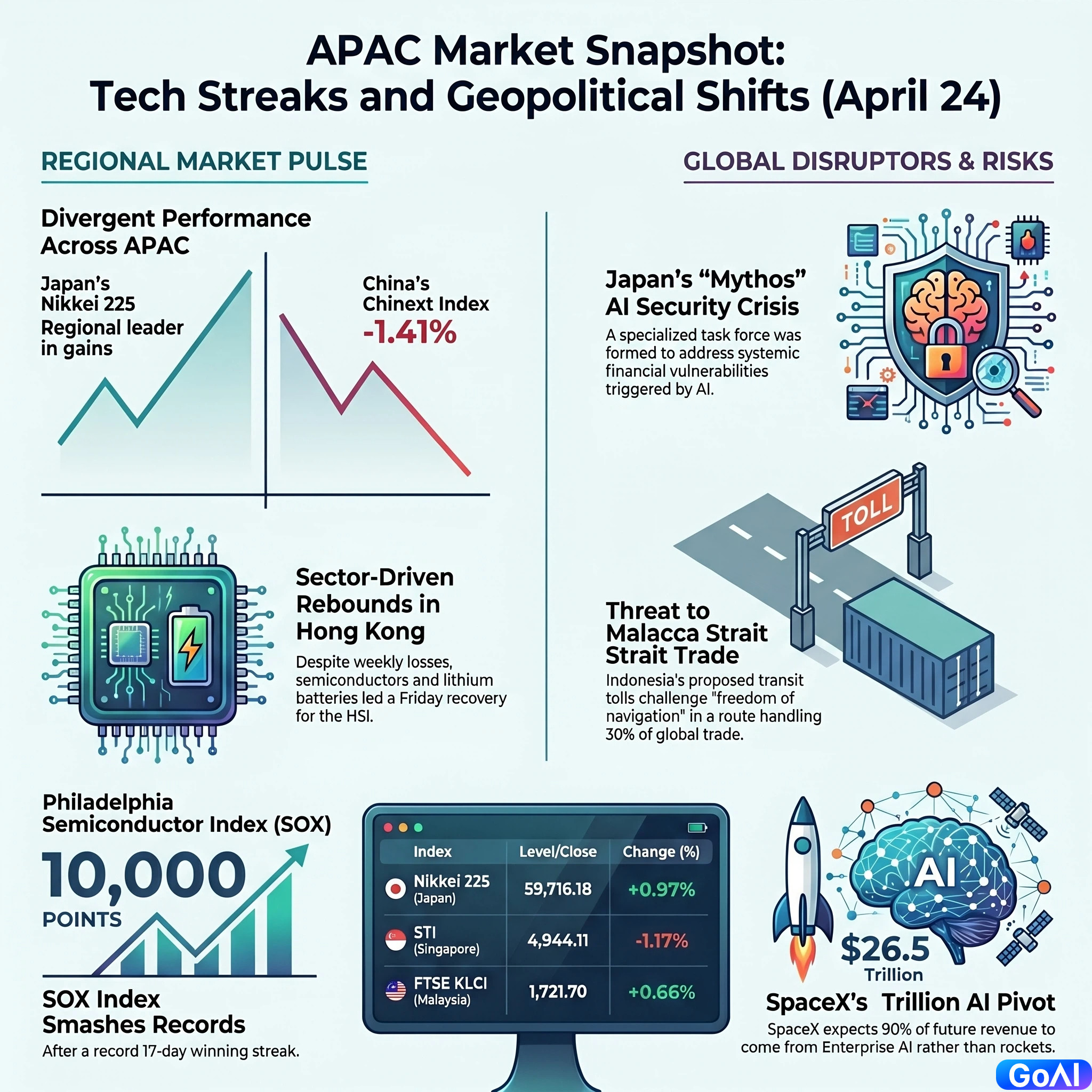
China Markets: The Shanghai Composite slipped 0.33%, the Shenzhen Component dropped 0.69%, and the Chinext Index fell 1.41%.
Lithium mining stocks saw a broad breakout, while the commercial aerospace sector continued its correction and computing hardware remained weak.
Hong Kong Markets: While benchmarks closed the week in negative territory—with the Hang Seng Index down 0.70% and the Hang Seng Tech Index falling 2.79%—Friday saw a notable recovery.
The HSI gained 0.24% and the Tech Index rose 0.75% in today's session. Semiconductors and lithium batteries led the rebound, whereas automotive and AI-application plays lagged.
Japan: The Nikkei 225 climbed 0.97% to 59,716.18. Mining, shipping, and glass sectors outperformed, while services and transport equipment saw slight declines.
South Korea: The KOSPI remained virtually flat at 6,475.63. Defense, aerospace, and energy-chemicals led the gains; however, heavyweight tech sectors like semiconductors and display panels weighed on the index.
Australia: The S&P/ASX 200 fell 0.57% to 8,743.4. Semiconductors and alternative energy trended higher, but aerospace and waste management suffered sharp losses.
Singapore: The STI dropped 1.17% to 4,944.11. Forestry and oil-gas sectors were strong, while industrial products and personalized services retraced.
Malaysia: The FTSE KLCI gained 0.66% to 1,721.70. Industrial products and energy sectors showed active momentum.
Key Events
Japan Forms Emergency Cybersecurity Task Force Over "Mythos" Crisis
Japanese Finance Minister Satsuki Katayama announced Friday the creation of a specialized task force to address systemic vulnerabilities in the nation's financial system.
The move follows growing alarm that Anthropic’s Mythos AI model is triggering critical security flaws. The task force includes high-level representatives from the FSA, BoJ, major megabanks, and the Japan Exchange Group (JPX).
Katayama characterized the situation as an "imminent crisis."
The Next Hormuz? Indonesia Hints at Malacca Strait Tolls
The controversial Iranian policy of charging transit fees in the Strait of Hormuz is sparking a "copycat effect." Indonesian Finance Minister Purbaya Yudhi Sadewa suggested that implementing a toll system in the Strait of Malacca—shared by Indonesia, Malaysia, and Singapore—could generate massive revenue.
The Malacca Strait handles approximately 30% of global trade and twice the daily vessel volume of Hormuz. While merely a proposal and currently unsupported by regional neighbors, it represents a significant challenge to the global rules of "freedom of navigation."
17-Day Winning Streak: SOX Index Hits Record Run
Fears of an "AI Bubble" have seemingly evaporated as the Philadelphia Semiconductor Index (SOX) broke the 10,000-point psychological barrier on Thursday.
The index has now surged for 17 consecutive sessions—the longest streak in its 32-year history—gaining roughly 40% during this period.
SpaceX IPO Bombshell: AI, Not Spaceships, to Drive Future Revenue
In a strategic pivot revealed in its S-1 filing, SpaceX estimates its Total Addressable Market (TAM) at $28.5 trillion.
Surprisingly, the company expects over 90% of this—roughly $26.5 trillion—to come from AI, primarily Enterprise AI applications, rather than its traditional rocket or satellite internet businesses.
Institutional Views
Goldman Sachs: Most Gulf Oil Output to Recover Within Months Post-Conflict
Goldman estimates that 14.5 million barrels per day (mb/d) are currently offline due to the Iran conflict. Once the Strait of Hormuz fully reopens, 70% of this output could return within three months and 88% within six.
However, the bank warns that prolonged shutdowns increase the risk of permanent reservoir damage.
ING: Markets Recalibrating for Diplomatic Deadlock
Analysts at ING note that Brent crude has returned to the $100+ range as the U.S.-Iran peace talks stall. They suggest the market is becoming "numb" to geopolitical headlines, shifting focus toward the long-term impact of sustained supply-side disruptions.
Capital Economics: UK Inflation May Peak Near 5%
Recent UK PMI data (rising to 52.0 in April) suggests a stronger-than-expected economy but also higher cost pressures. Analysts warn this may push CPI toward a 5% peak, potentially forcing the Bank of England to prioritize inflation risks over growth concerns.
Capital Economics: BoJ Rate Hike Possible as Early as June
While the Bank of Japan is expected to hold rates next week, Abhijit Surya suggests a hawkish shift in inflation forecasts could signal a June hike. Corporate inflation expectations in the "Tankan" survey are already beginning to exceed the 2% target.
Berenberg: Eurozone Stagnation Looms Due to Iran Conflict
Berenberg warns that the Eurozone Composite PMI drop (from 50.7 to 48.6) indicates stagnation. Supply shocks and declining consumer purchasing power are weighing heavily on the services sector, with current "positive" manufacturing signals actually reflecting panic-stocking and supply-chain bottlenecks.