
APAC Market Wrap - Apr 28

China Stock Markets: The Shanghai Composite edged down 0.19%, the Shenzhen Component dropped 1.1%, and the ChiNext Index slid 1.43%. In terms of sectors, industrial gas concepts saw repeated activity, while non-ferrous metals trended weaker.
Hong Kong Stock Market: The market was under broad pressure today, with all three major indices closing lower.
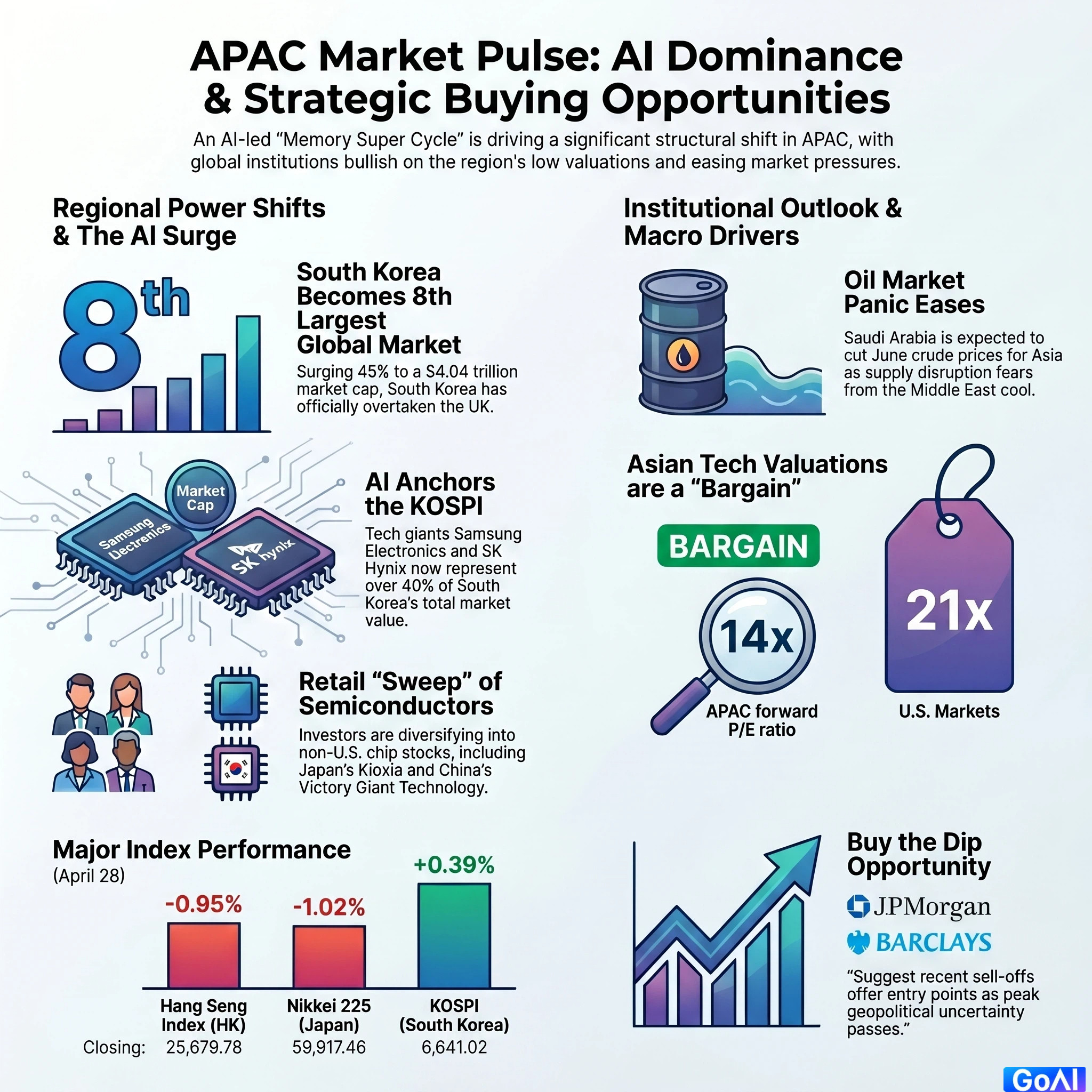
- Hang Seng Index (HSI): Down 0.95% to 25,679.78
- Hang Seng Tech Index: Down 2.28% to 4,827.19
- Hang Seng China Enterprises Index (HSCEI): Down 1.27% to 8,644.81
Sector Highlights: Pharmaceuticals and coal stocks strengthened, while lithium batteries, optical communications, and gold stocks declined.
Japan: The Nikkei 225 fell 1.02% to 59,917.46. Gains were seen in "Other Finance," construction, and mining; losses were led by Info-IT, electrical products, and air transport.
South Korea: The KOSPI rose 0.39% to 6,641.02. Steel and auto manufacturing led the gains, while aerospace, heavy industry, and biopharmaceuticals lagged.
Australia: The S&P/ASX 200 dropped 0.64% to 8,710.70. Energy and lithium mining stocks bucked the trend to rise, while non-energy minerals, consumer services, and retail led the decline.
Singapore: The STI dipped 0.10% to 4,887.69. Electronics, industrial services, and business services were strong, while finance and real estate pulled back slightly.
Malaysia: The FTSE Bursa Malaysia KLCI rose 0.72% to 1,729.60. Tech and utilities were active, while banking and plantations weakened.
Key Events
Oil Market Panic Easing? Saudi Arabia May Cut June OSP for Asia from Record Highs
Industry sources suggest Saudi Arabia may lower its Official Selling Price (OSP) for crude to Asia in June. This follows an easing of spot premiums and cooling demand after weeks of supply disruptions caused by the U.S.-Israel-Iran conflict.
Sources predict the flagship Arab Light OSP could drop to a premium of $7.50–$14.50/bbl over the Dubai/Oman average—a decrease of $5–$12 from May.
AI Boom Pushes South Korea Past UK to Become 8th Largest Global Stock Market
Driven by a massive rally in AI-related tech, South Korea's total market capitalization has overtaken the UK.
This year, South Korea’s market value surged over 45% to $4.04 trillion, while the UK’s grew roughly 3% to $3.99 trillion. This is a dramatic shift from late 2024, when the UK market was nearly double the size of Korea's. The rally is anchored by Samsung Electronics and SK Hynix, which now account for over 40% of the KOSPI’s value.
Korean Retail Investors "Sweep" Global Semiconductors: Chinese PCB Stock Enters Top 50
Amidst a "Memory Super Cycle," South Korean retail investors are expanding their horizons beyond Samsung and U.S. giants to Chinese and Japanese firms.
KSD data shows that for April (1st–24th), two non-U.S. stocks entered the Top 50 net buy list: NAND giant Kioxia and the recently HK-listed Chinese PCB firm Victory Giant Technology.
JPMorgan Bullish on Global Stocks: Iran Conflict Offers "Buy the Dip" Opportunity
Despite ongoing Middle East tensions, JPMorgan views the recent sell-off as an excellent buying opportunity rather than a reason to turn bearish, encouraging investors to capitalize on market weakness.
Institutional Perspectives
Goldman cut its 2026 earnings growth forecast for the MXAPJ by 1% to 29%, lowering its 12-month target to 870.
However, this still implies a 17% upside in USD terms. They maintain an Overweight rating on China, Japan, and South Korea, while downgrading India to Neutral and the Philippines to Underweight.
While warning of limited short-term upside for broader Asia due to the Strait of Hormuz deadlock, the team remains constructive on China. They project a 5%–10% upside for Chinese stocks by end-2026, favoring physical industries like energy, materials, and semiconductors.
In a major shift, Citi upgraded U.S. equities to Overweight, citing a tactical correction. While APAC has strong AI-driven earnings, Citi notes that macro pressures (high oil, conflict) are driving capital back to the U.S. as a safe haven.
Barclays suggests that as peak geopolitical risk passes, hedge funds are unwinding hedges. This could lead to a sharp rally, even if oil prices remain high. They are particularly bullish on Japan following the LDP election victory.
Matthew See argues that ceasefire expectations signal the peak of uncertainty. He expects a sharp reversal of systemic selling, benefiting tech-heavy markets like South Korea and Taiwan.
Fidelity reiterates its bullish stance, noting that the MSCI APAC Index forward P/E is only 14x (vs. 21x for the U.S.).
They highlight that KOSPI EPS is expected to soar 212% over the next 12 months, with $13 billion in foreign capital returning to non-China Asia in April.