
Mars Colonization and Space Data Centers: Musk’s Massive SpaceX Pay Package Revealed Ahead of IPO

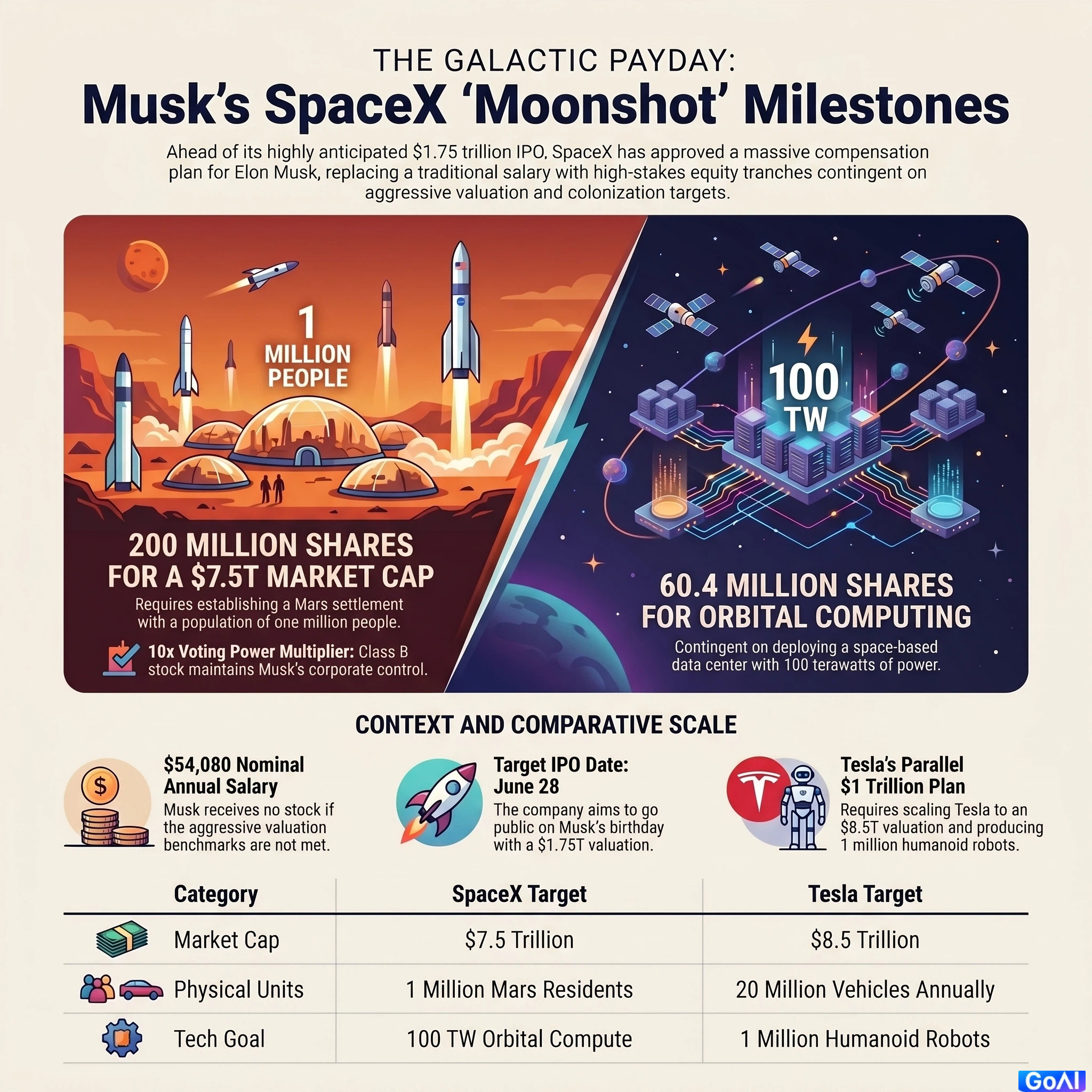
SpaceX’s board has reportedly approved an unprecedented compensation plan for CEO Elon Musk, tying his remuneration to moonshot milestones including Mars colonization and the construction of orbital data centers.
These ambitious targets, while futuristic in scope, align closely with SpaceX’s core corporate ethos.
Details of the package were disclosed in recent confidential filings with the Securities and Exchange Commission (SEC) as the company prepares for its highly anticipated initial public offering (IPO).
Excerpts from the registration documents reveal that Musk is set to receive 200 million shares of super-voting restricted stock if SpaceX achieves a market capitalization of $7.5 trillion and establishes a permanent Mars settlement with a population of at least one million people.
A secondary tranche of 60.4 million restricted shares hinges on another valuation target and the deployment of a space-based data center capable of providing at least 100 terawatts of computing power.
To put that scale in perspective: last month, Tesla announced "TeraFab," a joint venture with SpaceX and xAI aimed at producing 1 terawatt of AI computing capacity annually via the world’s largest chip manufacturing facility.
Musk has frequently characterized orbital data centers as the ultimate solution for meeting the compute demands of the AI revolution.
Both incentives consist of Class B restricted stock, carrying 10 times the voting power of Class A shares, and are scheduled to vest in increments as the company's valuation climbs.
SpaceX acknowledged in the filings that significant technical hurdles could impede these goals—a standard risk disclosure for an IPO. If these aggressive valuation benchmarks are not met, Musk receives no stock.
The plan includes no specific expiration date, contingent only on his continued service. Since 2019, Musk has drawn a nominal annual salary of just $54,080 from SpaceX.
As SpaceX remains private, the precise valuation of the package is difficult to quantify. Reports suggest the company aims to launch its IPO around June 28—Musk’s birthday—with a target valuation of approximately $1.75 trillion.
Musk’s unique compensation structures have long been a focal point of debate and a primary driver of his net worth.
A 2018 Tesla plan, which awarded him massive stock grants upon hitting specific market cap and revenue milestones, was successfully realized.
On April 24, Tesla filed with the SEC to register approximately 304 million common shares related to that 2018 agreement.
Furthermore, Tesla shareholders approved a new package last November that could see Musk’s compensation reach $1 trillion.
That plan requires Tesla to hit 12 increasingly difficult targets, including scaling its market cap from $1.4 trillion to $8.5 trillion, delivering 20 million vehicles annually, and producing 1 million humanoid robots.
Forbes currently estimates Musk’s net worth at $776 billion. While the goals set by Tesla and SpaceX are exceptionally steep, their realization would likely see his fortune multiply several times over.
The outsized incentives at SpaceX also underscore the company’s desire to secure more of Musk’s bandwidth as it nears its public debut.
Corporate governance experts note this could create friction between SpaceX investors and Tesla shareholders, as both entities effectively compete for the CEO's limited time and focus.