
Western Power Equipment Markets—Can China or India Shake South Korea’s Dominance?

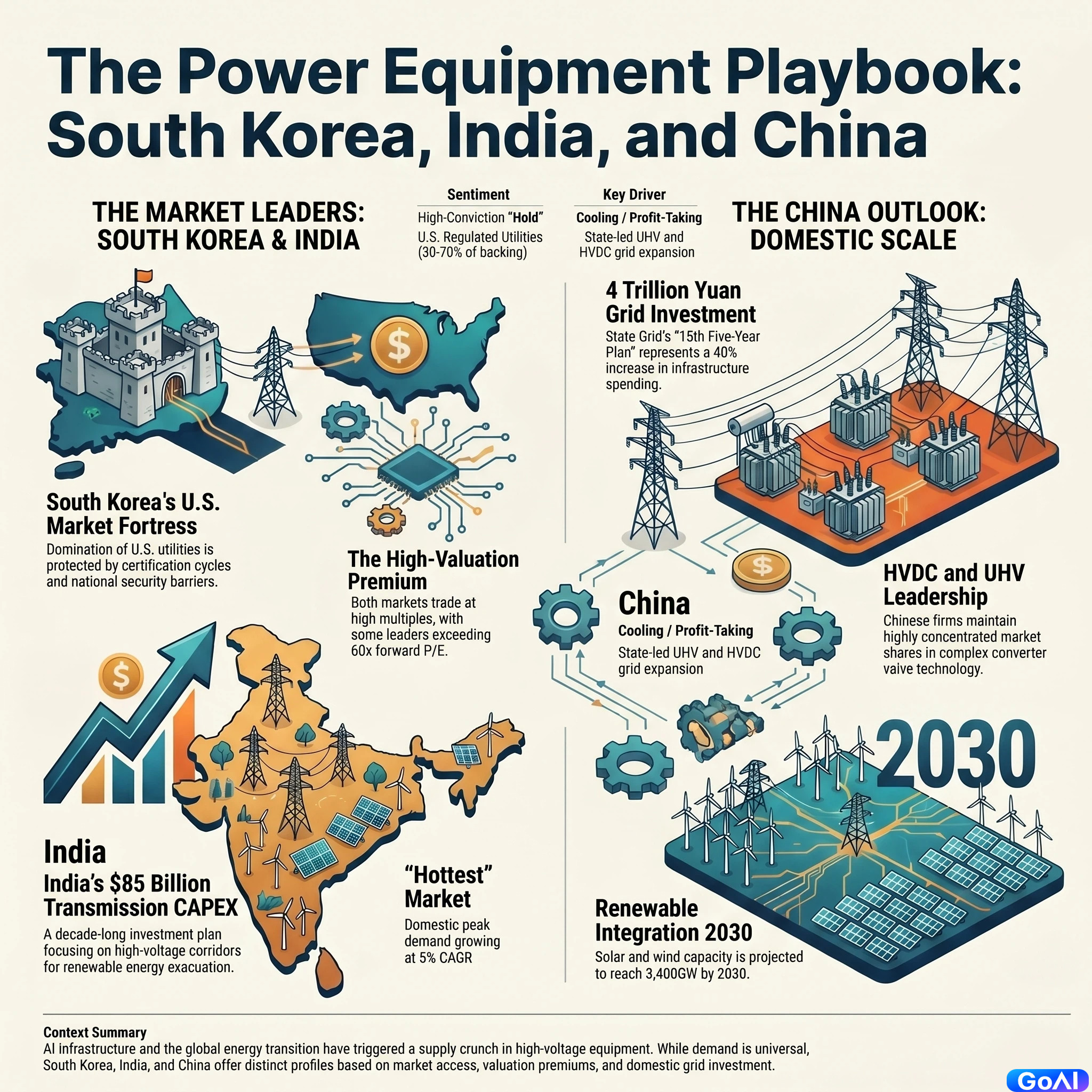
AI power infrastructure and the global energy transition are fundamentally reshaping the logic behind Asian power equipment trades.
For investors, the critical question is no longer whether demand exists, but rather which players possess the pricing power and order fulfillment capabilities to capitalize on the supply crunch in high-voltage equipment across Europe and the U.S..
According to a JPMorgan research report dated April 30, feedback from over 50 clients over the past two weeks reveals a clear hierarchy of market interest:
India is the "hottest" but carries the highest valuations; South Korea remains a high-conviction "hold," specifically due to its dominance in the U.S. regulated utility market; and China has seen a cooling in trade enthusiasm following weaker-than-expected Q1 results and a lack of near-term catalysts.
Stephen Tsui, APAC Equity Research Analyst at JPMorgan, noted that investor interest remains high, driven by AI power demand and regional decarbonization.
While sectors like transformers, switchgear, and HVDC remain core themes, capital is becoming increasingly discerning regarding valuations, positioning, order quality, and market entry barriers.
The core conclusion is that while Chinese and Indian capacity expansion can capture gains in emerging markets and select private sectors in the West, displacing South Korea in the U.S. regulated utility market remains a formidable challenge.
South Korea’s moat is built not just on capacity, but on a "triple barrier" of certification cycles, long-standing customer relationships, and national security considerations.
South Korea: U.S. Regulated Markets as a Fortress
South Korean power equipment stocks are neither cheap nor under-the-radar.
LS Electric has surged over 190% year-to-date—significantly outperforming the KOSPI’s 50% gain—with its 1-year forward P/E exceeding 60x.
Despite this, there has been no significant profit-taking, as order trends remain exceptionally robust.
Q1 new orders for South Korean firms more than doubled sequentially, bolstered by high prices and entry barriers in the U.S. market.
Hyosung Heavy remains a preferred pick due to its strong order backlog and growth visibility. For major players like HD Hyundai Electric and Hyosung Heavy, U.S. orders account for 50% to 70% of their backlogs, primarily serving regulated utilities and grid customers.
This is a market where low-cost capacity cannot easily penetrate due to rigorous certification and national security vetting.
This is why JPMorgan believes expansion from China and India does not pose a significant threat to South Korean market share.
While Chinese and Indian manufacturers can leverage lower labor and raw material costs to gain share in emerging markets and private Western sectors, entering the regulated utility systems of developed nations remains a much longer and more complex process.
India: Strongest Visibility Meets Peak Valuation
India is currently the most watched power equipment market in Asia, attracting investors not through low prices, but through a clear demand curve and high order coverage.
India’s National Power Adequacy Plan projects that by FY36, peak power demand will grow at a CAGR of approximately 5%, adding 20GW of peak demand annually.
This corresponds to a target of 60GW in new generating capacity per year, with renewables expected to comprise 60% of total installed capacity and 35% of generation by FY36.
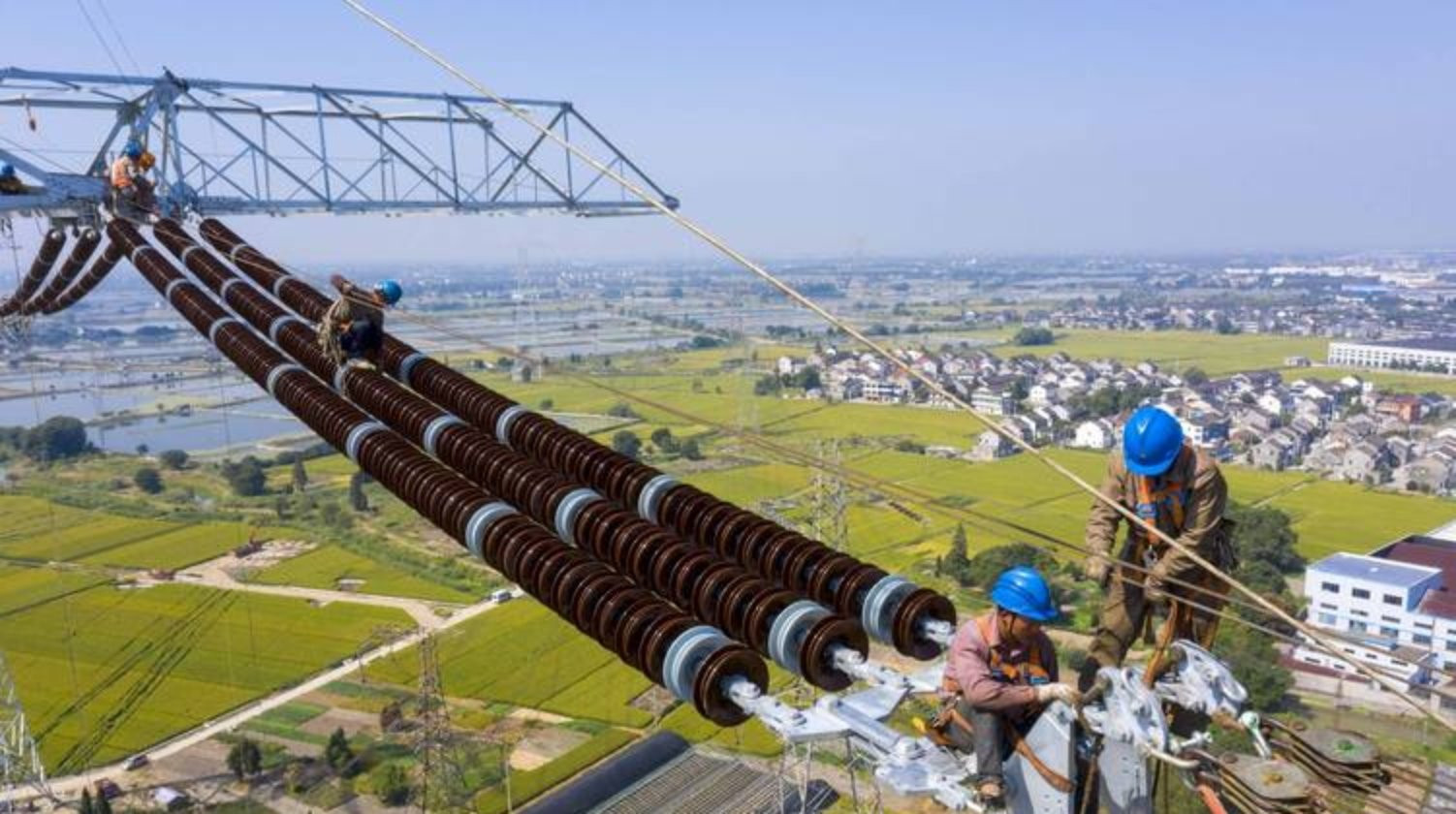
Transmission investment is rising in tandem. India’s Transmission Adequacy Plan outlines nearly $85 billion in CAPEX over the next decade—averaging $8 billion to $9 billion annually—focusing on high-voltage evacuation corridors for new renewable projects, with a structural shift toward HVDC and 765kV.
Order data supports this narrative. Backlogs for POWERIND and GVTD stand at ₹299 billion and ₹244 billion, respectively, representing 4.1x and 4.3x their trailing 12-month revenue. This is sufficient to support over 30% revenue growth for the next three years while keeping margins at cyclical highs.
However, valuation remains a hurdle, with some stocks trading near 60x CY27 P/E. Regional fund managers note that Indian firms remain expensive compared to South Korean peers, which offer similar growth with more direct U.S. exposure.
China: Cooling Momentum vs. Solid Fundamentals
Chinese power equipment stocks are under short-term pressure as investors lock in profits following disappointing Q1 results and a lack of immediate catalysts.
However, long-term fundamentals remain intact. China's power consumption is expected to grow at a 5% CAGR through 2030, with wind and solar installations projected to rise from 1,840GW in 2025 to 3,400GW by 2030—a 13% CAGR.
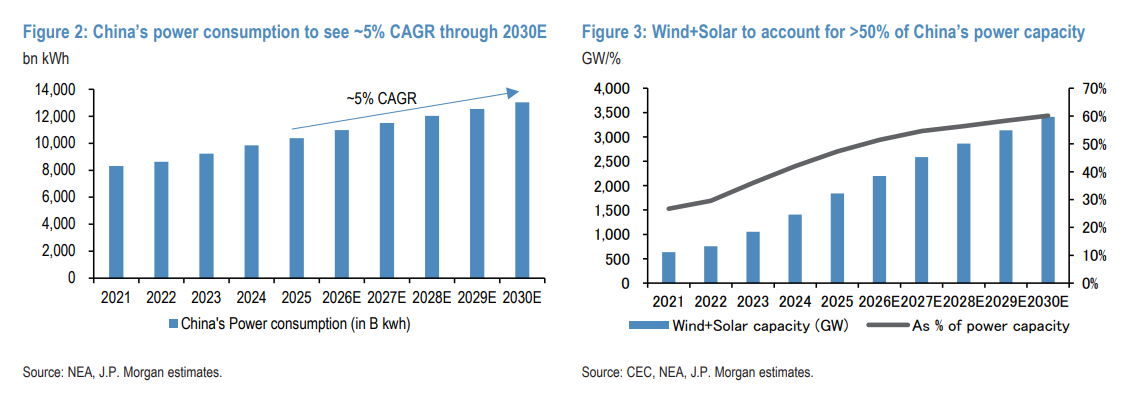
Renewables will likely increase from 47% to 60% of total capacity.
Grid investment is also accelerating. The State Grid Corporation of China plans to invest at least 4 trillion yuan during the "15th Five-Year Plan" period, a 40% increase over previous levels, implying an 8% to 10% CAGR. In Q1 2026, China’s grid fixed-asset investment already grew 40% year-on-year.
HVDC and UHV represent the most significant opportunities for Chinese manufacturers. JPMorgan notes that up to 20 DC UHV projects could be initiated during the 15th Five-Year Plan, with each project valued at over 30 billion yuan.
The competitive landscape remains highly concentrated and state-led, with NARI Technology and Xuji Electric holding approximately 50% and 20% of the converter valve market share, respectively.