
Gold's Fate Ties to the Fed: Morgan Stanley Targets $5,200 by Year-End Amid Lingering Rate Cut Hopes

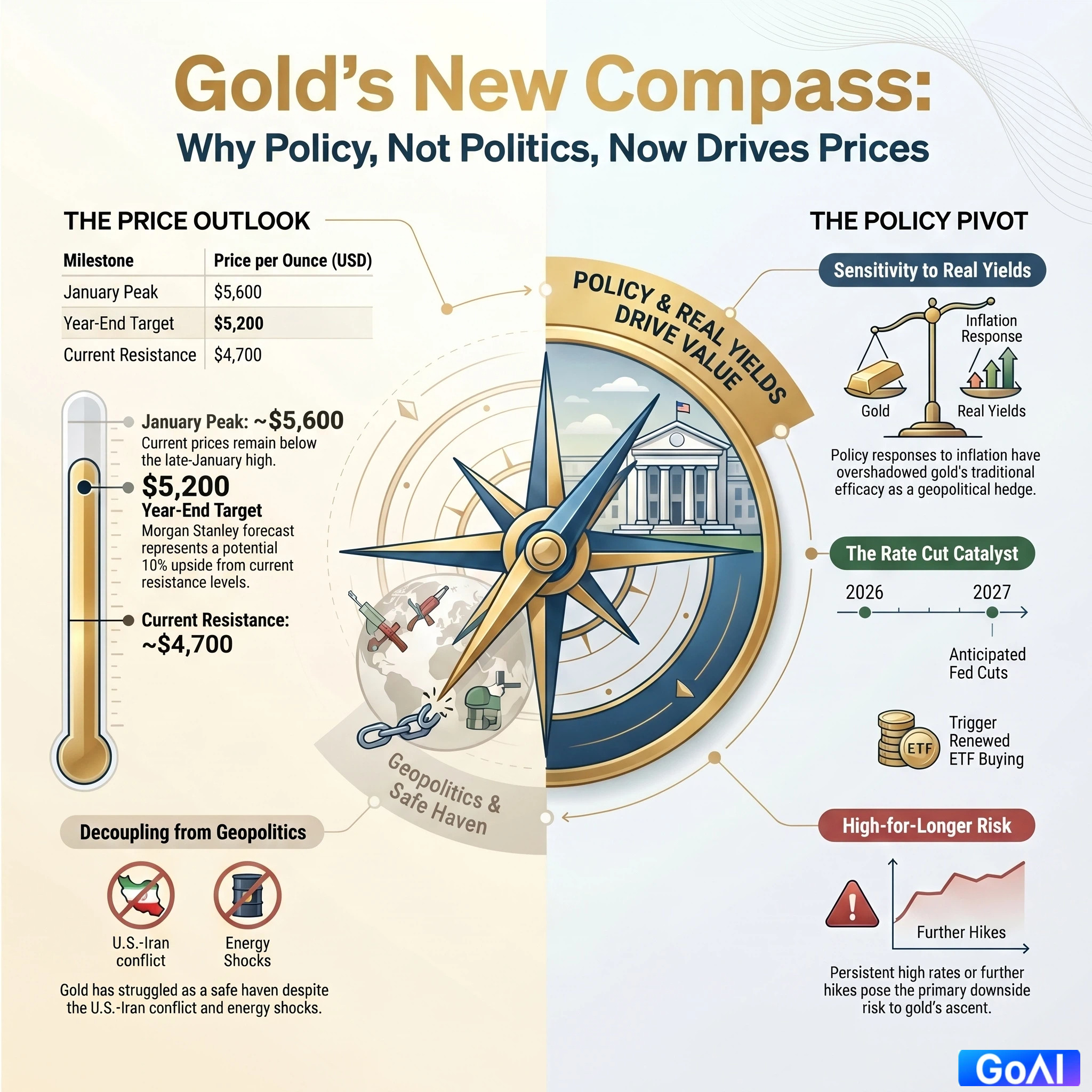
Despite persistent geopolitical uncertainty from the U.S.-Iran conflict, gold has struggled to assert its traditional safe-haven status.
However, the bullion market appears to be regaining upward momentum, with prices currently testing new resistance levels at $4,700 per ounce.
While gold remains well below the peak of nearly $5,600 set in late January, Morgan Stanley projects that the precious metal will continue its ascent, "sprinting" toward a target of $5,200 per ounce.
This forecast implies a potential upside of approximately 10% from current levels.
Shifting Drivers: From Geopolitics to Policy
Amy Gower, a metals and mining commodities strategist at Morgan Stanley Research, noted in a recent report that the core driver for gold has shifted from safe-haven demand toward Fed monetary policy and real yield trajectories.
The bank maintains its year-end price target of $5,200, betting that a resurgence in rate-cut expectations will provide the necessary fuel for the next leg up.
Gower expressed little surprise at gold’s lackluster performance in recent months despite the ongoing war with Iran.
"It is not surprising that gold has struggled to act as a safe haven this time around, given that the conflict triggered an energy supply shock which effectively dampened hopes for Fed rate cuts," she explained.
"Gold’s sensitivity to monetary policy has become the primary driver of its price," Gower added. "
This has overshadowed its safe-haven status and reduced its efficacy as a hedge against geopolitical and inflationary risks. Gold prices are reflecting not just specific events, but more importantly, the subsequent policy responses."
The Inflation-Interest Rate Tussle
Following the outbreak of the U.S.-Iran war, soaring oil prices fueled inflationary pressures, forcing the Federal Reserve to reassess its easing stance.
Consequently, markets have almost entirely priced out the possibility of a rate cut this year. However, Morgan Stanley remains a contrarian, still betting on at least one cut in 2026 to support the bullion rally.
"Gold prices are likely to remain sensitive to real yields, but we believe there is still room for upside," the report stated. Gower further projected that the Fed would follow up with additional cuts in January and March of 2027.
"This should benefit gold, as ETF buying is particularly sensitive to policy signals, and gold is now re-coupling with the movement of real interest rates," she noted.
The "Trump Factor" and Market Outlook
In the immediate term, gold’s trajectory depends heavily on the direction of the Middle East conflict.
President Trump recently stated that the U.S. and Iran held "very productive" talks over the past 24 hours and that a deal is "very likely," estimating a timeframe of about a week.
While a swift resolution could allow the global economy to recover from the current energy crisis, Gower warned that the longer the conflict persists, the greater the risk to gold.
"If the market begins to anticipate a 'higher-for-longer' rate environment or even further hikes, gold prices could suffer," she wrote. Conversely, she cautioned that even with a resolution, upside may be capped as high price levels could begin to dampen demand from ETFs, central banks, and consumers.