
A Fractured Financial World: Equity Markets Revel in Conflict While Bonds Recoil from Inflation

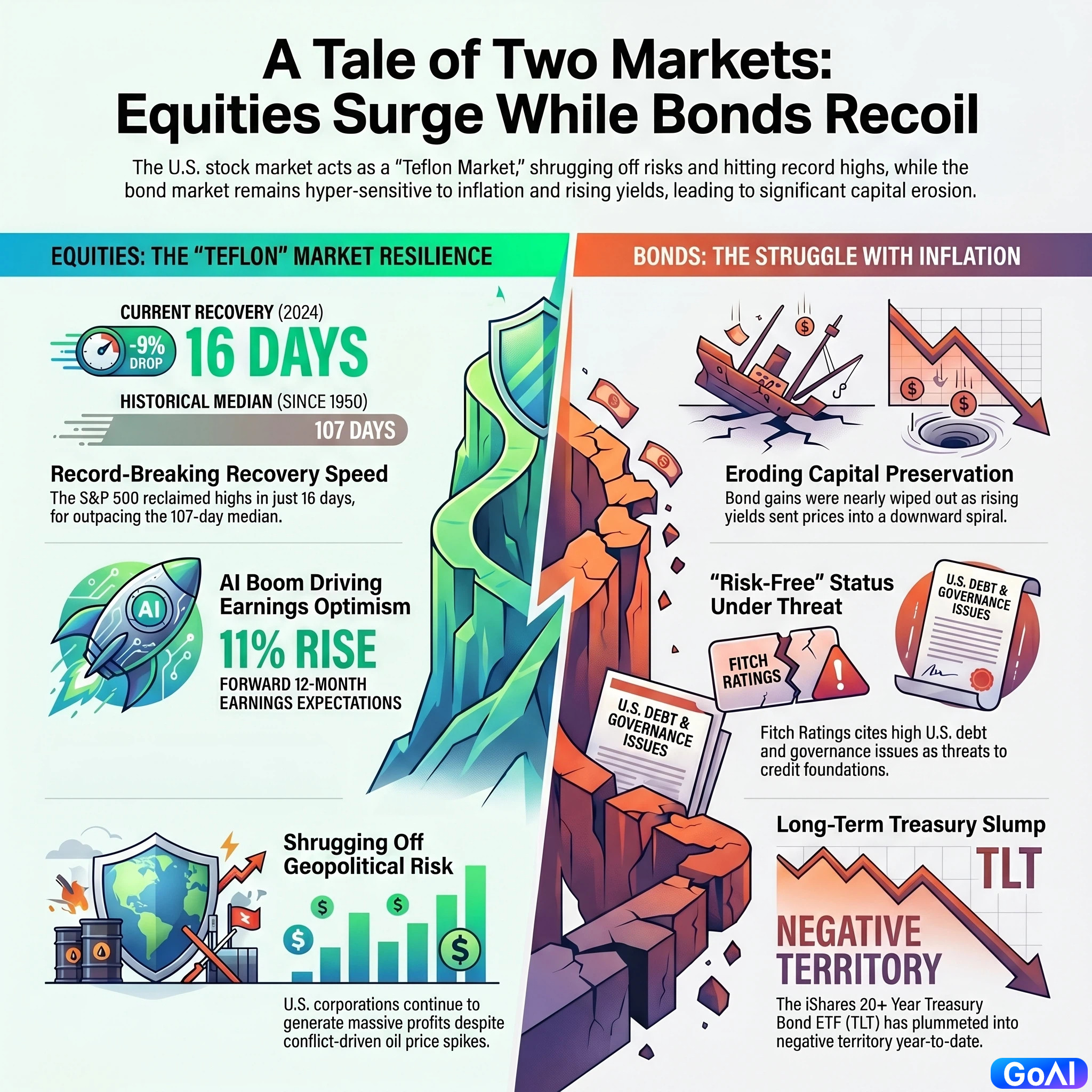
The global financial landscape is currently defined by a stark divergence: a surging U.S. stock market and a volatile, beleaguered bond market.
As the two primary barometers of global finance, they are reacting in diametrically opposed ways to the spike in oil prices and heightened economic risks triggered by the conflict with Iran.
Following a turbulent March, U.S. equities have repeatedly shrugged off risk, not only erasing losses sustained since the outbreak of hostilities but charging to fresh record highs.
Investors are betting that regardless of the war's trajectory, U.S. corporations will continue to generate massive profits. This optimism is mirrored globally; while other major international indices faced a severe setback in March, they have since rebounded strongly, with international stocks broadly outperforming U.S. equities on a year-to-date basis.
The bond market, however, tells a much grimmer story.
Bond traders remain hyper-sensitive to risk, with yields locked in a tight correlation with oil price volatility.
As crude prices soared and inflationary pressures mounted, yields climbed, sending bond prices—which move inversely to yields—into a downward spiral.
For diversified long-term investors holding a classic 60/40 mix, overall performance has remained respectable, but those gains are almost entirely attributable to equities. Bonds have largely failed to preserve capital.
The Resilience of a "Teflon Market"
Despite intermittent skirmishes in the Persian Gulf, the equity market has maintained a persistent upward trajectory.
Analysts are growing increasingly bullish on the outlook for the S&P 500, describing the current environment as a "Teflon Market"—one so resilient that bad news simply fails to stick.
"Despite lingering concerns, the market has shown remarkable resilience, driven by robust corporate earnings," Keith Lerner, Chief Investment Officer at Truist Advisory, noted in a report to clients this week.
Data shows that as of April 30, forward 12-month earnings expectations for S&P 500 companies have risen 11% since the start of the year. This optimism is fueled by the AI boom, which has largely overshadowed geopolitical conflicts, tariff disputes, and domestic government instability.
The speed of the recovery has been historic: after the S&P 500 fell 9.1% between late January and March 30, it took just 16 days to reclaim its highs. According to Vanguard data, this is the fastest recovery from a 9% drop since 1950, where the median recovery time is typically 107 days.
Independent economist Edward Yardeni suggests that the global bull market is firmly intact, anchored by corporate profitability. While he acknowledges the war in the Middle East is far from over, he expects the "extraordinary resilience of the U.S. economy and stock market" to persist.
The Bond Market’s Struggle and Shifting Policy Expectations
The fixed-income sector enjoys none of the stock market’s euphoria.
The Bloomberg U.S. Aggregate Index, a key benchmark for investment-grade bonds, saw its year-to-date gains nearly wiped out as war-driven oil spikes pushed yields higher.
Long-term Treasuries have fared even worse; the iShares 20+ Year Treasury Bond ETF (TLT), which saw a total return of 4.6% through February, has since plummeted into slightly negative territory for the year.
This sluggishness serves as a reminder that if inflation continues to climb, yields will likely follow, forcing investors into further paper losses.
More concerning is the challenge to U.S. Treasuries' status as the global "risk-free" asset. Fitch Ratings recently noted that the U.S. debt burden is significantly higher than that of other AA-rated nations, citing governance issues and widening budget deficits as factors shaking its credit foundation.
Central banks remain cautious in the face of this dual-threat environment—striving to curb inflation without stifling growth.
While Kevin Warsh, the nominee to succeed Jerome Powell as Fed Chair, has previously discussed the necessity of rate cuts, the market remains skeptical.
CME FedWatch data suggests that the most likely outcome is for the Fed to hold rates steady through December 2027, with the probability of a rate hike now higher than that of a cut.
Ultimately, while the equity market remains focused on chasing excess profits, the fixed-income market is laser-focused on risk.
This divergence may be tolerable for now, but if interest rates continue to climb alongside an economic slowdown, the stock market’s optimism will eventually face a severe reckoning.