
Is the "AI Investment Wave" Starting to Backfire on U.S. Stocks? Goldman Warns Key Upside Support Is Being Eroded

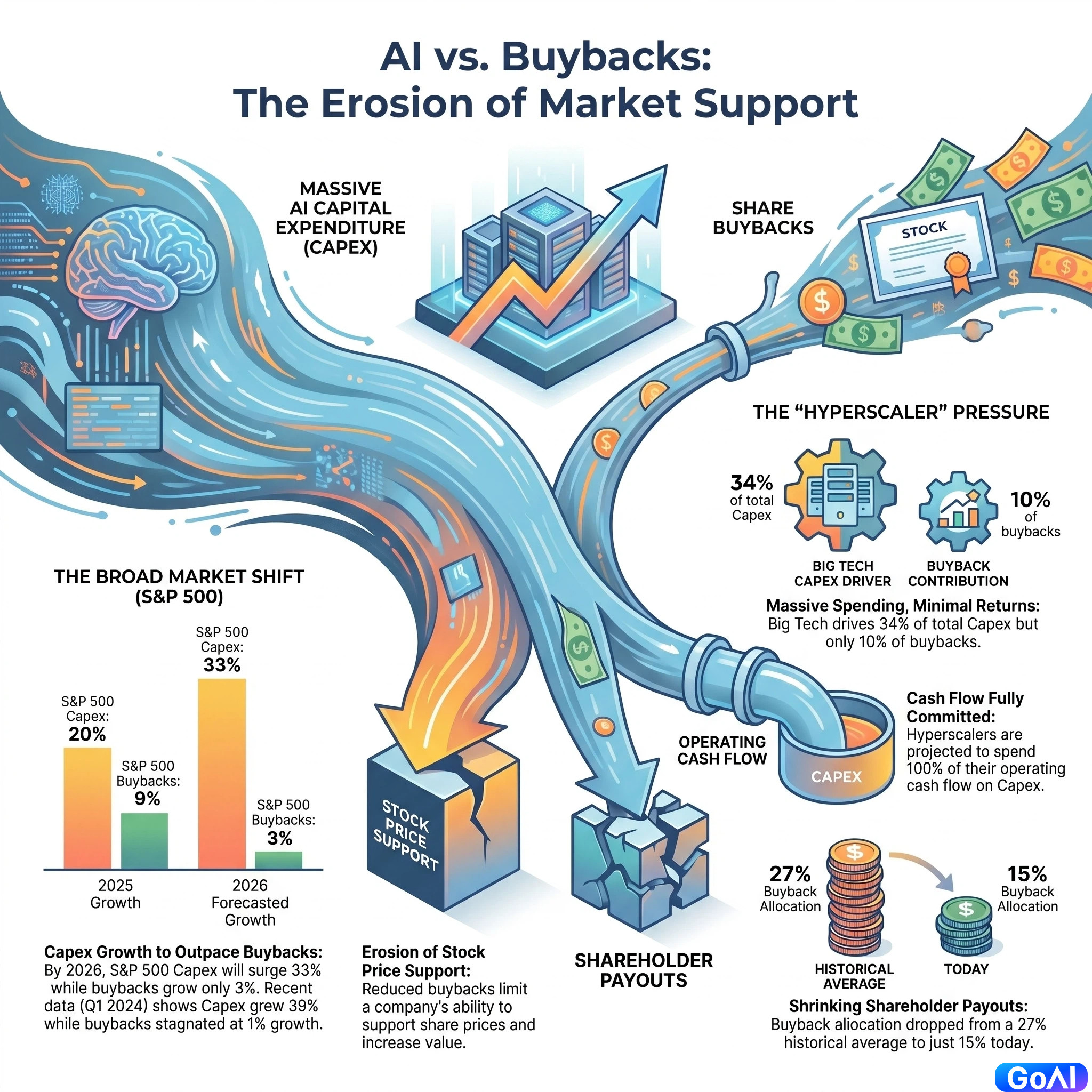
In the massively expensive "arms race" of artificial intelligence, corporations are aggressively deploying capital. However, this comes at a price: the pace of corporate share buybacks is slowing down.
Goldman Sachs points out that as AI capital expenditure (Capex) grows, the speed at which companies repurchase their own shares is decelerating.
Notably, the hyperscalers leading AI investment have seen an even more significant slowdown in buyback growth, which is weighing on the overall market's buyback rate.
In their latest report, analysts wrote: "The AI investment boom will drive S&P 500 companies to continue shifting from share buybacks to capital expenditures".
Stock buybacks are typically bullish for share prices.
When a company believes its stock is undervalued, buybacks provide price support and increase value by reducing the total share count. According to Goldman’s forecasts, Capex for S&P 500 companies will surge by 33% in 2026, while total share buybacks will grow by only 3%.
By comparison, 2025 saw Capex growth of 20% and buyback growth of 9%.
Analysts noted: "The Q1 earnings season highlighted the trend of capital being diverted from buybacks toward Capex and R&D. S&P 500 Capex grew by 39% in the first quarter, while total buybacks increased by only 1%".
Tech Giants Show Most Pronounced Shift
Goldman highlights that this dynamic—intensifying Capex growth coupled with stagnant buyback growth—is most evident among the Big Tech firms leading the AI spending spree.
According to Goldman, AI hyperscalers such as Amazon, Google, Meta, Microsoft, and Oracle are expected to see Capex reach $755 billion in 2026, an 83% increase year-over-year.
Analysts explained: "Consensus expectations suggest that hyperscale data center operators will spend 100% of their operating cash flow on Capex this year".
This implies there is virtually no room to return cash to shareholders without significantly slowing Capex growth, depleting cash balances, or substantially increasing debt.
"These companies are currently allocating 15% of their total cash spending to share buybacks, compared to an average of 27% between 2017 and 2022," the report stated.
Goldman also cited data showing that in 2025, these five companies—Amazon, Google, Meta, Microsoft, and Oracle—accounted for over one-third (34%) of the S&P 500's total Capex and R&D spending, while accounting for only 10% of buybacks and dividends.
The bank expects this hyperscaler dynamic to persist, stating that "reduced buyback activity from hyperscalers will put pressure on the overall buyback levels of the S&P 500".