
Still Questioning the "AI Fever"? Wedbush: Q1 Earnings Prove It; Nvidia is the Next Catalyst

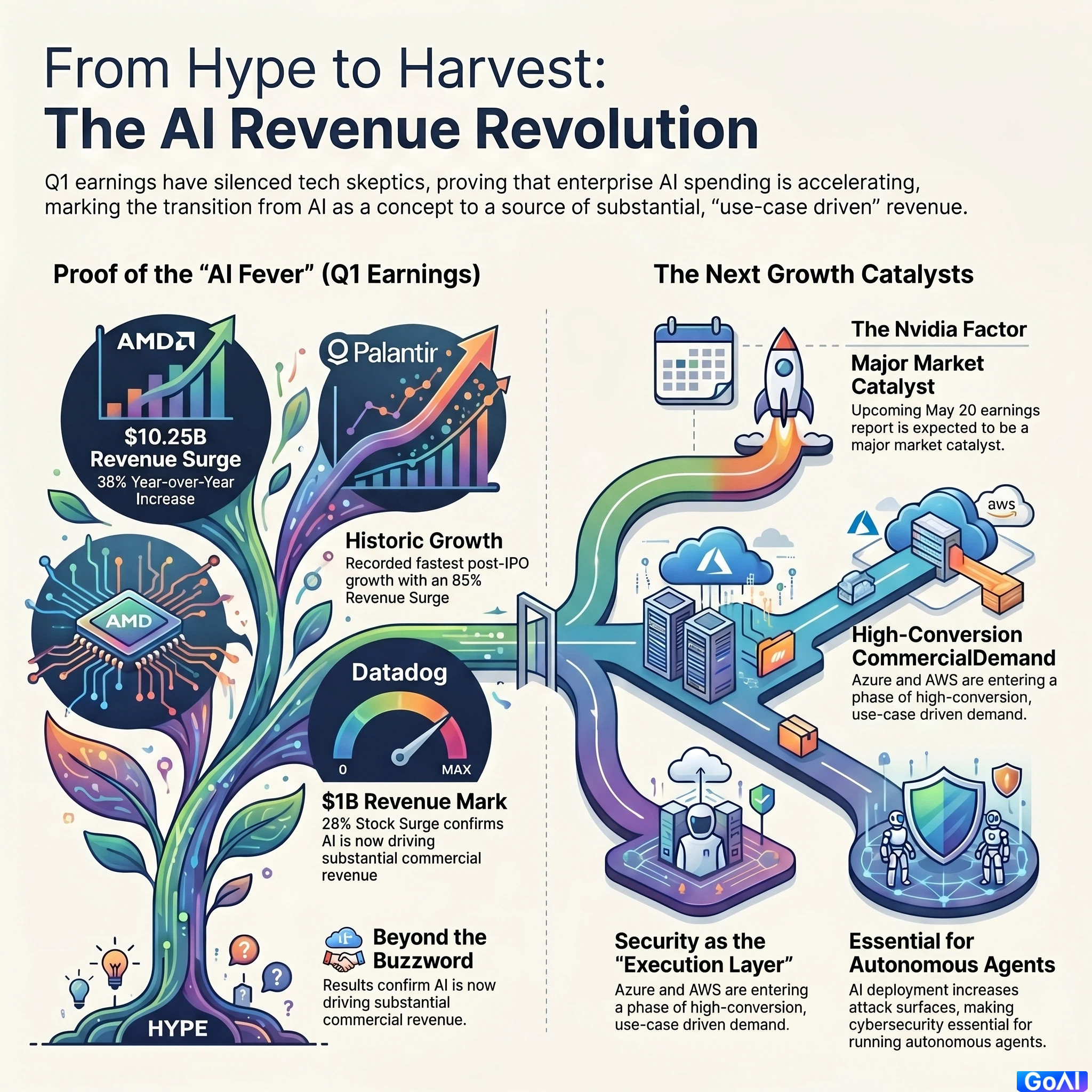
Wedbush, a prominent Wall Street investment firm, recently stated that the Q1 earnings season has served as a wake-up call for tech skeptics watching the AI revolution from the sidelines.
The firm expects Nvidia’s upcoming earnings report next week to act as yet another catalyst for the technology sector's upward trajectory.
In an investor note released Monday, a team led by renowned analyst Dan Ives pointed out that recent financial results from multiple tech companies clearly demonstrate that enterprise AI spending is accelerating rather than slowing.
Earnings Beat Across the Board
The team highlighted the stellar performance of chip giant AMD, which reported adjusted Q1 earnings of $1.37 per share on revenue of $10.25 billion (a 38% year-over-year increase), comfortably beating market expectations.
Furthermore, AMD's Q2 revenue guidance of $11.2 billion also surpassed analyst projections.
Other notable performers cited include:
- Palantir: Recorded its fastest growth since going public, with Q1 revenue surging 85% year-over-year.
- Datadog: Crossed the $1 billion quarterly revenue milestone for the first time, triggering a 28% single-day stock surge.
- Twilio: Logged its highest growth rate in three years.
Wedbush analysts noted that these results confirm AI is transitioning from a conceptual buzzword to a source of substantial revenue.
The Nvidia Factor and Cloud Growth
The market's eyes are now on Nvidia, which is scheduled to report its fiscal Q1 2027 results after the bell next Wednesday (May 20).
Wedbush believes the supply-demand imbalance for Nvidia’s Blackwell and Rubin AI chips remains "very favorable." Simultaneously, enterprise AI projects associated with cloud platforms from Microsoft (Azure), Alphabet (Google Cloud), and Amazon (AWS) continue to accelerate.
"We remain convinced that the commercialization phase of AI is just beginning, which is undoubtedly positive news for hyperscale cloud providers building the next stage of AI architecture," the report emphasized.
The firm added that the market is likely underestimating the cloud growth and AI transaction conversion rates for Azure and AWS over the coming year, citing positive data from Palantir, Datadog, and Innodata as evidence of an imminent wave of "use-case driven demand."
Security as the Execution Layer
Ives estimates that tech stocks could rise another 10% to 12% by year-end as investors realize that products from the likes of Anthropic and OpenAI do not spell "doom" for software companies.
He is particularly bullish on cybersecurity vendors such as CrowdStrike, Palo Alto Networks, Zscaler, and Rubrik.
According to Ives, conversations with CIOs and CISOs suggest that powerful Large Language Models (LLMs) are actually driving growth in the cybersecurity sector. As attack surfaces and the number of autonomous agents increase, security budgets are expected to grow significantly.
"Crucially, AI does not reduce the need for endpoint security, identity management, or cloud automation," Ives added. "
On the contrary, as enterprises deploy more LLM-based agents, the demand for runtime monitoring and Zero Trust enforcement will grow exponentially. Cybersecurity will become the execution layer of AI, not its victim."