
Global Investors Pour Into Asian Tech Stocks as Analysts Warn of "Double Exposure" Risk
Asian equities have become a magnet for global capital this year, with South Korea’s KOSPI index surging nearly 80% and hitting a fresh record closing high on Monday.
Markets in Japan and Taiwan have similarly witnessed massive inflows as international investors pivot toward the region.
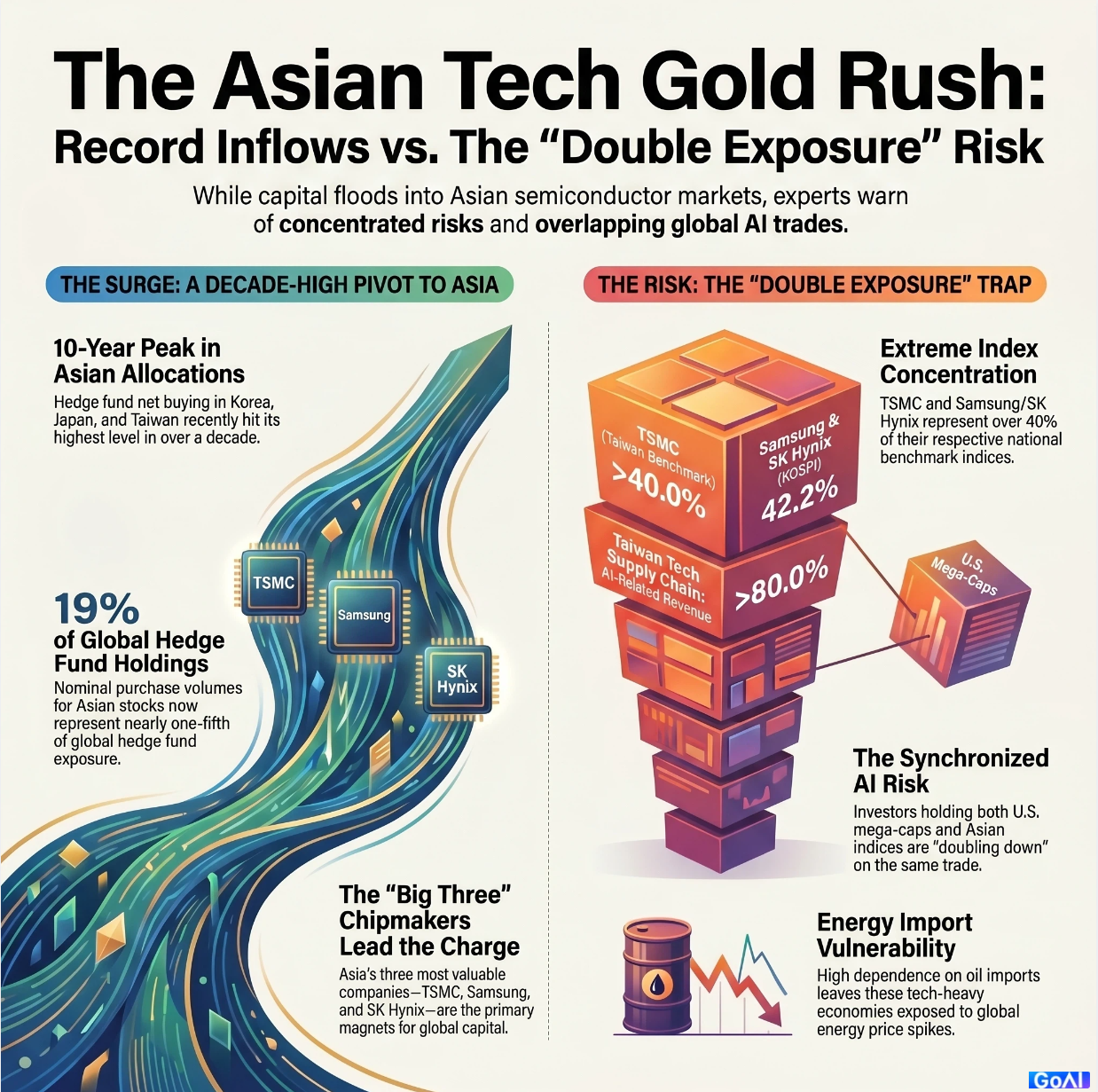
According to a recent client report from Morgan Stanley, global hedge funds have significantly ramped up their Asian allocations. Last week, net buying in South Korean, Japanese, and Taiwanese stocks reached a 10-year high.
The bank noted that these inflows were broad-based, originating from all geographic regions and spanning various investment strategies.
As of the week ending May 7, the nominal purchase volume for Asian stocks marked the highest in over a decade, with hedge funds' net exposure to Japan, South Korea, and Taiwan now accounting for approximately 19% of their global holdings.
Buying activity last week was heavily concentrated in the semiconductor and hardware sectors. Currently, the three most valuable companies in Asia are chipmakers—TSMC, Samsung Electronics, and SK Hynix—all of which are major beneficiaries of the AI-driven semiconductor boom.
Hussein Sacoor, partner at Tekne Capital, noted that the market remains in the early stages of the tech cycle, arguing that Asian allocations and valuations remain low relative to their growing global importance.
Concentration and Dependency Concerns
Goldman Sachs analyst Tim Moe highlighted that AI hardware is the primary engine driving Asian markets.
In Taiwan, over 80% of the technology supply chain's revenue is derived from AI-related fields, while the figure for South Korea stands at approximately 60%.
However, this high level of concentration carries inherent risks. Data from UOB shows that TSMC now accounts for more than 40% of Taiwan’s benchmark index by market capitalization.
Similarly, Manulife Investment data indicates that as of May, Samsung Electronics and SK Hynix collectively represent 42.2% of the KOSPI’s weighting.
This concentration makes both markets highly sensitive to the global AI spending cycle. It also implies that index-level gains may reflect the profitability of a few tech exporters rather than the broader health of the underlying economies.
Moe warned that supply chain disruptions, policy shifts regarding AI infrastructure, capital market pressures, and rapid technological changes in chip design could all impact these giants, subsequently jarring the South Korean and Taiwanese markets.
The "Double Bet" Trap
Jamie Mills O’Brien, Investment Director at abrdn, further pointed out that South Korea and Taiwan are heavily dependent on energy imports.
Amid the U.S.-Iran conflict and the resulting spike in oil prices, these economies face deteriorating terms of trade, which could sap domestic purchasing power and international competitiveness.
Mixo Das, Head of Korea and Taiwan Equity Strategy at JPMorgan, noted that AI-themed stocks are already highly concentrated globally, making up 40% to 45% of the S&P 500.
In Taiwan and South Korea, that proportion is even higher.
Florian Weidinger, CEO of Santa Lucia Asset Management, issued a final warning: many global investors seeking diversification may be unknowingly "doubling down" on the same AI trade.
By simultaneously holding U.S. Mega-cap tech and semiconductor-heavy Asian indices, they may find themselves exposed to a singular, synchronized risk.