
Hot CPI Prints Ignite Fed Rate Hike Expectations; Traders Bet Inflation Could Hit 5% This Year

Wall Street traders moved decisively on Tuesday to abandon remaining hopes for Federal Reserve rate cuts, shifting their focus to the growing reality that the next policy move may actually be a rate hike.
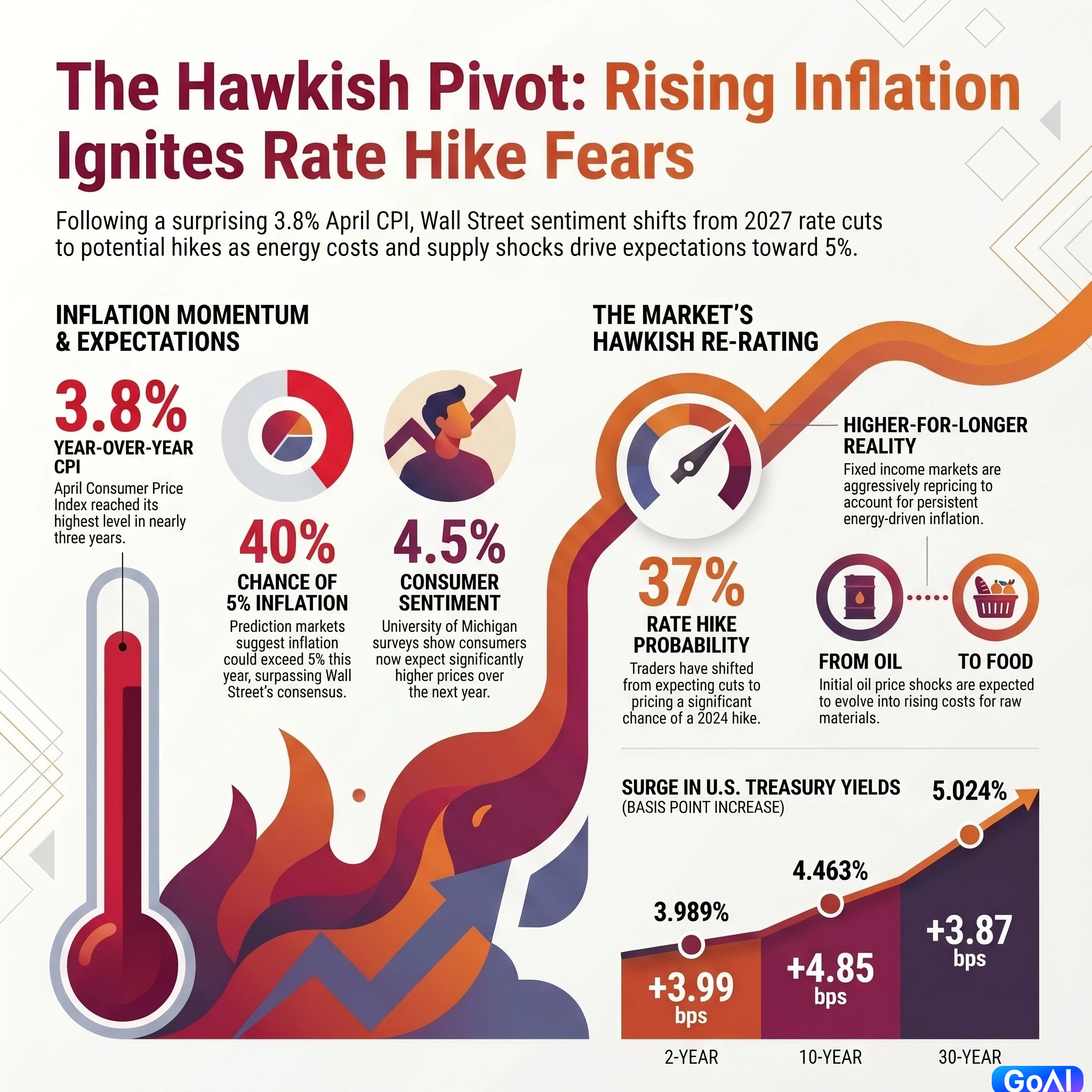
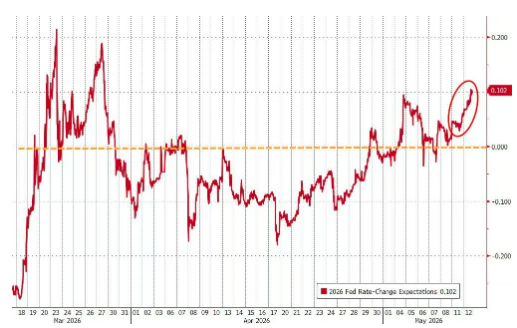
According to the CME FedWatch Tool, which tracks 30-day Fed Funds futures, market pricing has effectively ruled out any rate cuts through the end of 2027 following Tuesday's hotter-than-expected April CPI report.
Instead, the market is now pricing in a greater than one-third probability of a rate hike by year-end, as concerns over the soaring cost of living begin to eclipse anxieties regarding a cooling labor market.
"At this juncture, I suspect the Fed will hold steady, but the decisive factor will be inflation expectations," said Mark Zandi, Chief Economist at Moody’s Analytics.
"If expectations continue to climb and inflation slips further out of control, the Fed will have to pivot toward hiking rather than cutting."
Inflation Hits Three-Year High
Data released Tuesday by the Bureau of Labor Statistics showed the U.S. CPI rose 3.8% year-over-year in April, up from 3.3% in March.
While the monthly increase of 0.6% was in line with expectations, the annual rate topped consensus forecasts by 0.1 percentage point, reaching its highest level in nearly three years.
By midday in New York, the implied probability of a rate hike within the calendar year spiked to approximately 37%.
This hawkish shift poses a significant challenge for incoming Fed Chair Kevin Warsh, who is expected to take the helm later this month. Warsh has been a vocal proponent of rate cuts, a stance echoed by President Trump.
However, Zandi noted that in the current environment, a rate cut is virtually indefensible. "If inflation expectations keep trending upward, even maintaining the status quo will be difficult, let alone easing."
Treasury Sell-off Intensifies
As oil prices and inflation remain on an upward trajectory, traders have ramped up bearish bets on U.S. Treasuries. Yields surged across the curve on Tuesday:
- 2-year yield: Up 3.99 bps to 3.989%
- 5-year yield: Up 5.13 bps to 4.124%
- 10-year yield: Up 4.85 bps to 4.463%
- 30-year yield: Up 3.87 bps to 5.024%
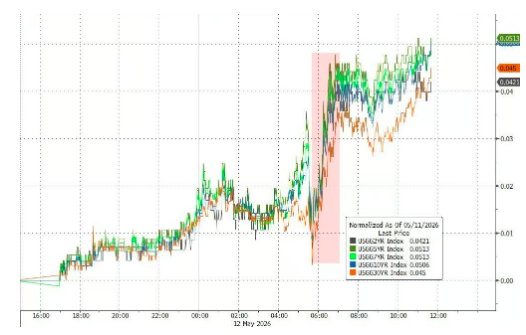
The sell-off has pushed the 5-year yield back above the 4% threshold, triggering a surge in short positions. "A substantial short base has formed in the market," said Kelsey Berro, Fixed Income Portfolio Manager at J.P. Morgan Asset Management.
"The market has become highly efficient at repricing the reality of 'higher-for-longer' inflation driven by energy costs."
In the SOFR options market, traders are hedging against the risk of even more aggressive hiking cycles. Interest rate swaps now suggest an 85% probability of a 25-basis-point hike by the April policy meeting.
Traders Brace for 5% Inflation
While April’s price growth was the fastest since May 2023, prediction markets suggest the peak is still ahead. On the Kalshi platform, traders believe there is a nearly 40% chance that inflation will exceed 5% this year—a level not seen since February 2023.
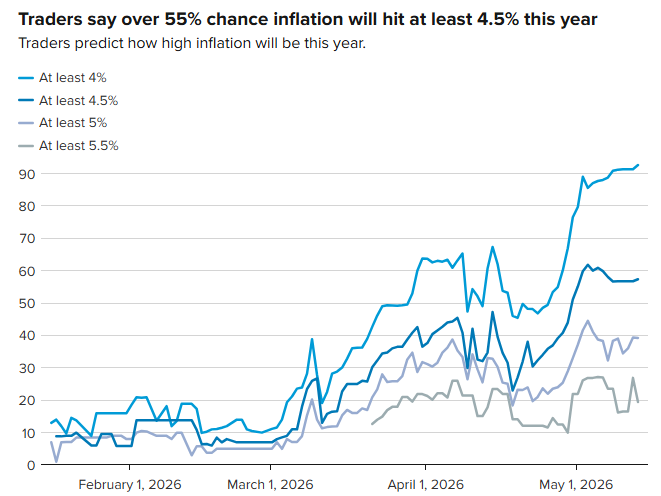
This outlook is significantly more aggressive than the Wall Street consensus. While FactSet-surveyed economists expect inflation to peak at 3.8% this quarter before receding to 2.8% by year-end, consumer sentiment aligns more with the traders.
A University of Michigan survey released Friday showed consumers expect inflation of 4.5% over the next year.
"The initial impact of the Middle East conflict was an oil price shock, which hit the gas pump immediately. The next phase will be the rising cost of food and raw materials," said Skyler Weinand, Chief Investment Officer at Regan Capital.
With most Kalshi traders betting that traffic through the Strait of Hormuz will not normalize until October, the risk of a prolonged supply shock remains high.
Consequently, the platform now reflects a more than 50% probability that the Fed will be forced into rate hikes before July 2027.