
APAC Market Wrap - May 13

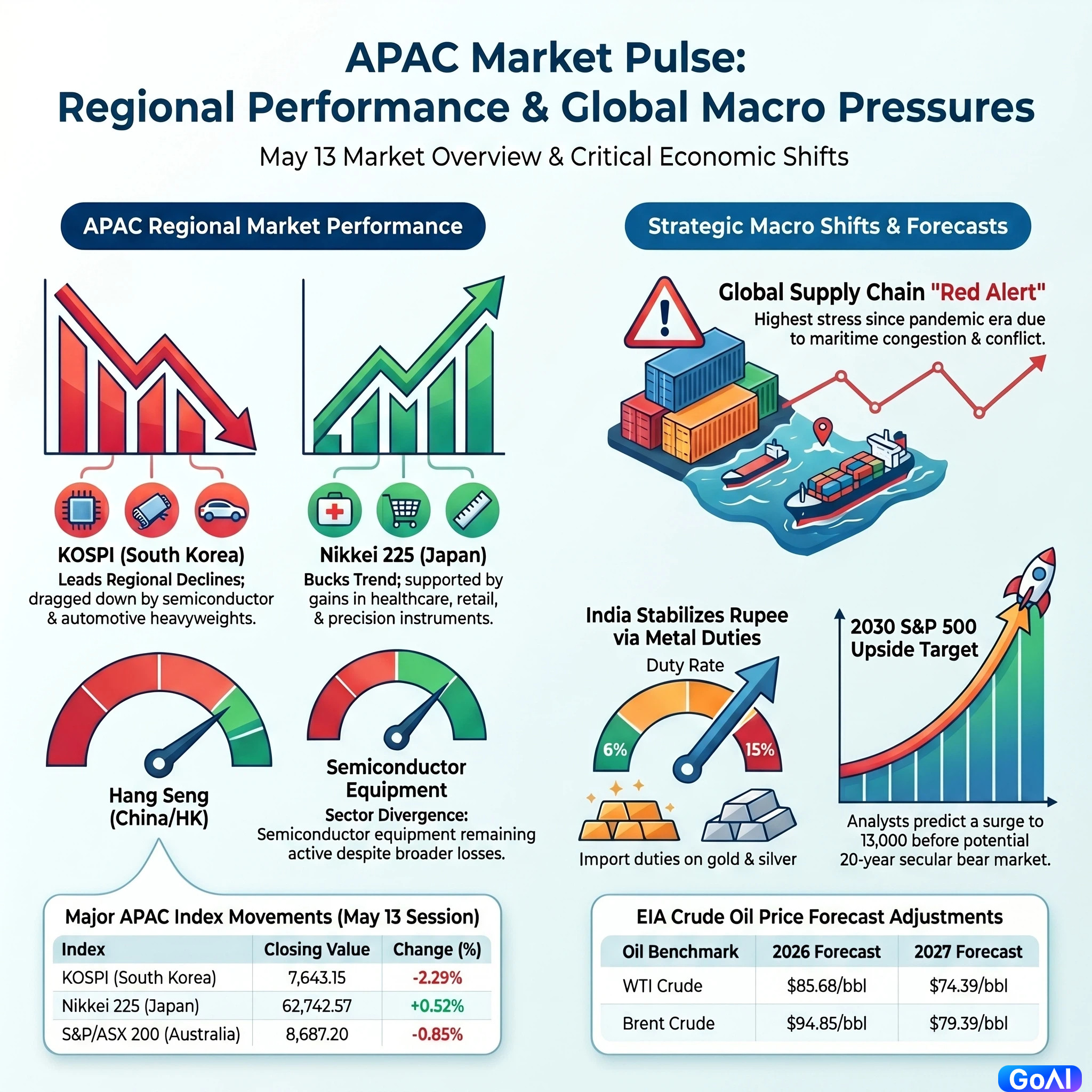
China: Major indices closed lower, with the Shanghai Composite slipping 0.25% to 4,214.49 and the Shenzhen Component falling 0.47% to 15,824.92.
The ChiNext Index edged up 0.15% to 3,934.88. Sector-wise, semiconductor equipment, UHV (Ultra-High Voltage), power-computing synergy, and CPO concepts were active.
Conversely, rare earths, innovative drugs, AI applications, lithium batteries, photovoltaics, industrial metals, and commercial aerospace led the declines.
Hong Kong: The market faced overall pressure as the three major indices retreated in tandem.
The Hang Seng Index fell 0.22% to 26,347.91, the Hang Seng Tech Index dropped 0.70% to 5,070.61, and the H-Share Index finished marginally lower at 8,882.37. Tech giants were mixed; Lenovo fell over 3%, while Tencent and Bilibili dropped over 1%.
Kuaishou and NetEase gained over 1%. Oil majors remained active with PetroChina up over 3%, while chipmakers saw a correction and pork producers like Muyuan Foods weakened.
Japan: The Nikkei 225 rose 0.52% to 62,742.57. Healthcare, precision instruments, and retail sectors posted gains, while non-ferrous metals, electric power, and gas sectors trended lower.
South Korea: The KOSPI tumbled 2.29% to 7,643.15. While pharmaceutical, biotech, and medical equipment sectors led the gainers, heavyweight semiconductor, automotive, and electronics sectors dragged the index down.
Australia: The S&P/ASX 200 fell 0.85% to 8,687.20. Healthcare, utilities, and consumer staples sectors rose, while energy, financials, and industrials closed lower.
Singapore: The Straits Times Index (STI) dipped 0.18% to 4,918.52. Real estate, telecommunications, and utilities showed modest activity, while financials, technology, and industrials weakened.
Malaysia: The FTSE Bursa Malaysia KLCI declined 0.32% to 1,745.63. Technology, healthcare, and consumer sectors were slightly active, but banking, plantations, and energy saw weakness.
Key Events
India Doubles Precious Metal Import Duties to Stabilize Rupee
The Indian government issued an order on Wednesday hiking import duties on gold and silver from 6% to 15%. This effective rate comprises a 10% basic customs duty and a 5% Agricultural Infrastructure and Development Cess.
The move aims to curb overseas purchases, alleviate pressure on foreign exchange reserves, and support the Rupee amid the economic fallout from rising energy prices and Middle East hostilities.
Global Supply Chain Stress Hits Critical Levels
Signs are mounting that the energy crisis is manifesting in supply chain pressure indicators, some of which are flashing "red" for the first time since the 2020–2023 pandemic era.
"Logistics activity dashboards" show certain metrics at their highest levels in years, reflecting maritime congestion and disruptions sparked by the war in Iran.
Logistics, which accounts for roughly 10% of global GDP, is once again becoming a primary concern for central banks wary of resurgent inflation.
Institutional Perspectives
EIA Adjusts Oil Price Forecasts
In its Short-Term Energy Outlook, the EIA lowered its 2026 WTI crude forecast to $85.68/bbl (from $87.41) but raised the 2027 estimate to $74.39.
For Brent, the 2026 forecast was adjusted to $94.85/bbl (from $96.00), while the 2027 projection rose to $79.39.
Sanctuary Wealth's 13,000 Target
Chief Investment Strategist Mary Ann Bartels predicts the S&P 500 could surge another 75% to reach 10,000–13,000 points by 2030 before entering a grueling 20-year secular bear market.
She describes the potential upcoming rally as "staggering" before long-term returns flatline toward zero.