
Labor Crisis Fails to Cool Memory Boom: JPMorgan Stands Firm on Samsung, Calls Pullbacks a "Buying Opportunity"

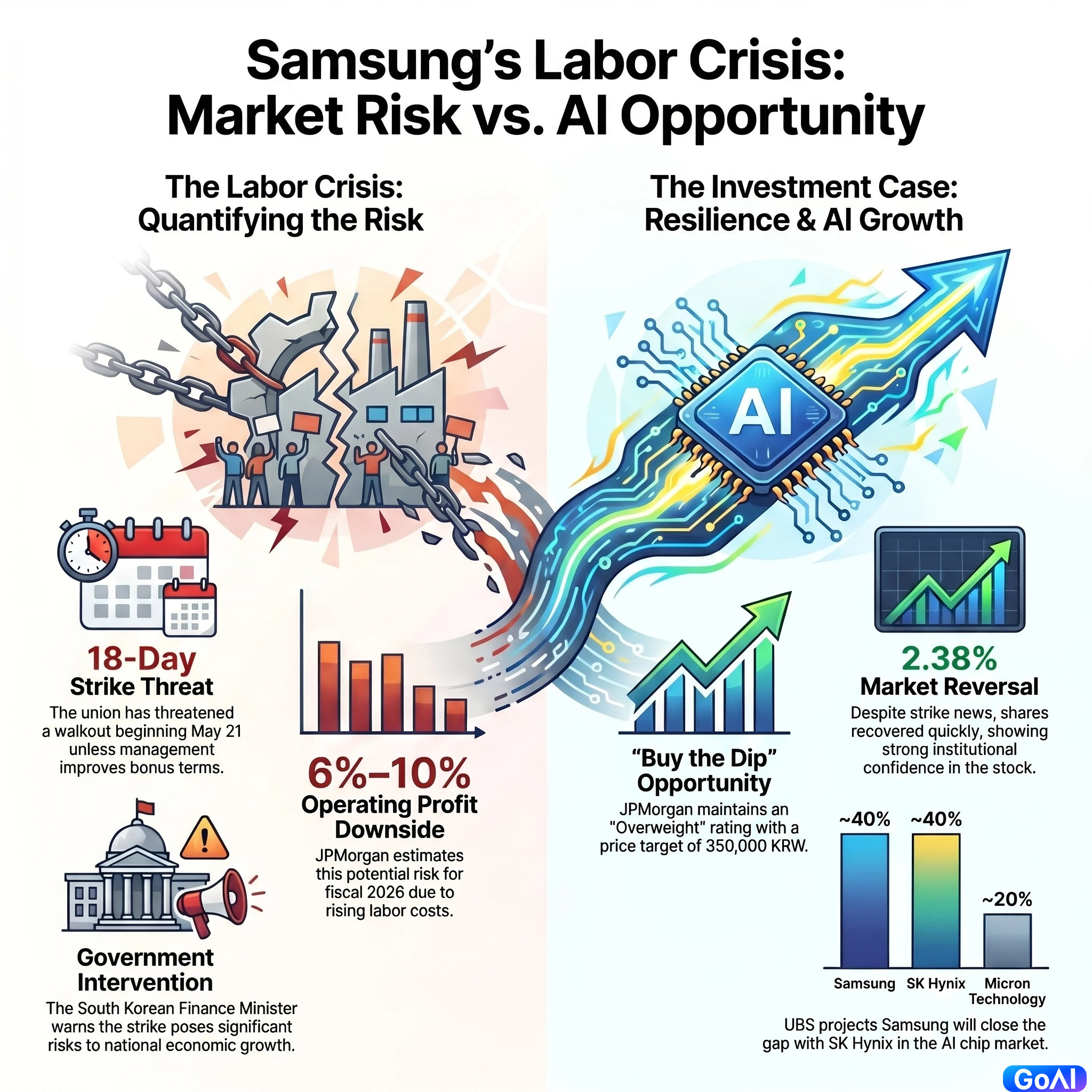
A looming labor dispute that threatens to rattle the global semiconductor supply chain is currently weighing on Samsung Electronics, the world’s largest memory chipmaker.
Despite the friction, JPMorgan analysts maintained their bullish stance on Wednesday, urging investors to use any strike-related share price weakness as an entry point.
Quantifying the Risk
JPMorgan acknowledged that the gap between labor and management remains wide, particularly regarding core demands like removing performance bonus caps. The bank estimates:
-
Operating Profit: A potential 6%–10% downside risk for fiscal 2026 due to rising labor-related costs.
-
Revenue: A potential 1%–2% impact on Device Solutions (DS) division revenue if production is disrupted.
"Nonetheless, our investment thesis for an 'Overweight' rating remains unchanged, driven by our conviction in a 'higher-for-longer' memory upcycle and Samsung’s improving position in High Bandwidth Memory (HBM)," the analysts wrote. "We recommend buying the dip on any strike-driven pullbacks."
JPMorgan reaffirmed its 350,000 KRW price target.
Market Resilience
Samsung shares extended their gains on Thursday, rising 2.38% to 290,750 KRW by press time, bringing its market cap to approximately $1.24 trillion.
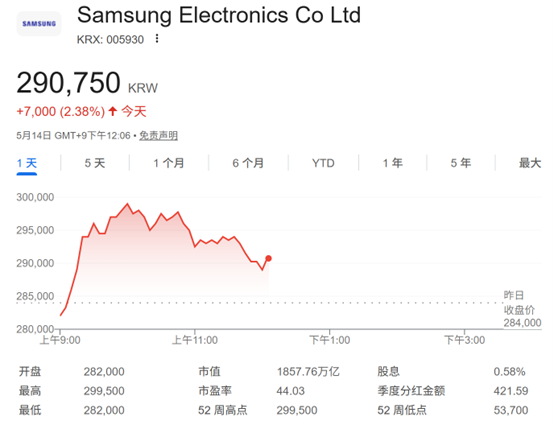
The stock has shown remarkable resilience; after sliding as much as 5% on Wednesday following the collapse of negotiations, it staged a dramatic reversal to close up 1.79%.
The Road to a Potential Strike
The union has threatened an 18-day strike beginning May 21 unless management improves terms regarding wages and bonuses. Workers are specifically demanding a larger share of the profits generated by the company’s burgeoning AI chip business.
South Korean authorities are moving swiftly to prevent a walkout:
-
Finance Minister Koo Yun-cheol stated on Thursday that a strike would pose significant risks to economic growth, exports, and market stability.
-
Writing on X, he expressed deep regret over the stalemate, emphasizing that "a strike must be avoided at all costs."
-
The Prime Minister’s Office issued a concurrent statement promising to monitor the situation closely and provide support to ensure "zero strike occurrence" through continued dialogue.
The HBM Competitive Landscape
The dispute comes at a critical juncture as Samsung races to close the gap with SK Hynix in the HBM market—the specialized memory used in Nvidia’s AI processors.
Samsung employees have benchmarked their compensation against SK Hynix, noting that their rival paid significantly higher bonuses following its AI-driven profit surge.
However, institutional optimism remains high. UBS noted in a Wednesday report that Samsung is on track to achieve parity with SK Hynix in HBM market share by 2027.
The bank projects that by then, both giants will command roughly 40% of the market each, with Micron Technology holding the remaining 20%.