
India Intensifies Gold Import Restrictions as Asia Gets Dragged into "FX Reserve Defense"

While the Chinese Yuan maintained its strength this month—briefly surging past the 6.8 mark against the USD—traders in the foreign exchange market are noticing a far less optimistic reality for other Asian currencies.
Driven by the spike in oil prices triggered by the conflict in Iran, an increasing number of Asian policymakers are burning through cash to support their local currencies, leading to a significant depletion of the region's once-ample foreign exchange reserves.
Even major economies like India are beginning to show signs of strain.
Last weekend, Prime Minister Narendra Modi urged citizens to cut spending—specifically on fuel, overseas travel, and gold—as these items have significantly bloated India's import bill.
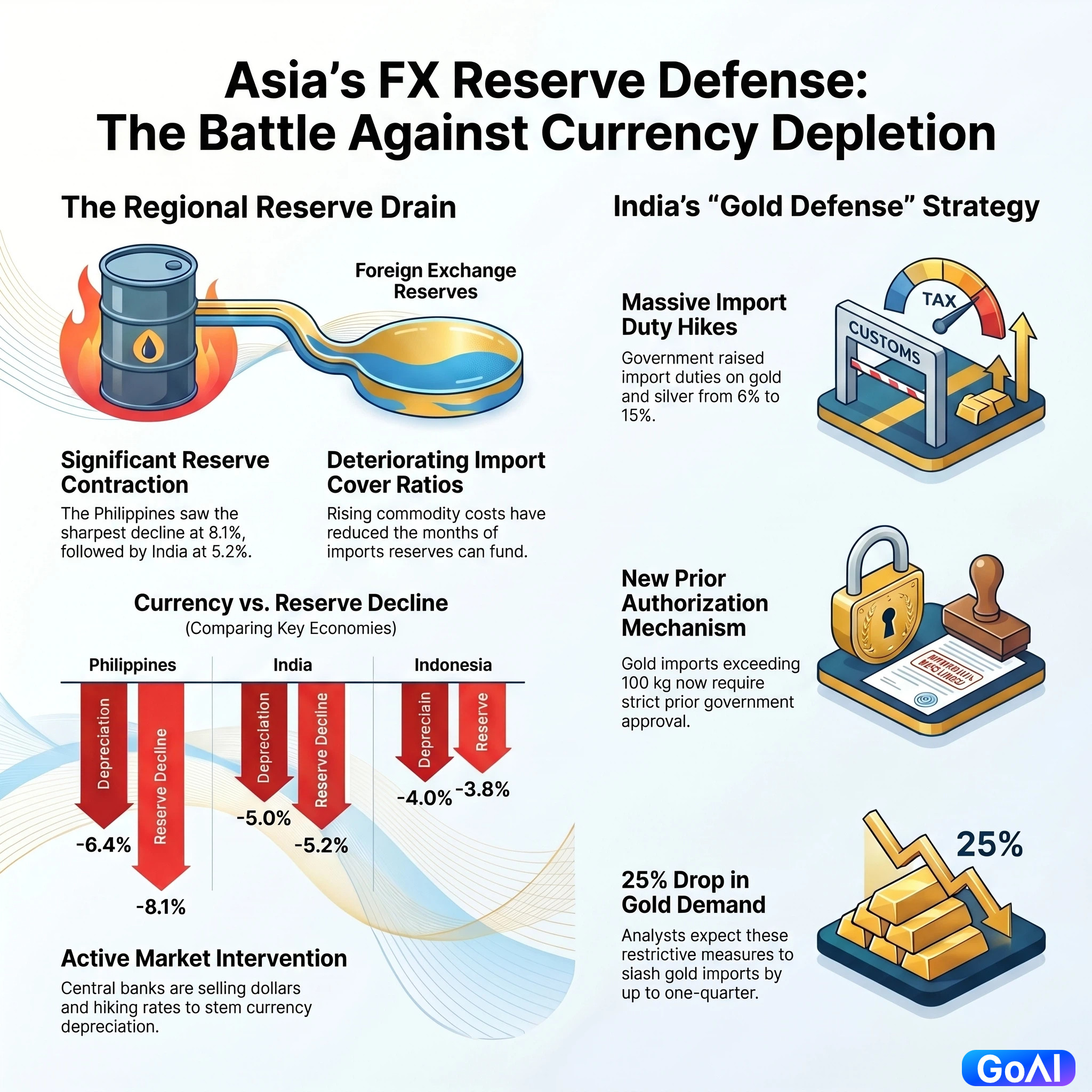
By Wednesday, the government followed up by raising import duties on gold and silver from 6% to 15%.
The "heavy blow" to gold imports escalated further on Thursday. According to a government notification, gold imports exceeding 100 kg will now fall under a "prior authorization" management mechanism.
Subsequent import licenses will only be issued once export volumes reach 50% of the previous intake. These changes target duty-free imports intended for jewelry re-export.
Madhavi Arora, an economist at Emkay Global Financial Services, noted that these measures highlight policymakers' deep concerns over USD outflows driven by import-heavy sectors.
"We expect gold imports to drop by 20% to 25% this year as a result of these measures," she added.
As the world's third-largest oil importer, India has been hit hard by the inflationary shock of energy disruptions in the Persian Gulf.
The rising import bill has triggered massive capital outflows, sending the Rupee to historic lows and forcing the Reserve Bank of India (RBI) to intervene by selling dollars.
Since gold is India's second-largest import commodity after crude oil, these restrictions represent a desperate attempt to curb reserve depletion.
Asia Engulfed in a Battle for Reserves
India is far from alone. Across Asia, foreign exchange reserves are shrinking rapidly as central banks defend their currencies against the fallout of the war in Iran.
Compiled data shows that since the conflict began:
- The Philippines has seen the sharpest percentage decline, with reserves dropping 8.1% to $104 billion.
- India’s reserves have shrunk 5.2% to $6910 billion.
- Indonesia’s reserves have contracted 3.8% to $146 billion.
These declines reflect both direct market interventions and the valuation loss of non-dollar assets.
The slump further confirms that energy-dependent Asian economies are among the primary "losers" of the Middle East conflict, even if their overall financial health is sturdier than it was during the 1997 Asian Financial Crisis.
In recent weeks, central bank interventions have become frequent. A senior Indonesian policymaker stated this week that the country would employ "judicious intervention" and use all monetary tools after the Rupiah hit record lows.
Economists at ANZ, Dhiraj Nim and Sanjay Mathur, noted in a report that the balance of payments in India, Indonesia, and the Philippines has deteriorated significantly, contrasting with the relative stability found elsewhere in the region.
With the Philippine Peso nearing the 60 level against the greenback, the central bank’s interventions have struggled to stem the tide.
Last month, the Philippine central bank delivered a surprise 25-basis-point rate hike and signaled further tightening. Since late February, the Philippine Peso has depreciated 6.4%, the Indian Rupee 5%, and the Indonesian Rupiah 4%.
The depletion of reserves, coupled with rising commodity costs, has led to a decline in the import cover ratio—a key metric of how many months of imports a nation's reserves can fund.
According to BNY Mellon, the ratio for the Philippines has dropped from 9.9 to 8.2, while South Korea’s has fallen from 8.2 to 6.9.
"The decline in import cover across much of Asia primarily reflects rising energy costs," said Khoon Goh, Head of Asia Macro Strategy at BNY Mellon. "
In this context, we expect FX interventions to remain prudent, especially as crude oil prices remain elevated."