
APAC Market Wrap - May 15

China: Major indices closed lower, with the Shanghai Composite sliding 1.02% to 4,135.39 and the Shenzhen Component dropping 1.17% to 15,561.37. The ChiNext Index fell 0.56% to 3,929.06.
Coal, home appliances, and machinery equipment sectors were active. On the downside, non-ferrous metals, innovative drugs, lithium batteries, photovoltaics, industrial metals, and commercial aerospace sectors led the declines.
Hong Kong: The market faced broad pressure as the three major indices retreated in tandem.
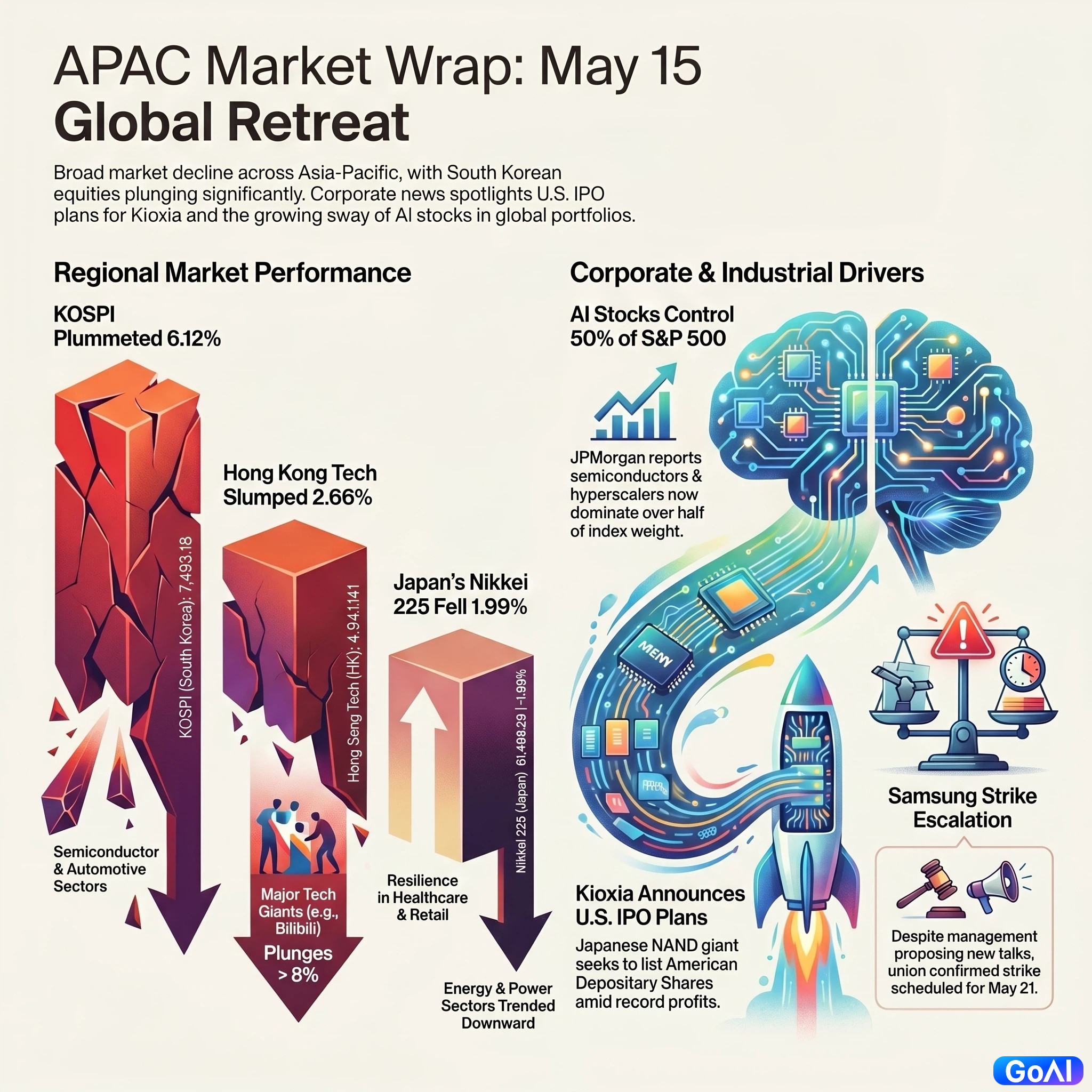
The Hang Seng Index fell 1.62% to 25,962.73, the Hang Seng Tech Index tumbled 2.66% to 4,941.14, and the H-Share Index dropped 1.89% to 8,691.03.
Tech giants were mostly lower; Lenovo, Alibaba, and Xiaomi fell over 3%, while Bilibili plunged over 8%.
Oil stocks remained relatively active, while chipmakers saw a sharp correction, with Hua Hong Semiconductor falling nearly 9%. Pork producers also weakened.
Japan: The Nikkei 225 fell 1.99% to 61,409.29. Healthcare, precision instruments, and retail sectors showed resilience, while non-ferrous metals, electric power, and gas sectors trended lower.
South Korea: The KOSPI plummeted 6.12% to 7,493.18. While pharmaceutical, biotech, and medical equipment sectors were relatively defensive, heavyweight semiconductor, automotive, and electronics sectors dragged the index significantly lower.
Australia: The S&P/ASX 200 edged down 0.11% to 8,630.80. Healthcare, utilities, and consumer staples posted gains, while energy, financials, and industrials closed lower.
Singapore: The Straits Times Index (STI) dipped 0.18% to 4,918.52. Real estate, telecommunications, and utilities saw modest activity, while financials, technology, and industrials weakened.
Malaysia: The FTSE Bursa Malaysia KLCI declined 0.32% to 1,745.63. Technology, healthcare, and consumer sectors were slightly active, but banking, plantations, and energy saw weakness.
Key Events
NAND Giant Kioxia Reports Record Profits; Announces U.S. IPO Plans
Amid a global memory chip shortage that has driven prices to historic highs, Japanese memory giant Kioxia Holdings Corporation officially announced plans to list on a U.S. exchange.
In a press release on Friday (May 15), Kioxia stated it is preparing to list American Depositary Shares (ADS) to expand its investor base and enhance corporate value.
The company noted that the timing and method remain subject to regulatory approval and market conditions.
JPMorgan Data: AI Stocks Now Dominate Over Half of the S&P 500
A new report from JPMorgan Asset Management highlights the sheer dominance of the "AI Trade" in U.S. equities.
AI-related sectors now account for over half of the S&P 500's total weight. Leading the charge is the semiconductor sector (e.g., SMH, SOX) at 18.2%, followed by hyperscalers (Amazon, Meta, Microsoft, Alphabet) at 17.8%.
Other contributors include hardware (10.1%), software (8.0%), power infrastructure (2.7%), and metals/mining (0.5%).
Samsung Proposes Talks; Union Conditions Dialogue on Core Demands
Samsung Electronics has proposed restarting negotiations without preconditions following the failure of government-mediated talks.
The Samsung union expressed willingness to talk after June 7 (the scheduled end of their strike phase) but confirmed that the strike set for May 21 will proceed.
The union maintains that further dialogue is only possible if management addresses key demands regarding performance bonuses.
Institutional Perspectives
TD Securities on the USD: Strategists suggest the U.S. Dollar could weaken this year even if the Fed holds rates steady.
With the U.S.-Iran stalemate keeping oil prices high, the firm no longer expects rate cuts in 2026 but maintains a bearish outlook for the USD, predicting it will fall below the 98 level once the Strait of Hormuz reopens.
KCM Trade on Gold: Gold prices fell on Friday as rising energy costs fueled inflation fears and "higher-for-longer" rate expectations.
Analyst Tim Waterer noted that gold has become an "unfortunate victim" of skepticism surrounding future rate cuts, as rising bond yields and a stronger USD weigh on the metal.
SMBC Nikko on JGBs: Strategists are closely watching potential government subsidies for electricity and gas.
Market sentiment suggests that as long as the stimulus remains around 300 billion yen, the JGB market will not view it as excessive fiscal support.
However, fears of a larger supplemental budget have already contributed to a sharp rise in Japanese government bond yields.